
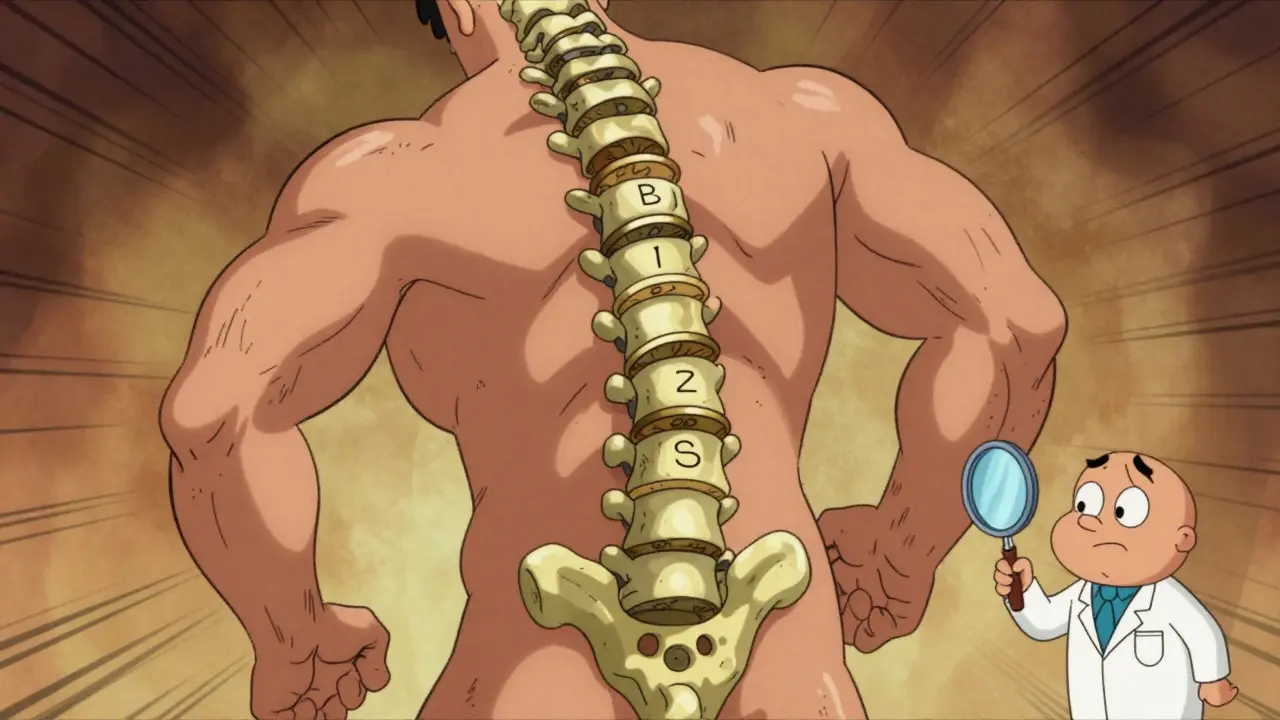
When your lower back aches after standing too long, or your legs feel heavy when walking, it might not just be a bad posture or tired muscles. For about 6 in every 100 people, it could be spondylolisthesis-a slipped vertebra that’s quietly changing how your spine moves and feels. This isn’t rare. It’s common, often overlooked, and sometimes misunderstood. Many people live with it for years without knowing why their back won’t quit hurting. Others suddenly find themselves unable to walk more than a few blocks. The good news? You don’t have to just live with it. There are clear steps to understand what’s happening, and real choices when it comes to treatment-even when fusion comes up as an option.
What Exactly Is a Slipped Vertebra?
Spondylolisthesis sounds complicated, but it’s simple when you break it down. One of your lower back bones (usually the fifth lumbar, or L5) slides forward over the one below it (S1). Think of it like a stack of coins where one has shifted out of place. It doesn’t always cause pain. In fact, nearly half of people with this slippage never feel a thing. But when it does cause symptoms, it’s often because the slipped bone is pinching nerves, tightening muscles, or throwing off your whole spinal alignment.
The most common type in adults over 50 is called degenerative spondylolisthesis. It happens because the discs and joints in your spine wear down over time. Arthritis plays a big role here. As the cartilage breaks down, the vertebra loses its grip and slips forward. In younger people, especially athletes, it’s often due to a stress fracture in a small bone bridge called the pars interarticularis. Gymnasts, weightlifters, and football players are at higher risk because their sports force the spine into repeated backward bends. This tiny crack can turn into a slip over time.
How Do You Know If It’s Spondylolisthesis?
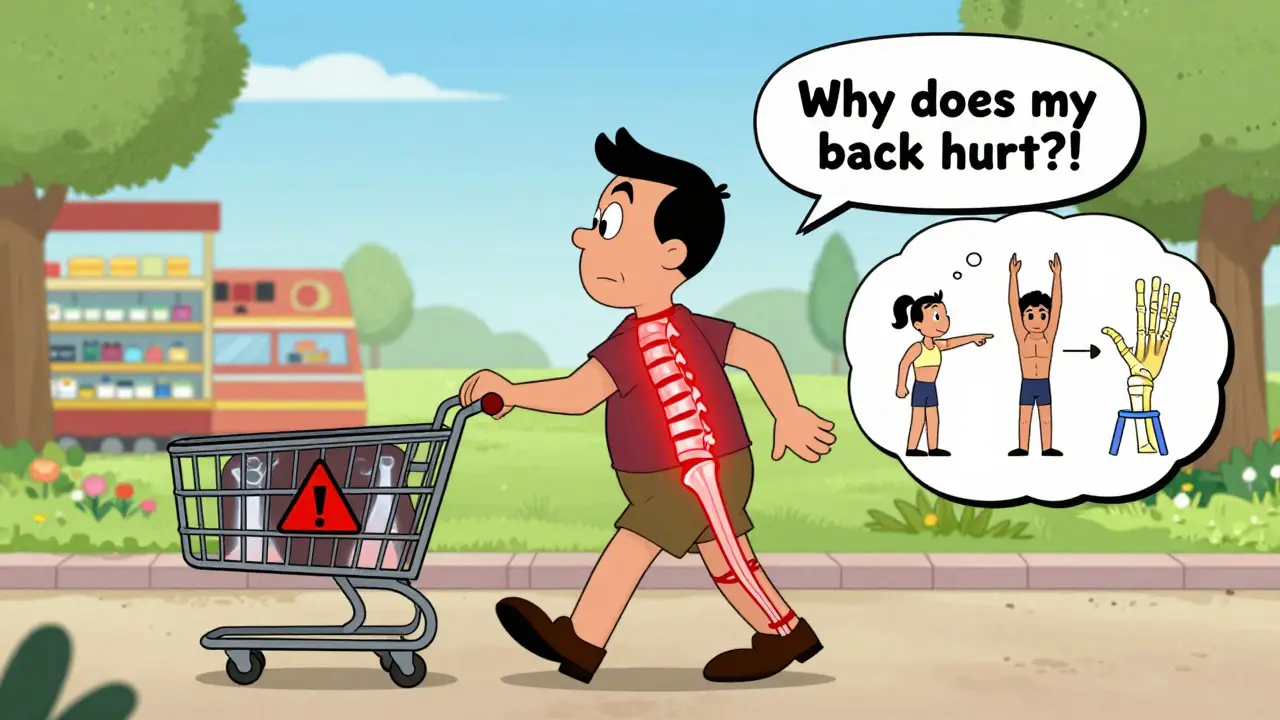
The pain usually starts as a dull ache in the lower back that feels like a deep muscle strain. But unlike a pulled muscle, this pain gets worse when you stand or walk and improves when you sit or lean forward. That’s because leaning forward opens up space around the nerves. You might also notice tight hamstrings-so tight you can’t touch your toes. About 70% of people with this condition have them. Stiffness in the lower back, trouble standing for long periods, and pain radiating into the buttocks or thighs are also common.
If the slip is severe (Grade III or higher), you might start feeling numbness, tingling, or weakness in one or both legs. This means the slipped bone is pressing on nerves that run down to your legs. In advanced cases, the spine can develop an exaggerated curve in the lower back (lordosis), and later, a rounding of the upper back (kyphosis). These changes aren’t just cosmetic-they change how you move, how you stand, and how much energy it takes to do simple things.
Diagnosis starts with a simple X-ray while standing. That’s key. A lying-down X-ray can miss the slip because gravity isn’t pulling the bone forward. If the X-ray shows slippage, doctors often follow up with an MRI to see if nerves are compressed, or a CT scan to get a clear look at the bone structure. The Meyerding scale is used to measure how far the bone has slipped-graded from I (less than 25%) to IV (75-100%). Grade I and II are common. Grade III and above are less frequent but often need more serious attention.
Conservative Treatments: What Works and What Doesn’t
Most people don’t need surgery. In fact, 80% of cases improve with time and non-invasive care. The goal isn’t to push the bone back into place-it’s to manage pain, reduce pressure on nerves, and strengthen the muscles that support your spine.
Physical therapy is the cornerstone. A good program focuses on three things: core strengthening (your abs and lower back muscles), hamstring stretching (to reduce tension pulling on the pelvis), and posture training. It takes 12 to 16 weeks of consistent sessions to see real results. Only about 65% of people stick with it long enough. If you’re not seeing improvement after 3 months, it’s worth re-evaluating.
Medications help too. Over-the-counter NSAIDs like ibuprofen or naproxen can reduce inflammation and pain. If those aren’t enough, a doctor might suggest an epidural steroid injection. This delivers anti-inflammatory medicine directly near the affected nerve. It’s not a cure, but it can give you a few months of relief to work on therapy and avoid surgery.
Activity changes matter. Avoid sports or exercises that hyperextend your back-like heavy lifting, gymnastics, or football. Swimming and cycling are better choices. Walking is usually fine, as long as you don’t push through pain. Weight management is critical. If your BMI is over 30, your risk of surgical complications jumps by 47%. Losing even 10 pounds can reduce pressure on your spine.
Fusion Surgery: The Real Choices
If conservative care fails after 6 to 12 months, and your pain is disabling-then surgery becomes a real option. Spinal fusion is the most common procedure. It works by joining two vertebrae together so they heal into one solid piece. That stops the slipping and removes the motion that causes pain.
There are three main ways to do it:
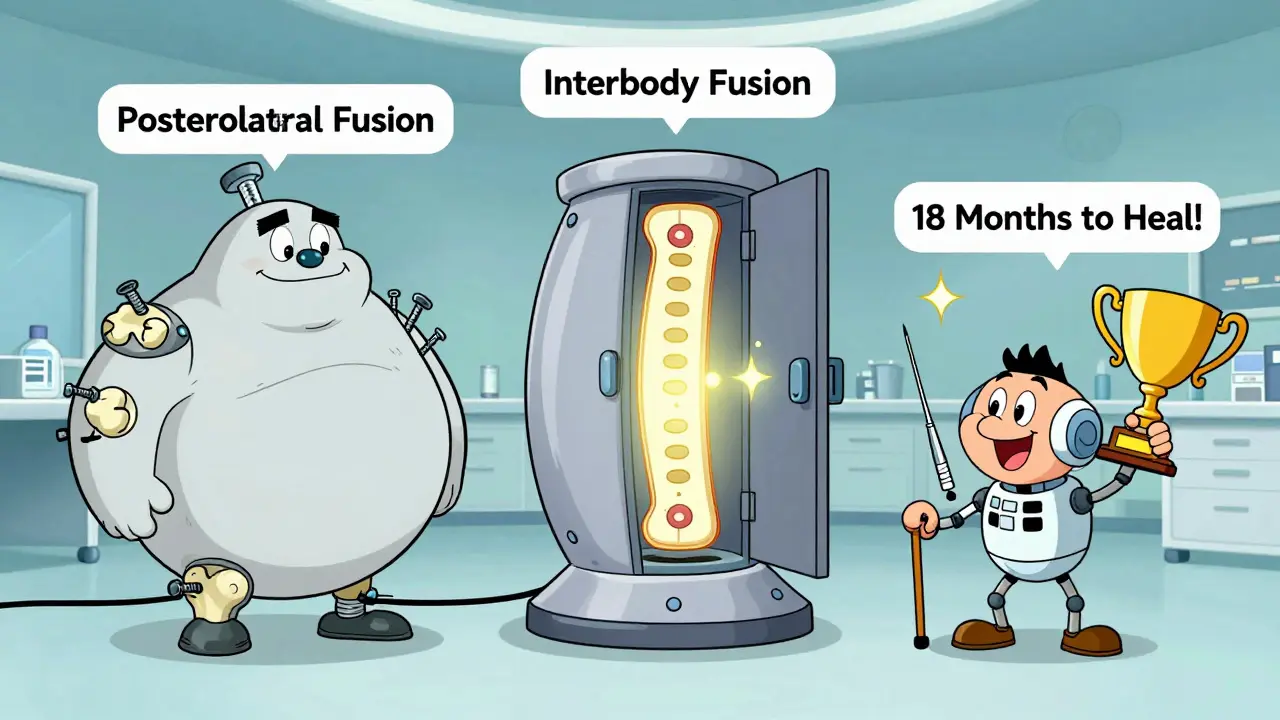
- Posterolateral fusion (55% of cases): Bone grafts are placed along the back of the spine, and metal screws hold everything in place while bone grows. It’s been the standard for decades. Success rates are 75-85% for mild slips but drop to 60-70% for severe ones.
- Interbody fusion (35% of cases): This removes the damaged disc between the vertebrae and inserts a spacer filled with bone graft. It restores disc height, opens up nerve space, and provides better stability. Techniques like PLIF and TLIF are common here. Success rates are higher-85-92% across all slip grades.
- Minimally invasive fusion (10% of cases): Smaller incisions, less muscle damage, faster recovery. These are becoming more popular, especially for older patients or those with other health risks.
Why does the type matter? Because interbody fusion doesn’t just fuse bones-it restores the natural spacing between them. That relieves nerve pressure directly. That’s why it works better for high-grade slips and why success rates are higher.
What Happens After Surgery?
Recovery isn’t quick. You’ll need 6 to 8 weeks of restricted activity. No lifting, twisting, or bending. Physical therapy starts around 6 weeks out and lasts 3 to 6 months. Full healing? It can take up to 18 months. Your body is growing new bone, and that takes time.
Smoking is a dealbreaker. Smokers have more than 3 times the risk of the bones not fusing properly (called pseudoarthrosis). Quitting before surgery isn’t optional-it’s essential. Weight matters too. Losing excess weight reduces strain on the fused segment and lowers complication risk.
Success rates look good: 85-92% for interbody fusion, with 78-85% of patients reporting satisfaction at the 2-year mark. But there’s a catch. About 12-15% of people with severe slips need revision surgery later. Why? Adjacent segment disease. When one part of the spine is fused, the segments above and below take on more stress. Over time, they can wear out. Studies show 18-22% of patients develop this within five years.
New Options and What’s Coming
Surgery isn’t the only path anymore. New FDA-approved interbody devices introduced in 2022 are showing 89% fusion rates at 6 months-better than older models. Biologics like bone morphogenetic protein (BMP) and stem cell therapies are being tested. One 2023 trial found BMP-2 boosted fusion rates to 94% in high-risk patients, compared to 81% with traditional bone grafts.
There’s also growing interest in motion-preserving alternatives. Dynamic stabilization devices act like a flexible brace around the spine, allowing some movement while reducing pain. Early data shows 76% success over 5 years for mild slips-close to fusion, but without locking the joint. Long-term data is still limited, but it’s a promising path for younger patients who want to avoid fusion.
Researchers are also getting better at predicting who will benefit from surgery. A 2023 study identified 11 clinical and imaging markers that can predict surgical outcomes with 83% accuracy. That means doctors can stop guessing who needs surgery-and start knowing.
When to Consider Surgery
You don’t need surgery just because you have a slip. You need it when:
- Conservative care has failed for over a year
- Pain is constant and limits daily life
- Leg pain, numbness, or weakness is getting worse
- You can’t walk more than a few blocks without stopping
- Slippage is Grade III or higher
And if you’re considering fusion, ask your surgeon: Which technique are you recommending? Why? What’s the expected success rate for my grade of slip? Don’t accept a one-size-fits-all answer. Your slip, your body, your life-your treatment should match.
Can spondylolisthesis get worse over time?
Yes, especially if left untreated. Degenerative slips can slowly progress as arthritis worsens. Traumatic or isthmic slips may also worsen with activity, especially in young athletes. High-grade slips (Grade III-IV) are more likely to progress and cause nerve damage. Regular monitoring with imaging every 1-2 years is recommended if symptoms change or worsen.
Is walking bad for spondylolisthesis?
Not necessarily. Walking is often one of the best activities for people with spondylolisthesis. It’s low-impact and helps maintain mobility. Many patients find walking with a slight forward lean (like using a shopping cart) reduces pain. Avoid long walks if you’re in acute pain or have neurological symptoms. Listen to your body-stop if pain increases or numbness spreads.
Can spondylolisthesis cause sciatica?
Yes. When the slipped vertebra compresses the nerve roots that form the sciatic nerve, it can cause sciatica-sharp, shooting pain down one or both legs, often with numbness or tingling. This is more common with Grade III-IV slips. MRI scans can confirm if nerve compression is the source of the pain.
Do I need an MRI to diagnose spondylolisthesis?
Not always. A standing lateral X-ray is the first and most important test to confirm slippage. But if you have leg pain, numbness, or weakness, an MRI is needed to check for nerve compression, disc degeneration, or other soft tissue causes. CT scans are used if bone detail is critical-like before surgery.
Is fusion the only surgical option for spondylolisthesis?
No. Fusion is the most common, but newer options exist. Dynamic stabilization devices allow limited movement while reducing pain and are being used for mild to moderate slips. Spinal decompression without fusion is sometimes done if nerve pressure is the main issue and the slip is stable. However, fusion remains the gold standard for severe or progressive cases because it prevents further slippage and provides long-term stability.
Laura Gabel
March 20, 2026 AT 00:05jerome Reverdy
March 20, 2026 AT 15:10Jeremy Van Veelen
March 21, 2026 AT 16:50Justin Archuletta
March 22, 2026 AT 13:14MALYN RICABLANCA
March 24, 2026 AT 10:55Kal Lambert
March 24, 2026 AT 18:46Sanjana Rajan
March 26, 2026 AT 07:04Kyle Young
March 27, 2026 AT 02:39Emily Hager
March 29, 2026 AT 03:37Melissa Starks
March 29, 2026 AT 20:03Lauren Volpi
March 30, 2026 AT 03:31Melissa Stansbury
March 30, 2026 AT 19:52cara s
April 1, 2026 AT 18:37Andrew Mamone
April 2, 2026 AT 02:56