

When you see bright red blood in your stool or on the toilet paper, it’s natural to panic. But not all lower GI bleeding is the same. Two of the most common causes - diverticula and angiodysplasia - look very different, act differently, and need totally different approaches. Knowing how they’re diagnosed and treated can make all the difference in your recovery.
What Exactly Is Lower GI Bleeding?
Lower gastrointestinal (GI) bleeding means blood is coming from somewhere in your colon, rectum, or anus - anywhere past the ligament of Treitz, which is deep in your small intestine. The most obvious sign is hematochezia: bright red or maroon blood in your stool. Sometimes it’s just a few streaks; other times, it’s a full bowl of blood. This isn’t the same as melena (black, tarry stools), which usually points to bleeding higher up, like in your stomach or duodenum.It’s more common than you think. About 20 to 33% of all GI bleeds happen below the small intestine. In people over 60, it’s one of the top reasons they end up in the hospital. The good news? Most of the time, the bleeding stops on its own. The challenge is figuring out why it started - because the cause determines everything that comes next.
Diverticula: The Silent Bleeder
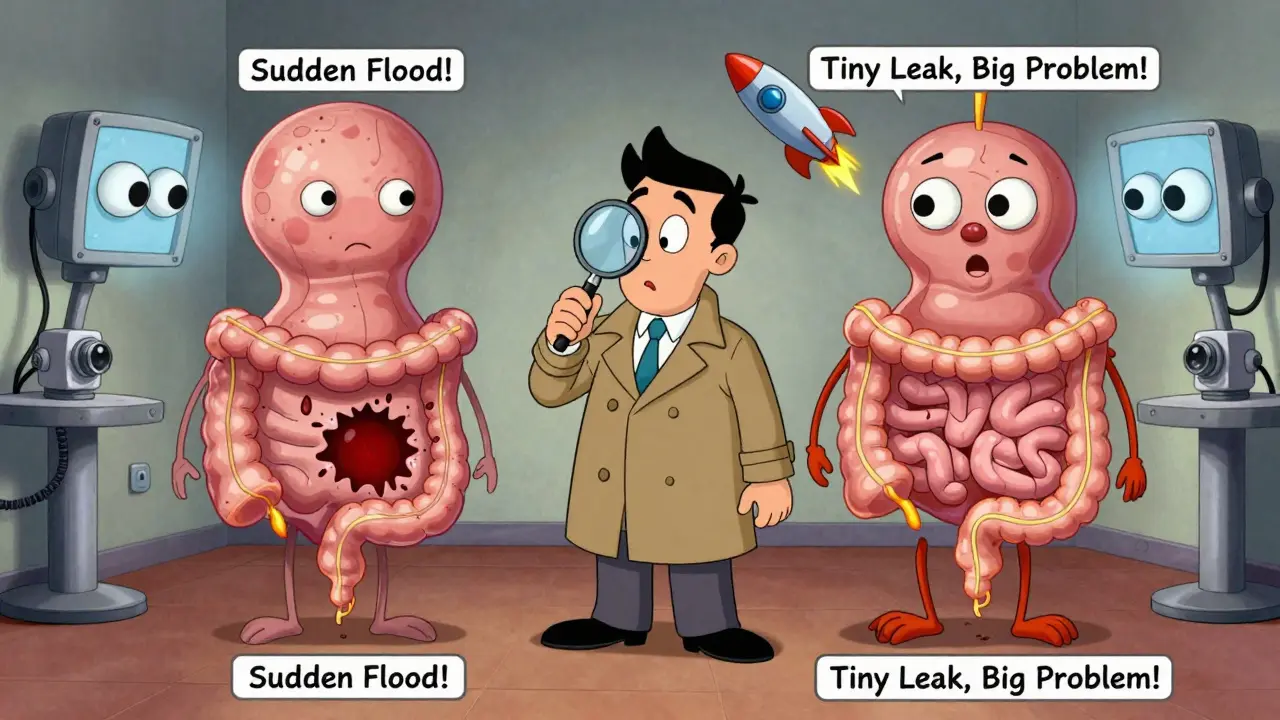
Diverticula are small pouches that form in the wall of your colon, especially in the sigmoid area. They’re super common - over half of people over 60 have them. Most never cause problems. But when one of these pouches develops a weak spot near a blood vessel, that vessel can rupture. And when it does? It bleeds. Hard.This isn’t diverticulitis. That’s when the pouches get inflamed and painful. Diverticular bleeding is different. It’s painless. Sudden. And sometimes massive. People describe it as “like a faucet turned on.” You might feel fine one minute, then suddenly dizzy, weak, and covered in blood.
Why does this happen? The blood vessels that feed the colon run right next to the inside of the bowel wall. When a diverticulum forms, the vessel gets stretched over the top of the pouch. It’s like a rubber band being pulled too tight - eventually, it snaps. This is why the bleeding is often so dramatic. About 30 to 50% of hospitalizations for lower GI bleeding are due to diverticula.
Angiodysplasia: The Slow Leak
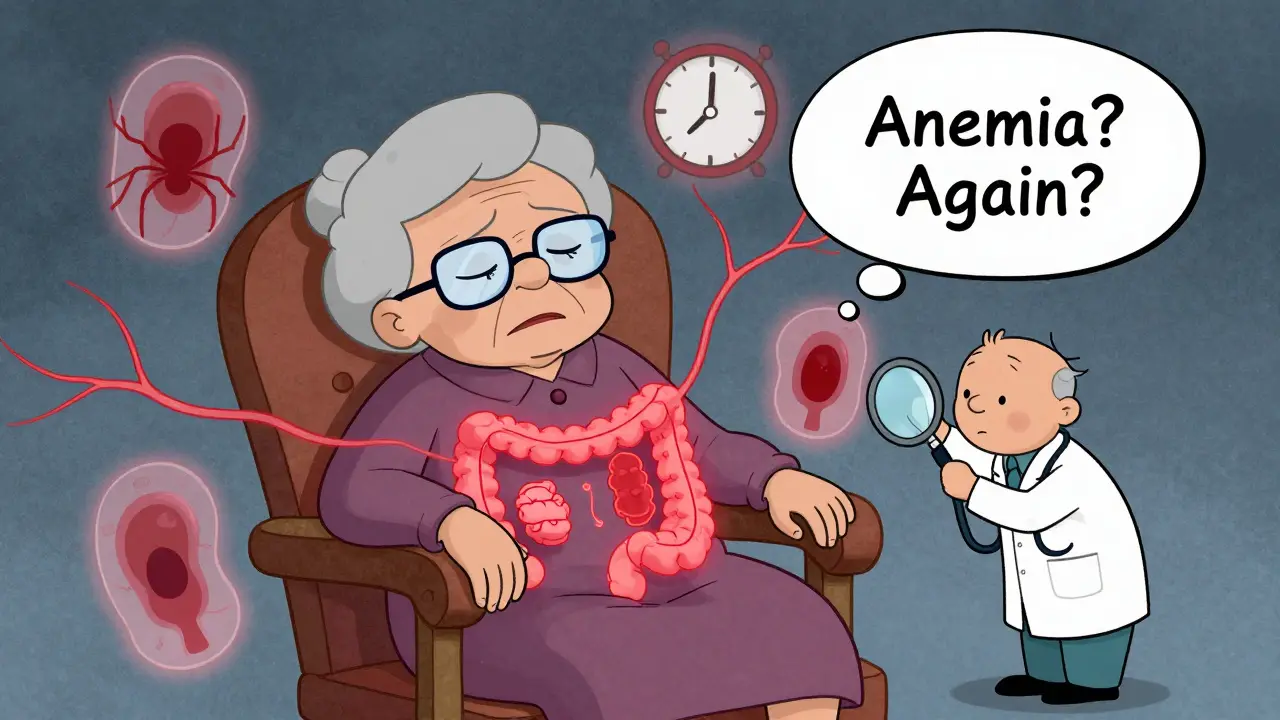
Now, think of a completely different scenario. You’ve been feeling tired for months. Your skin feels pale. You get winded climbing stairs. You don’t see blood in your stool - not even once. But your blood tests show you’re anemic. That’s often angiodysplasia.Also called vascular ectasia or AVM (arteriovenous malformation), angiodysplasia is when small blood vessels in the colon grow abnormally. They form tangled, fragile networks - kind of like spider veins inside your intestine. These aren’t caused by inflammation or injury. They just happen over time, especially as you age. Over 80% of cases occur in people 65 and older, with the average patient being 72.
The bleeding is slow. It drips. It doesn’t flood. But over weeks or months, it adds up. That’s why people with this condition often have iron deficiency anemia before they ever notice blood in their stool. It’s easy to miss. Many patients go years with unexplained fatigue before someone connects the dots.
There’s also a surprising link to heart disease. If you have aortic stenosis - a narrowing of the valve that pumps blood out of your heart - the turbulent flow can damage a key clotting protein called von Willebrand factor. That makes you more likely to bleed from these fragile vessels. So if you’re an older patient with heart valve issues and unexplained GI bleeding, doctors should definitely consider this.
How Do Doctors Figure Out What’s Causing the Bleed?
The first thing they do? Stabilize you. If you’re dizzy, your heart is racing, or your blood pressure is low, they’ll give you fluids and maybe a blood transfusion. Then they’ll check your hemoglobin. If it’s below 10 g/dL, you’ve lost a significant amount of blood.After that, the real detective work begins. Here’s how it usually goes:
- Colonoscopy - This is the gold standard. It’s done within 24 hours of admission. A flexible scope is inserted through the anus, letting the doctor see the entire colon. If they spot a bleeding diverticulum - a red, oozing pouch - they can treat it right away. Same with angiodysplasia: they can zap the abnormal vessels with heat or electricity.
- CT Angiography - If the colonoscopy doesn’t find anything but you’re still bleeding, this scan looks for active bleeding in real time. It can detect leaks as small as 0.5 mL per minute. It’s especially helpful when you’re too unstable for a scope.
- Capsule Endoscopy - Sometimes the bleed is coming from your small intestine. You swallow a tiny camera in a pill. It takes pictures as it travels. It finds the cause in about 62% of cases where colonoscopy was negative.
- Device-Assisted Enteroscopy - This is more invasive. A special scope with balloons is used to reach deep into the small bowel. It’s not for everyone - it needs an expert and takes longer - but it finds the problem in 71% of tricky cases.
One thing to know: colonoscopy doesn’t always catch angiodysplasia. These lesions are small and can be hard to see. A 2022 study found that using AI-assisted colonoscopy improved detection by 35%. That’s huge. If your first colonoscopy was negative but you’re still anemic, ask if AI tools were used. If not, a repeat scope with better tech might be needed.
How Is Each Condition Treated?
| Feature | Diverticular Bleeding | Angiodysplasia Bleeding |
|---|---|---|
| Initial Treatment | Most stop on their own. Supportive care: fluids, blood transfusion. | Often needs intervention. Chronic anemia requires long-term management. |
| Endoscopic Therapy | Epinephrine + thermal coagulation. 85-90% success at stopping bleeding. | Argon plasma coagulation (APC). 80-90% immediate stop. |
| Rebleeding Rate | 20-30% within weeks or months. | 20-40% within 1-2 years. |
| Medical Therapy | Not typically used. Surgery if recurrent. | Thalidomide (100 mg/day) reduces transfusions in 70% of cases. Octreotide injections also help. |
| Surgery | Segmental colectomy if bleeding is localized. | Right hemicolectomy for cecal angiodysplasia. |
For diverticula, about 80% of bleeds stop without any treatment. Doctors just monitor you. If it doesn’t stop, they go in with a scope. They inject epinephrine to shrink the blood vessel, then use heat (thermal coagulation) to seal it. It works in 85-90% of cases. But rebleeding is common - about 1 in 4 people will bleed again. That’s why some patients need surgery to remove the affected segment of colon.
Angiodysplasia is trickier. Even after successful endoscopic treatment, up to 40% of people bleed again within two years. That’s why doctors are turning to medical options. Thalidomide - yes, the same drug used for leprosy and multiple myeloma - has shown surprising results. A 2019 trial found that 100 mg daily cut transfusion needs by 70%. It’s not a cure, but it helps. Octreotide, a hormone-like drug, is also used as a short-term fix. Both are used off-label but are backed by solid data.
What Happens After the Bleeding Stops?
You might think the story ends once the blood stops. But it doesn’t. For diverticula, you’re not at higher risk of future bleeds just because you had one. But you still need to manage your colon health - eat fiber, stay hydrated, avoid NSAIDs. No need for routine repeat scopes unless symptoms return.For angiodysplasia, you’re in it for the long haul. Recurrent bleeding is common. You’ll likely need ongoing iron supplements. Some people need repeat endoscopies every year or two. Others benefit from long-term thalidomide. If you’re older and have heart disease, your doctor might check your von Willebrand factor levels. That’s not routine, but it’s important if you keep bleeding.
One thing you should know: many patients with angiodysplasia go years without a diagnosis. A survey of 243 people on a GI support forum found they had, on average, 3 negative colonoscopies before their angiodysplasia was finally found. That’s not because doctors missed it - it’s because the lesions are tiny, intermittent, and easy to overlook. If you’re still anemic after a clean colonoscopy, don’t give up. Push for capsule endoscopy or repeat scope with AI assistance.
What Should You Do If You Notice Blood?
Don’t wait. Don’t assume it’s hemorrhoids. Even if it’s a one-time thing, get checked. Lower GI bleeding can be a sign of something serious - or something manageable. Either way, early diagnosis saves lives.Here’s what to do:
- Call your doctor or go to urgent care if you see bright red blood in your stool.
- Don’t take aspirin, ibuprofen, or other NSAIDs - they can make bleeding worse.
- Stay hydrated. Dehydration makes your blood pressure drop faster.
- Write down details: How much blood? Was it painful? Did you feel faint? Any recent weight loss or fatigue?
- If you’re over 60 and have heart disease, mention it. That’s a big clue.
Most people recover fully. But knowing the difference between a one-time diverticular bleed and a slow leak from angiodysplasia changes everything. One might be a quick fix. The other needs a long-term plan.
Is lower GI bleeding always serious?
Not always. About 80% of diverticular bleeds stop on their own without treatment. But because you can’t tell the cause just by looking at the blood, any episode of rectal bleeding needs medical evaluation. The risk isn’t the bleed itself - it’s missing something like cancer, angiodysplasia, or ischemic colitis that could get worse if untreated.
Can angiodysplasia be cured?
There’s no permanent cure. Endoscopic treatment can stop active bleeding, but the abnormal vessels often return. That’s why many patients need repeat procedures or long-term medications like thalidomide. The goal isn’t to eliminate every lesion - it’s to control bleeding and prevent severe anemia.
Why does colonoscopy sometimes miss angiodysplasia?
Because the lesions are tiny, flat, and often in hard-to-see areas like the cecum. They also bleed intermittently - so if you’re not actively bleeding during the scope, they may look normal. New AI tools help spot them better, but even then, they’re easy to overlook. If you’re still anemic after a normal colonoscopy, a second look - or capsule endoscopy - is often needed.
Is thalidomide safe for older adults?
It’s not without risks - it can cause nerve damage, drowsiness, or blood clots. But for patients with recurrent angiodysplasia who need frequent transfusions, the benefits often outweigh the risks. Doctors start with a low dose (100 mg daily) and monitor closely. It’s not a first-line treatment, but it’s become a key tool for people who’ve tried everything else.
Should I get a colonoscopy if I’m over 60 and have no symptoms?
Yes - for cancer screening. But if you’ve never had bleeding or anemia, there’s no reason to do one just because you’re over 60. Screening colonoscopies are for cancer prevention, not for checking for diverticula or angiodysplasia. Those only need investigation if you have symptoms like blood in stool or unexplained fatigue.
Reggie McIntyre
February 15, 2026 AT 05:08Man, I read this and felt like a medical documentary just dropped in my lap. Diverticula? I thought they were just a funny word for old people’s guts. Turns out they’re like tiny landmines waiting to blow. And angiodysplasia? That’s the silent thief-stealing your energy one drop at a time. I’ve been tired for months and thought it was just coffee withdrawal. Turns out I might’ve been bleeding internally. Time to book that colonoscopy.
Brad Ralph
February 15, 2026 AT 17:08So we’re just supposed to trust a camera on a string to find invisible blood vessels? 🤔
christian jon
February 17, 2026 AT 10:34OH MY GOD. I CAN’T BELIEVE THIS ISN’T ON THE FRONT PAGE OF THE NEW YORK TIMES. THIS IS THE MOST IMPORTANT THING THAT’S HAPPENED IN MEDICINE SINCE PENICILLIN. I’VE BEEN SAYING THIS FOR YEARS-DOCTORS ARE JUST SLEEPWALKING THROUGH COLONOSCOPIES LIKE THEY’RE CHECKING OFF A BOX ON A T-ACCOUNT. AND NOW YOU’RE TELLING ME AI CAN SEE THE LITTLE SPIDER VEINS? I’M CRYING. I’M SO PROUD OF HUMANITY. WE DID IT.
Also, I’m sending this to my senator. We need mandatory AI colonoscopies for everyone over 50. No exceptions. No excuses. This is civil rights.
Suzette Smith
February 19, 2026 AT 10:18I dunno, I’ve heard that thalidomide thing before. It’s not exactly a miracle cure, you know? I mean, sure, it helps-but I’ve got friends who took it and ended up with numb feet and weird dreams. Maybe we should just focus on diet and less stress? I’m not convinced we need more drugs.
Autumn Frankart
February 19, 2026 AT 17:02They’re hiding something. Why is this information only out now? Why is the FDA letting them use thalidomide off-label? Why is no one talking about how Big Pharma profits from chronic bleeding? I’ve got a cousin who had three colonoscopies and they never found anything-until he started bleeding again. Then they ‘discovered’ angiodysplasia. Coincidence? I think not. The system wants you sick. They need you on lifelong meds. You think they want you cured? No. They want you paying. Always paying.
And don’t get me started on AI colonoscopy. That’s just a cover for automated surveillance. They’re scanning your insides, then selling the data. I’m not getting scanned. Not again.
Pat Mun
February 21, 2026 AT 07:43Okay, I just read this whole thing and I’m so inspired. I used to think GI issues were just ‘gut feelings’-but now I realize they’re actual, physical, life-changing events. I’m telling everyone I know: if you’re tired, if you’re pale, if you’ve ever had a weird stomach ache-don’t ignore it. Don’t brush it off as ‘stress’ or ‘old age.’ You deserve to know what’s happening inside you. I’m going to donate to a GI research fund tonight. And I’m gonna make a playlist called ‘Bleeding Light’-it’ll have songs about resilience and veins and hope. You’re not alone. You’re not broken. You’re just waiting for someone to see you.
Also, if you’re reading this and you’re scared? I got you. I’ve been there. I’m here now. Let’s do this.
andres az
February 22, 2026 AT 11:31Based on the data presented, the diagnostic sensitivity of standard colonoscopy for angiodysplasia is suboptimal, with a reported miss rate of up to 40% in asymptomatic intervals. The reliance on endoscopic intervention without molecular biomarkers or serum vWF profiling introduces significant diagnostic bias. Furthermore, the therapeutic efficacy of thalidomide in this context lacks phase III validation and remains off-label. The institutional push toward AI-assisted detection may be a form of technological overcompensation rather than a paradigm shift. In essence, we’re optimizing the wrong variables.
Steve DESTIVELLE
February 22, 2026 AT 18:10Life is a river. Blood is water. The body is a map. We search for the leak but forget the ocean. Diverticula? Angiodysplasia? Names we give to silence. The real question is not why it bleeds-but why we are so afraid to listen. We rush to fix with heat and electricity. But what if the body is trying to speak? Not to stop the bleed-but to ask: What are you ignoring? What are you swallowing? What are you too busy to feel?
Maybe the cure is not in the colon. Maybe it’s in the quiet.
Stephon Devereux
February 22, 2026 AT 18:33This is one of the clearest, most practical breakdowns of lower GI bleeding I’ve seen in years. Seriously. I work in primary care and I’ve had patients come in with anemia for two years before anyone connected the dots. I’m sharing this with my whole team. The part about von Willebrand factor and aortic stenosis? Gold. I’m printing this out. Also, the AI colonoscopy stat? That’s a game-changer. We’ve been using it for six months now and our detection rate jumped 40%. If you’re still having unexplained anemia after a clean scope-push for a repeat. Don’t let them dismiss you. You’re not crazy. You’re just not done yet.
alex clo
February 24, 2026 AT 04:26Thank you for this comprehensive and well-structured overview. The clinical distinctions between diverticular bleeding and angiodysplasia are often conflated in primary care settings, leading to suboptimal management. The inclusion of therapeutic options such as thalidomide and octreotide, along with the emphasis on repeat imaging, represents a significant step toward evidence-based, patient-centered care. I will be incorporating these guidelines into our institutional protocols.
Alyssa Williams
February 25, 2026 AT 10:07I just got diagnosed with angiodysplasia last month and I’m still in shock. I thought I was just tired because I’m 68. Turns out I was slowly turning into a vampire. 😅 But seriously-this post saved me. I had three negative scopes before they found it. I’m on thalidomide now and my energy is back. I’m walking my dog every day again. I even started painting. Don’t give up. If your doctor says ‘it’s nothing,’ go get a second opinion. And tell them to use AI. I did. It worked. You got this.
Ernie Simsek
February 27, 2026 AT 07:48Bro. I had a diverticular bleed last year. Felt like I was being stabbed from the inside. Went to the ER, got a transfusion, they said ‘it’ll stop.’ It did. Then it came back. Twice. They didn’t even do a CT angiography until I screamed. Now I’m on a 6-month watch. I hate how they treat this like a minor inconvenience. It’s not. It’s a wake-up call. If you’re bleeding? You’re not ‘fine.’ You’re one step away from a code blue. Get checked. Get loud. Don’t be polite about your own survival.