
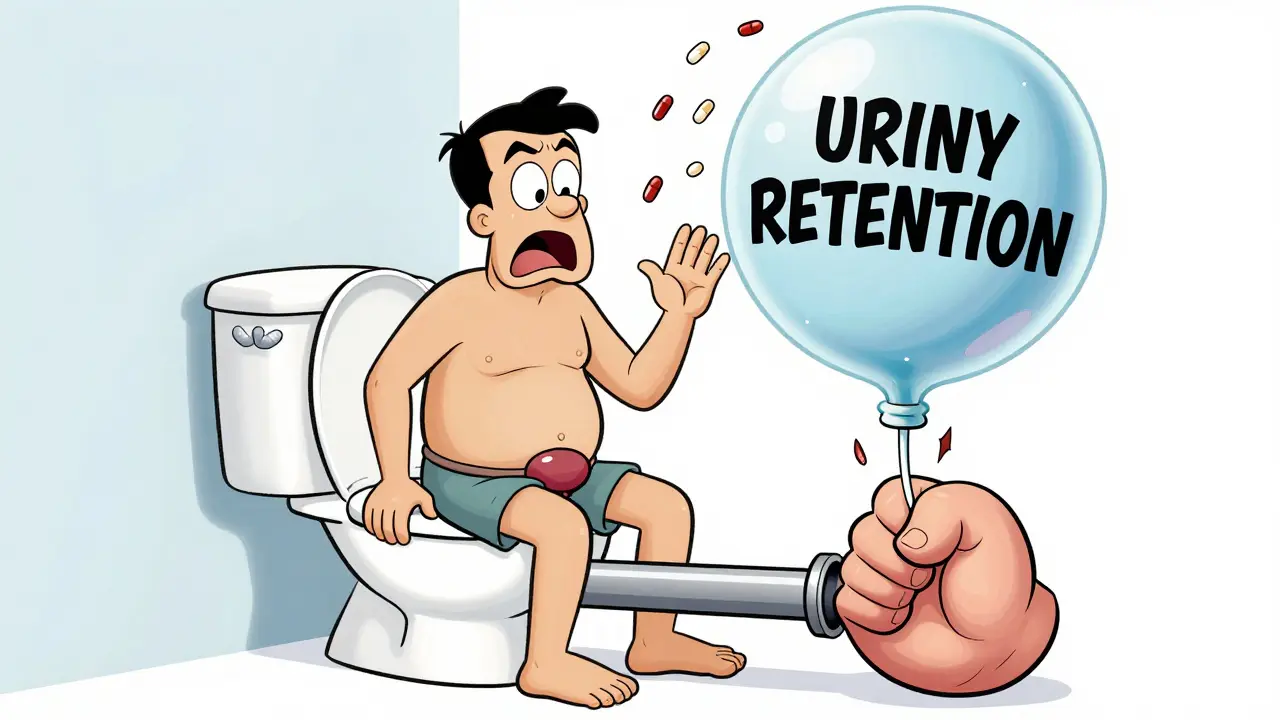
Urinary Retention Risk Calculator for Men with BPH
This tool helps you determine if you're at high risk for urinary retention when taking anticholinergic medications. Based on guidelines from the American Urological Association.
When you’re dealing with an overactive bladder-sudden urges, frequent trips to the bathroom, accidents-it’s tempting to reach for a pill that promises relief. But for men with prostate problems, that pill might be a ticking time bomb. Anticholinergics, the go-to drugs for overactive bladder, can trigger urinary retention in men with enlarged prostates. And when that happens, it’s not just uncomfortable-it’s a medical emergency.
How Anticholinergics Work (And Why They’re Risky)
Anticholinergics like oxybutynin, tolterodine, solifenacin, and fesoterodine block acetylcholine, a chemical that tells your bladder muscle to contract. In theory, this helps calm those sudden, uncontrollable urges. But here’s the catch: in men with benign prostatic hyperplasia (BPH), the prostate is already squeezing the urethra shut. The bladder has to work twice as hard just to push urine out. When you add an anticholinergic, you’re not just calming the urge-you’re weakening the bladder’s ability to push at all. It’s like turning down the engine on a car already stuck in mud.Studies show men with BPH who take these drugs have a 2.3 times higher risk of acute urinary retention compared to those who don’t. That’s not a small number. In fact, up to 10% of all urinary retention cases are linked to medications-and anticholinergics top the list.
What Is Urinary Retention? (And Why It’s Serious)
Urinary retention means your bladder fills up but won’t empty. It can be chronic-where you slowly leak or feel like you never fully empty-or acute, where you can’t pee at all. Acute retention is a true emergency. The bladder swells, sometimes holding over a liter of urine. The pressure can damage the kidneys. You’ll feel intense lower abdominal pain, bloating, and nausea. Many men end up in the ER with a catheter stuck in them.One man on a prostate forum shared: "After Detrol, I couldn’t pee for 18 hours. My bladder was the size of a watermelon. They had to catheterize me. I’m still on a catheter six months later." That’s not rare. Between 2018 and 2022, over 1,200 cases of urinary retention linked to anticholinergics were reported to the FDA. Sixty-three percent of those cases involved men over 65 with diagnosed BPH.
The Double Hit: Anatomy Meets Pharmacology
The problem isn’t just that anticholinergics weaken the bladder. It’s that men with BPH already have a compromised system. The prostate blocks the urethra. The bladder compensates by thickening its muscle wall. Over time, it’s working at maximum capacity. Add an anticholinergic, and you remove the last bit of power it has left. It’s not just a side effect-it’s a mechanical failure.The American Urological Association (AUA) says this clearly: avoid anticholinergics in men with prostate volumes over 30 grams or symptom scores above 20. That’s not a suggestion. It’s a hard line. And yet, a 2019 study found that 40% of nursing home residents with BPH were still being prescribed these drugs despite clear guidelines.

Who’s Most at Risk?
Not every man with prostate issues will have a problem. But certain factors make it much more likely:- Age over 65
- Prostate size greater than 30 grams (measured by ultrasound or MRI)
- Peak urine flow rate under 10 mL per second
- Post-void residual urine over 150 mL
- Already taking multiple medications (polypharmacy)
- History of previous urinary retention
A 2022 study in European Urology showed that men with these risk factors had an 18% chance of retention on anticholinergics. That’s nearly one in five. For men without these markers, the risk drops to 4%.
What Should You Do Instead?
There are better options. Safer alternatives exist that don’t put your bladder at risk.Alpha-blockers like tamsulosin (Flomax) and alfuzosin (Uroxatral) relax the muscles around the prostate and urethra. They don’t weaken the bladder-they help it work better. Studies show that men with BPH who start alpha-blockers after a catheterization have a 30-50% higher chance of successfully urinating on their own within days.
5-alpha reductase inhibitors like finasteride (Proscar) and dutasteride (Avodart) shrink the prostate over time. They take months to work, but they cut the risk of acute retention by half after four to six years of use.
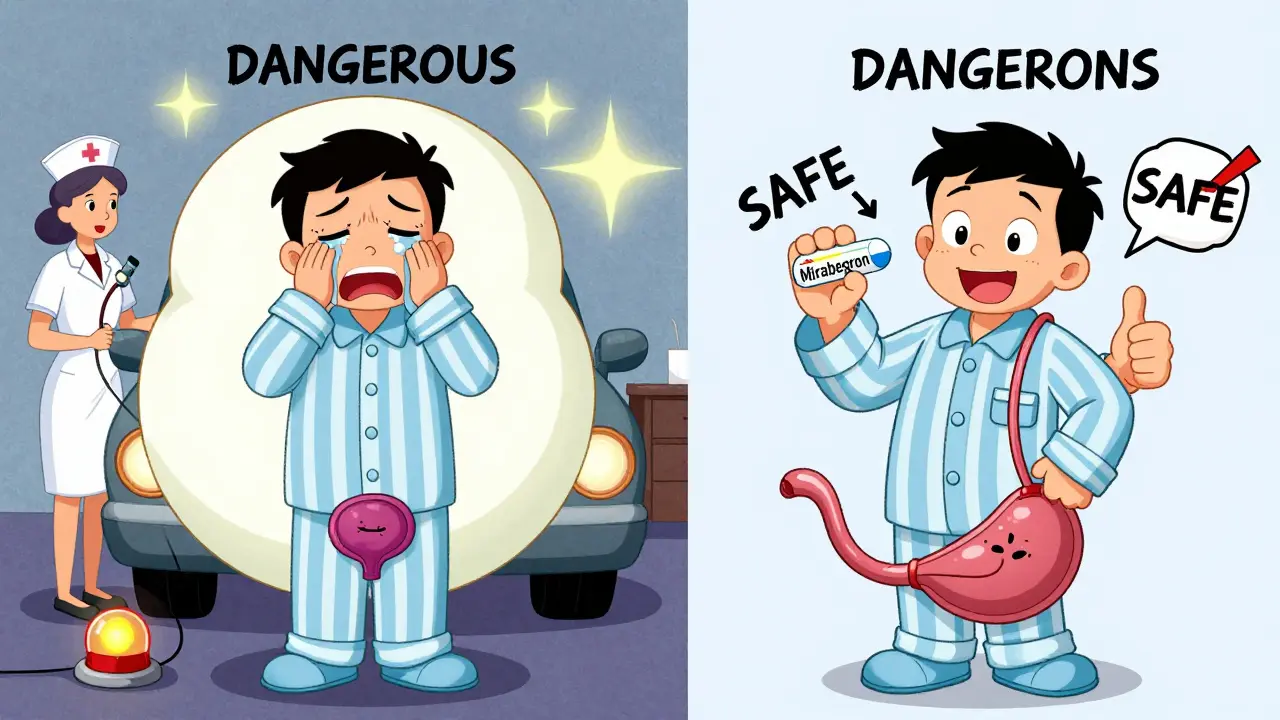
Beta-3 agonists like mirabegron (Myrbetriq) and vibegron (Gemtesa) are newer and much safer. Instead of blocking bladder contractions, they gently stimulate the bladder to relax. In trials, they reduced urgency episodes just as well as anticholinergics-but with only a 4% retention rate in men with BPH, compared to 18% with anticholinergics. The FDA approved vibegron specifically for patients with BPH who can’t tolerate older drugs.
What If You’re Already Taking One?
If you’re on an anticholinergic and have prostate symptoms, don’t stop cold turkey. Talk to your urologist. Ask for:- A digital rectal exam to check prostate size
- A uroflow test to measure your urine flow rate
- A post-void residual scan to see how much urine you’re holding
If your flow rate is below 10 mL/sec or your residual is over 150 mL, the risk is too high. Switching to an alpha-blocker or beta-3 agonist is the right move. Some urologists may cautiously try a low dose of solifenacin in men with mild BPH and strong bladder contractions-but only with weekly monitoring. Even then, the data shows retention rates still hit 12%.
The Bottom Line
Anticholinergics aren’t evil drugs. For younger women with overactive bladder and no prostate issues, they can be helpful. But for men with BPH, they’re dangerous. The benefits are small-about one fewer leak per two days. The risks? Hospital visits, catheters, kidney damage, and surgery.Doctors need to stop prescribing them as a first-line fix. Patients need to ask: "Is this helping me, or just hiding the problem?" And if you’re already on one, ask your doctor: "What’s my flow rate? What’s my residual? Am I at risk?"
There’s a better way. Safer drugs exist. Better monitoring tools exist. The data is clear. It’s time to stop using anticholinergics as a band-aid on a broken system.
Can anticholinergics cause permanent bladder damage?
Yes, if urinary retention is left untreated for too long, the bladder muscle can stretch beyond its ability to recover. Repeated episodes can lead to a flaccid, overdistended bladder that no longer contracts properly. This may require long-term catheter use or even surgical intervention. Early recognition and treatment prevent permanent damage.
Are there any anticholinergics that are safer for men with BPH?
No anticholinergic is truly safe for men with BPH. Even "selective" ones like solifenacin still carry a 12-28% risk of retention in this group. The European Association of Urology and American Urological Association both recommend avoiding all anticholinergics in men with prostate enlargement. Safer alternatives like beta-3 agonists (mirabegron, vibegron) exist and should be used instead.
How long does it take for urinary retention to happen after starting an anticholinergic?
It can happen within days or take weeks. Some men experience sudden retention after their first dose. Others develop it gradually as the drug builds up in their system. Because symptoms can be subtle-like weak stream or feeling like you’re not emptying fully-many don’t realize the problem until they can’t pee at all. That’s why screening before starting these drugs is critical.
What tests should I ask my doctor for before starting an anticholinergic?
Ask for three key tests: a digital rectal exam to estimate prostate size, uroflowmetry to measure your urine flow rate (anything under 10 mL/sec is high risk), and a post-void residual scan to see how much urine is left after you go. If any of these show signs of obstruction, anticholinergics should be avoided.
Why aren’t doctors more aware of this risk?
Many doctors still think of overactive bladder as a standalone issue, not as part of a larger urinary system problem. Anticholinergics are heavily marketed for urgency and frequency. But for men over 65, especially those with prostate symptoms, the risks far outweigh the benefits. Guidelines have been clear since 2018, but implementation lags. Patient advocacy and better screening are changing that.
Can I switch from an anticholinergic to a beta-3 agonist on my own?
No. Stopping anticholinergics suddenly can worsen bladder symptoms. Switching medications requires medical supervision. Your doctor will likely taper you off slowly and start the new drug at a low dose while monitoring your flow and residual. Never change your meds without consulting your urologist.
Tim Schulz
March 15, 2026 AT 05:13Jinesh Jain
March 15, 2026 AT 13:09Sabrina Sanches
March 16, 2026 AT 12:02Shruti Chaturvedi
March 16, 2026 AT 20:21Katherine Rodriguez
March 17, 2026 AT 06:57Emma Deasy
March 18, 2026 AT 02:46tamilan Nadar
March 18, 2026 AT 07:46Adam M
March 20, 2026 AT 02:09Noluthando Devour Mamabolo
March 21, 2026 AT 06:32Leah Dobbin
March 21, 2026 AT 15:42