
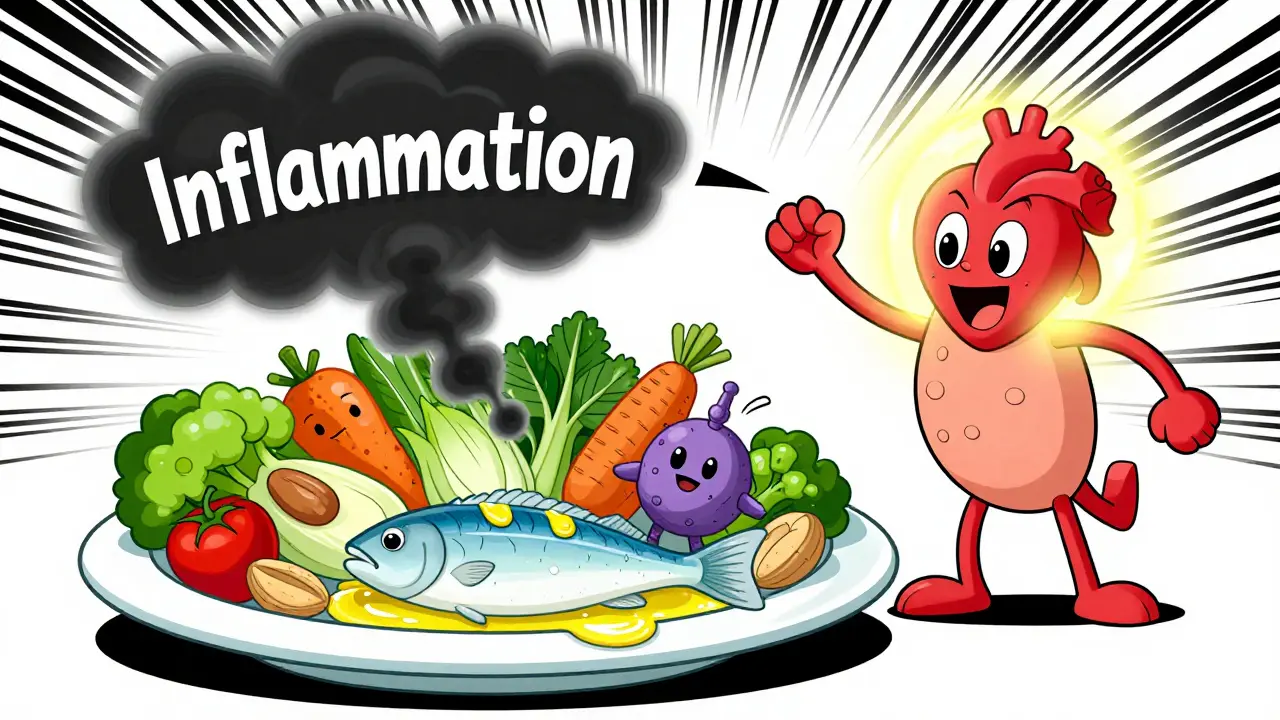
When your immune system starts attacking your own body, food becomes more than just fuel-it becomes a tool. For millions living with autoimmune diseases like rheumatoid arthritis, Hashimoto’s thyroiditis, or Crohn’s disease, what’s on your plate can mean the difference between constant pain and quiet days. There’s no magic bullet, but a growing body of science shows that certain eating patterns can calm down overactive immune responses and reduce inflammation in measurable, real-world ways.
What Anti-Inflammatory Eating Really Means
Anti-inflammatory eating isn’t a fad. It’s not about cutting out carbs or fasting for days. It’s about filling your plate with foods that naturally help reduce inflammation, while removing the ones that fuel it. Think of it like tuning a car engine-you’re not replacing the whole thing, just removing the dirt and adding the right fuel. These diets share common rules: lots of vegetables, fruits, whole grains, legumes, fatty fish, nuts, seeds, and olive oil. They cut back sharply on processed foods, added sugars, refined carbs, trans fats, and too much red meat. It’s not about perfection. It’s about patterns. A 2022 meta-analysis in the British Journal of Nutrition found that people following these patterns cut their CRP (a key inflammation marker) by 20-30% compared to those eating standard Western diets. That’s not small. That’s clinically meaningful.The Top Diets with Real Evidence
Not all anti-inflammatory diets are created equal. Some have decades of research behind them. Others are newer, with promising but still limited data. The Mediterranean diet is the gold standard. It’s not a diet you go on-it’s a way of eating that’s been followed for centuries around the Mediterranean Sea. Studies show it works. In a 2021 trial of over 2,500 people with rheumatoid arthritis, those on the Mediterranean diet saw a 22% drop in disease activity scores and 18% lower CRP levels. Why? It’s packed with olive oil (rich in oleocanthal, a natural anti-inflammatory), fatty fish (omega-3s like EPA and DHA), and fiber from beans and whole grains. One serving of fatty fish per week gives you 250-500mg of omega-3s-the amount shown to reduce pro-inflammatory cytokines by 15-25%. Vegan and vegetarian diets also show strong results. A review of 21,484 people found vegetarians had 26% lower CRP levels than meat-eaters, as long as they’d stuck with the diet for at least two years. The key? More plants mean more polyphenols and fiber, which feed good gut bacteria. Those bacteria produce butyrate, a short-chain fatty acid linked to 20% lower levels of IL-6, another major inflammation driver. The ketogenic diet is getting attention for its surprising mechanism. A 2023 study from UCSF showed that when mice with a multiple sclerosis-like condition were fed a low-carb, high-fat diet, their bodies produced β-hydroxybutyrate (βHB)-a ketone body. That ketone triggered gut bacteria to release indole lactic acid (ILA), which blocked the activation of T helper 17 cells, the immune cells that drive autoimmune attacks. In mice, this cut disease severity by 40%. Human trials are just starting, but early signs are promising. The kicker? You need to hit ketosis-βHB levels above 1.0 mmol/L-which usually means keeping carbs under 50g per day. The Autoimmune Protocol (AIP) diet is more intense. It starts with a strict 5-8 week elimination phase: no grains, legumes, dairy, eggs, nuts, seeds, nightshades (like tomatoes, peppers, eggplant), or coffee. Then, you slowly add them back one at a time to see what triggers symptoms. People with Hashimoto’s or IBD report 60-70% symptom improvement in observational studies. One person on Reddit shared that eliminating nightshades cut their psoriatic arthritis pain in half. But AIP is hard. It’s expensive. It’s socially isolating. And while many swear by it, there’s still no large, randomized trial proving it works better than other diets.What Doesn’t Work (And Why)
The Western diet-high in processed meats, sugary drinks, white bread, and fried foods-is the opposite of anti-inflammatory. Studies show people who eat this way have 30-50% higher CRP levels than those who avoid these foods. Added sugar is especially damaging. More than 25g per day (about 6 teaspoons) spikes blood sugar, triggers fat storage around organs, and activates inflammatory pathways. Trans fats, found in many packaged snacks and fried foods, are even worse. They directly interfere with cell membrane function and increase inflammation.
What You Should Eat Every Day
Here’s a simple, practical guide based on the strongest evidence:- Vegetables: 7-10 servings daily. Focus on leafy greens (spinach, kale), cruciferous veggies (broccoli, Brussels sprouts), and colorful ones like beets and carrots.
- Fruits: 3-5 servings daily. Berries (blueberries, strawberries) are top choices-high in anthocyanins that block NF-κB, a key inflammation switch.
- Whole grains: At least 3 servings daily. Oats, quinoa, brown rice, and barley provide 25-30g of fiber, which feeds good gut bacteria.
- Legumes: 3 servings weekly. Lentils, chickpeas, and black beans are fiber and protein powerhouses.
- Fatty fish: 2-3 servings weekly. Salmon, sardines, mackerel, and anchovies deliver omega-3s. If you don’t eat fish, consider a high-quality fish oil supplement.
- Nuts and seeds: 1-2 servings daily. Walnuts, flaxseeds, chia seeds, and almonds are rich in omega-3s and vitamin E.
- Extra virgin olive oil: At least 2 tablespoons daily. Use it in salads, drizzled on veggies, or for light cooking.
- Herbs and spices: Turmeric, ginger, garlic, and rosemary have potent anti-inflammatory compounds.
What to Avoid
- Added sugars (soda, candy, sweetened yogurt, baked goods)
- Refined carbs (white bread, pasta, pastries)
- Processed meats (bacon, sausages, deli meats)
- Trans fats (partially hydrogenated oils in packaged snacks)
- Excessive saturated fats (fried foods, butter, fatty cuts of red meat)
- Artificial additives and preservatives

Challenges and Real-Life Hurdles
Let’s be honest-changing how you eat is hard. Social events, family meals, work lunches-they all get in the way. A 2022 survey found 78% of people with autoimmune conditions struggle to stick to their diet when dining out or at gatherings. Cost is another issue. Eating fresh, organic, and high-quality foods costs more. In the U.S., the Mediterranean diet runs about $50-75 more per week than a standard diet. That’s a real barrier for many. And then there’s the frustration of conflicting advice. The Arthritis Foundation found 58% of people feel overwhelmed by mixed messages online. One person told me, “I read five different diets, each claiming to be the best. I didn’t know who to trust.”How to Make It Stick
Start small. Don’t overhaul your whole life on day one. Pick one change: swap white bread for sourdough. Add a serving of greens to lunch. Drink water instead of soda. Small wins build momentum. Track your symptoms. Keep a simple journal: “What I ate” and “How I felt.” After a few weeks, patterns emerge. Maybe you notice joint pain flares after eating tomatoes. Maybe your energy spikes after eating lentils. Get support. The American College of Lifestyle Medicine says 83% of people who worked with a registered dietitian stuck with their diet for a full year. Only 42% did without help. A dietitian doesn’t need to be an autoimmune expert-just someone who knows how to help you make sustainable changes.What’s Next?
Science is moving fast. The NIH is funding a five-year trial called DIETA, which will test the Mediterranean diet against standard care in 1,000 early rheumatoid arthritis patients. Results are due in 2026. Meanwhile, companies are testing microbiome-based diets-using your gut bacteria to recommend personalized food plans. Early data shows promise. But here’s the truth: no diet will cure autoimmune disease. Medications still matter. But food can reduce your dose. It can help you feel better on your worst days. It can give you back control. For many, that’s worth more than any pill.Can diet really reduce inflammation in autoimmune diseases?
Yes. Multiple studies show that anti-inflammatory diets like the Mediterranean, vegetarian, and AIP diets can reduce key inflammation markers like CRP and IL-6 by 20-30%. In rheumatoid arthritis, these diets have been shown to lower disease activity scores. The effect is real, measurable, and clinically relevant, though diet alone won’t replace medication.
Is the ketogenic diet safe for autoimmune conditions?
Early research is promising, especially for conditions like multiple sclerosis. A 2023 study showed that ketones produced during keto can block immune cells that drive autoimmune attacks. But human trials are small and short-term. Long-term effects on cholesterol, bone density, and gut health aren’t fully known. It’s not for everyone-especially those with kidney issues or eating disorders. Always talk to a doctor before starting keto.
Why is the Mediterranean diet recommended over others?
Because it has the strongest evidence. Over 20 large studies, including randomized trials with thousands of participants, show it reduces inflammation, improves joint pain, and lowers heart disease risk. It’s also sustainable-people stick with it longer than restrictive diets like keto or AIP. It doesn’t require eliminating entire food groups, making it easier to follow socially and long-term.
Do I need to go completely vegan or gluten-free?
No. You don’t need to eliminate entire food groups unless you have a diagnosed sensitivity. Many people with autoimmune disease improve by simply eating more plants, less sugar, and more omega-3s-even while still eating eggs, dairy, or gluten. The goal is to reduce inflammation, not follow a rigid label. Focus on adding good foods first, then remove only what clearly triggers symptoms.
How long before I see results from an anti-inflammatory diet?
Some people notice changes in 2-4 weeks-less morning stiffness, better digestion, more energy. But full benefits often take 8-12 weeks. For elimination diets like AIP, you need at least 5-8 weeks before reintroducing foods. Patience matters. This isn’t a quick fix. It’s a long-term strategy to support your immune system.
Namrata Goyal
March 25, 2026 AT 16:51Kevin Y.
March 26, 2026 AT 21:09Korn Deno
March 28, 2026 AT 08:51Aaron Sims
March 28, 2026 AT 23:29Natasha Rodríguez Lara
March 29, 2026 AT 21:11Linda Foster
March 30, 2026 AT 00:54Rama Rish
March 30, 2026 AT 23:47Kevin Siewe
March 31, 2026 AT 02:13Chris Farley
April 1, 2026 AT 12:48Darlene Gomez
April 2, 2026 AT 20:00Katie Putbrese
April 2, 2026 AT 21:40Amber Gray
April 3, 2026 AT 13:39Danielle Arnold
April 5, 2026 AT 08:29Donna Fogelsong
April 7, 2026 AT 05:39