
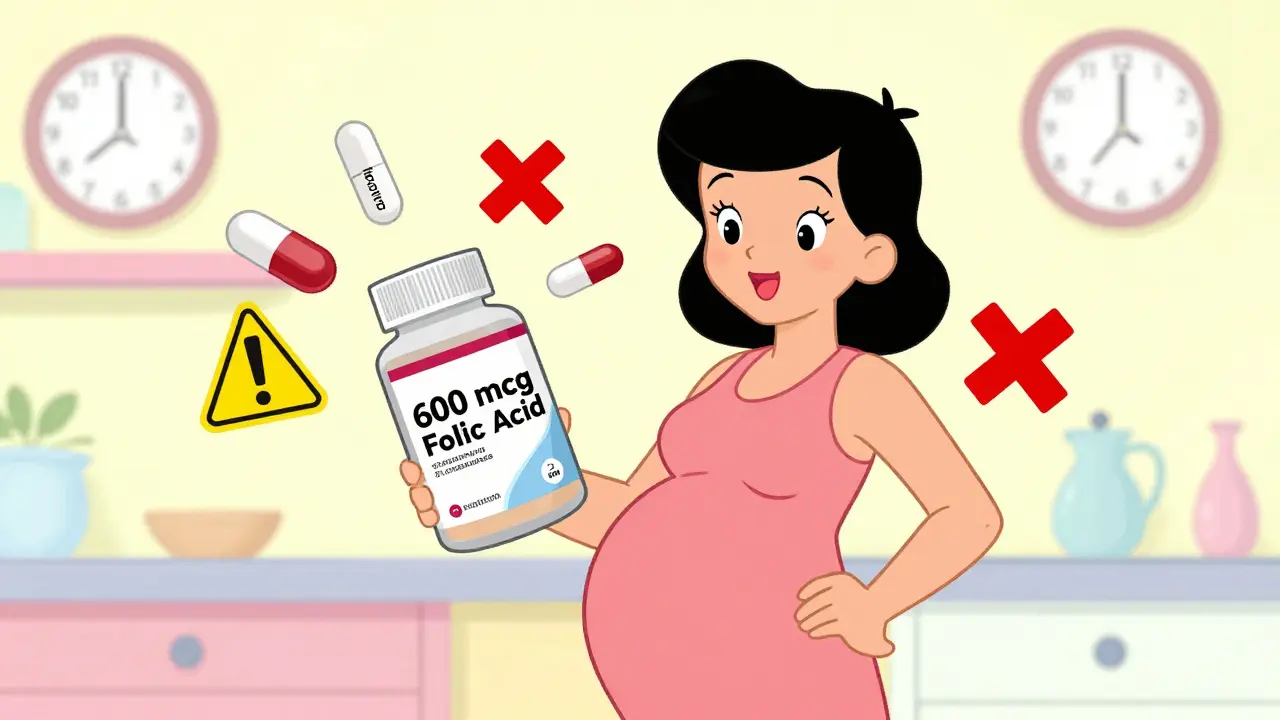
When you're pregnant, taking folic acid isn't just a suggestion-it's one of the most important things you can do to protect your baby's development. But here's the thing: folic acid doesn't play nice with every medication. If you're on any prescription drugs, even ones you've been taking for years, mixing them with prenatal vitamins could reduce their effectiveness-or worse, put you or your baby at risk.
Why Folic Acid Matters So Much in Pregnancy
Folic acid is the synthetic form of folate, a B vitamin your body needs to make DNA and build new cells. During early pregnancy, it's absolutely critical for closing the neural tube-the structure that becomes your baby's brain and spinal cord. If this doesn't close properly, it can lead to serious birth defects like spina bifida or anencephaly.
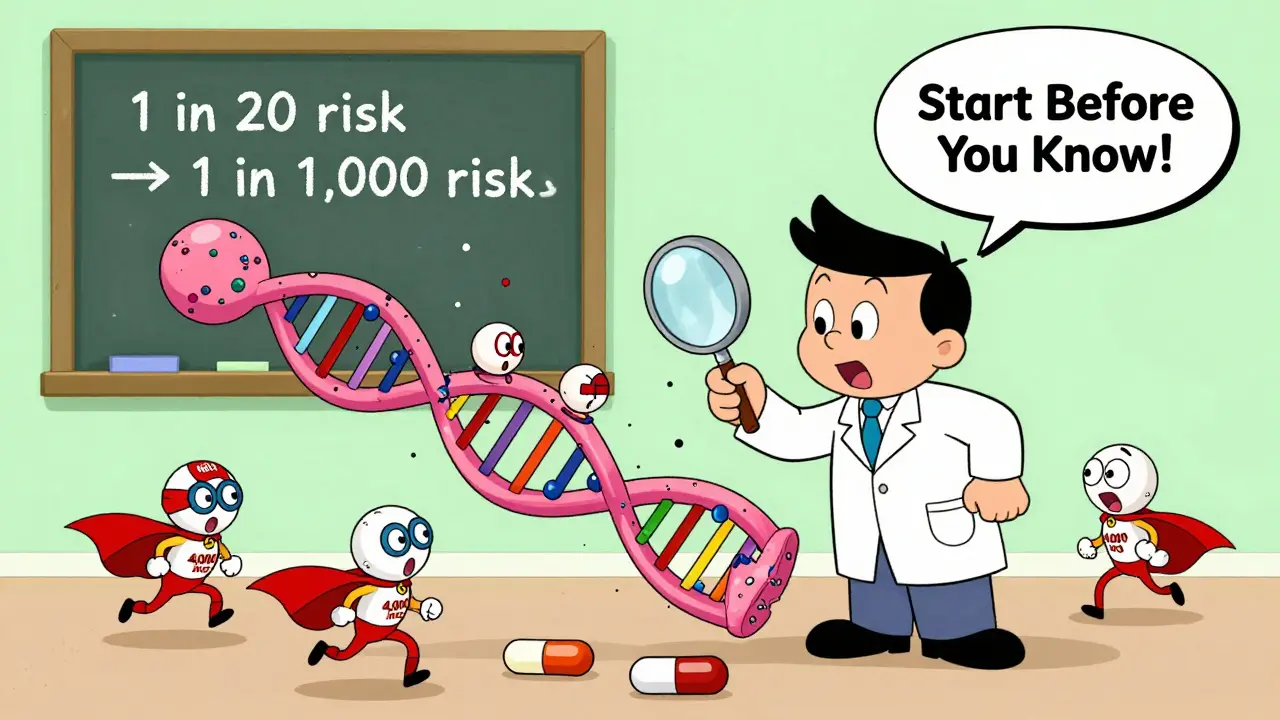
The science is clear: taking 400 micrograms (mcg) of folic acid daily before conception and through the first trimester cuts the risk of these defects by 50 to 70%. That’s why doctors recommend starting before you even know you're pregnant. The neural tube closes by day 28 after conception-most women don’t realize they’re pregnant until then.
Most prenatal vitamins now contain 600 to 1,000 mcg of folic acid. That’s more than enough for most women. But if you’re on certain medications, that standard dose might not be enough-or it might interfere with your treatment.
Medications That Can Reduce Folic Acid Absorption
Not all drugs react the same way with folic acid. Some make it harder for your body to absorb it. Others block its effects entirely.
Anticonvulsants (anti-seizure drugs) like phenytoin (Dilantin), carbamazepine (Tegretol), and valproic acid are the biggest concern. These drugs lower folate levels in your blood. In fact, women with epilepsy who take these medications have a 1 in 20 chance of having a baby with a neural tube defect-much higher than the general population’s 1 in 1,000 risk.
Because of this, neurologists and OB-GYNs often recommend 4,000 to 5,000 mcg of folic acid daily for women on these drugs. That’s 5 to 10 times the normal dose. But this isn’t something to guess at. You need medical supervision. Taking too much without guidance can mask other problems or cause unintended side effects.
Sulfasalazine, used for ulcerative colitis and rheumatoid arthritis, also blocks folate absorption. The UK’s NICE guidelines specifically warn that taking folic acid with sulfasalazine without medical oversight can make the drug less effective. If you're on this medication, your doctor may need to adjust your dose or switch you to a different form of folate.
Pyrimethamine, sometimes used to treat toxoplasmosis during pregnancy, works by blocking folate in parasites. But it also blocks it in your body. Adding folic acid can reduce the drug’s effectiveness. Pharmacists report that 32% of pregnant women on pyrimethamine need their doses adjusted when they start folic acid supplements.
Medications That Folic Acid Can Interfere With
It’s not just about folic acid being blocked-sometimes it blocks other drugs.
Phenytoin (Dilantin) is a classic example. Folic acid can reduce how well phenytoin works. There are documented cases where women on phenytoin for epilepsy started taking prenatal vitamins and had breakthrough seizures. One Reddit user, u/AnxiousMom2022, described exactly this scenario: she felt fine until she began her prenatal supplement, then had a seizure she hadn’t had in years. Her neurologist later confirmed folic acid was likely the trigger.
Methotrexate, used to treat autoimmune diseases and sometimes ectopic pregnancies, is a folate antagonist. It kills rapidly dividing cells-including cancer cells and, in pregnancy, abnormal tissue. But here’s the twist: in some cases, doctors use low-dose folic acid to reduce methotrexate’s side effects (like nausea and liver stress) without reducing its effectiveness. This is done under strict medical supervision. One BabyCenter user shared how her doctor gave her 1 mg of folic acid daily during her ectopic pregnancy treatment with methotrexate. She said it made the whole process far more tolerable.
Don’t assume you can manage this yourself. Even if you’ve read about it online, never adjust your dose without talking to your provider.
Iron and Calcium: The Silent Interferers
You might think the only problem is with prescription drugs. But even common supplements can mess with folic acid absorption.
Prenatal vitamins often contain iron. But when you take iron and folic acid together, the iron can reduce folic acid absorption by 20 to 30%. That’s a significant drop. Many women report nausea from prenatal vitamins-often because of the iron. The fix? Take your prenatal vitamin at night with food, and take a separate folic acid supplement in the morning on an empty stomach.
Calcium also interferes. Taking folic acid with dairy, calcium supplements, or antacids can reduce absorption by up to 50%. The FDA updated its labeling in 2021 to warn about this. If you’re taking calcium for bone health, space it out by at least 4 hours from your folic acid.
And don’t forget antacids. If you’re popping Tums or Pepcid regularly for heartburn, that’s another reason to take your folic acid separately. A 2021 study showed antacids can cut folic acid absorption in half.
What About MTHFR Gene Mutations?
You’ve probably heard about MTHFR-a gene that affects how your body processes folic acid. About 10 to 15% of people of European descent and 20 to 25% of Hispanics carry a version of this gene (the 677C>T variant) that makes it harder to convert synthetic folic acid into its active form.
For these people, standard folic acid supplements might not be enough. That’s why some newer prenatal vitamins now contain L-methylfolate (also called Quatrefolic®), the active form of folate that bypasses this conversion step. The FDA approved the first prenatal vitamin with Quatrefolic® in 2023. It’s pricier-around $46 a month-but it’s a game-changer for women with MTHFR mutations.
Do you need to get tested for MTHFR? Not necessarily. Most doctors won’t recommend it unless you’ve had a previous pregnancy affected by a neural tube defect or have unexplained high homocysteine levels. But if you’ve tried regular folic acid and still had complications, talk to your doctor about switching to L-methylfolate.

How to Take Folic Acid Safely
Here’s what works in real life:
- Start at least one month before trying to conceive. Don’t wait until you miss your period.
- Take your folic acid on an empty stomach with water. Morning is best.
- Avoid taking it with calcium-rich foods (milk, cheese, yogurt), antacids, or iron supplements. Space them out by at least 4 hours.
- If you’re on anticonvulsants, sulfasalazine, or pyrimethamine, tell your doctor before starting any prenatal vitamin.
- Don’t assume your over-the-counter prenatal has enough. Check the label. Some have only 400 mcg; others have 1,000 mcg. Prescription ones can go higher.
- If you’re nauseous from your prenatal, switch to a separate folic acid supplement (400-800 mcg) and take iron later in the day.
Most women do fine with 600-800 mcg daily. But if you’re on any of the medications mentioned above, your needs are different. Don’t guess. Get tested. Ask your doctor.
What’s New in 2025?
The CDC is pushing to fortify corn masa flour with folic acid in 2025. Why? Hispanic women have 20 to 30% higher rates of neural tube defects than non-Hispanic white women. Fortifying masa flour-used in tortillas and tamales-could help close that gap.
Researchers are also looking into whether folic acid might lower autism risk. A 2022 study of 45,300 children showed a 40% reduction in autism spectrum disorder when mothers took folic acid before and during early pregnancy. But a 2021 Danish study found no link. More research is needed.
One thing’s certain: folic acid is not a magic bullet, but it’s one of the most powerful tools we have to prevent devastating birth defects. The key is using it right.
What to Do If You’re Already Pregnant and Haven’t Taken Folic Acid
It’s not too late. Start today. Even if you’re past 12 weeks, folic acid still supports healthy red blood cell production and brain development. The neural tube closes early, but your baby’s brain keeps growing. Don’t wait for the next appointment-get a supplement now.
And if you’re on medication? Tell your OB-GYN or pharmacist. Bring your pill bottles. They need to see everything you’re taking-prescription, over-the-counter, herbal, even vitamins from the grocery store.
Can I get enough folic acid from food alone during pregnancy?
No. While foods like spinach, lentils, and fortified cereals contain folate, you’d need to eat a huge amount to reach the 600 mcg daily recommendation. For example, you’d need over 2 cups of cooked spinach every day. Even with fortified grains, most women still fall short. Supplements are necessary.
Is it safe to take more than 1,000 mcg of folic acid during pregnancy?
Only under medical supervision. The upper limit for adults is 1,000 mcg per day. Taking more than that without a doctor’s advice can mask a vitamin B12 deficiency, which can cause nerve damage. It may also lead to unmetabolized folic acid building up in your blood. While no serious harm has been proven, the long-term effects aren’t fully known. Higher doses are only recommended for specific conditions like epilepsy or previous neural tube defects.
Do all prenatal vitamins have the same amount of folic acid?
No. Over-the-counter brands range from 400 mcg to 1,000 mcg. Prescription prenatal vitamins can go higher-up to 5,000 mcg for high-risk cases. Always check the label. A $10 bottle from CVS might have 600 mcg, while a premium brand like Thorne has 1,000 mcg. Don’t assume higher price means higher dose.
Can folic acid cause miscarriage?
No. In fact, studies show the opposite. A large 2020 analysis of over 200,000 pregnancies found that women who took folic acid before conception had a 20% lower risk of early miscarriage. Folic acid supports healthy cell division and placental development. There’s no credible evidence it causes harm at recommended doses.
What if I’m allergic to folic acid?
True allergies to folic acid are extremely rare. Most people who think they’re allergic are actually reacting to fillers, dyes, or other ingredients in the pill. If you’ve had a rash, swelling, or breathing trouble after taking a prenatal vitamin, talk to your doctor. You may need a different brand or the active form-L-methylfolate-which is less likely to cause reactions.
Should I stop taking folic acid after the first trimester?
No. While the neural tube closes by week 6, folic acid continues to support your baby’s brain, spinal cord, and blood cell development throughout pregnancy. It also helps prevent anemia in the mother. Most experts recommend continuing folic acid through pregnancy and even while breastfeeding.
If you’re on medication and pregnant-or planning to be-don’t rely on internet forums or advice from friends. Your health is too important for that. Talk to your doctor. Bring your pill bottles. Ask: "Does this interact with folic acid?" That simple question could prevent a serious problem.
Manan Pandya
December 30, 2025 AT 14:34Folic acid interactions are way more complex than most prenatal guides admit. I’ve seen patients on phenytoin crash into seizures after starting OTC prenatal vitamins-no warning, no adjustment. The 4,000–5,000 mcg dose isn’t ‘overkill’ for them; it’s survival. Always check med lists with your pharmacist, not just your OB. That’s non-negotiable.
Aliza Efraimov
December 31, 2025 AT 23:32I had a seizure at 10 weeks because I took my prenatal with my anticonvulsant. I thought ‘more folic acid = safer’-wrong. My neurologist almost fired me for not speaking up. This post? Lifesaver. I’m screaming this from the rooftops now. If you’re on ANY seizure med, STOP scrolling and call your doctor TODAY. I almost lost my baby because I trusted a label.
Nisha Marwaha
January 2, 2026 AT 14:48From a clinical pharmacology standpoint, the folate-methotrexate dynamic is particularly nuanced. While methotrexate is a dihydrofolate reductase inhibitor, low-dose folic acid (1 mg/day) exerts a cytoprotective effect on healthy tissues without compromising therapeutic efficacy in ectopic pregnancy or RA contexts. The key lies in pharmacokinetic separation-administering folic acid 24 hours post-methotrexate mitigates interference. L-methylfolate bypasses MTHFR polymorphisms entirely, rendering it superior in 677C>T heterozygotes and homozygotes. This is not anecdotal-it’s evidence-based, tier-1 recommendation per ACOG 2024.
Paige Shipe
January 4, 2026 AT 06:10I read this and immediately thought-why do we even let people take supplements without a prescription? You can’t just pick up a pill at CVS and assume it’s safe. I know someone who took folic acid with her Tums and ended up with a neural tube defect. It’s irresponsible. The FDA should ban over-the-counter prenatal vitamins. People are too dumb to read labels.
Kevin Lopez
January 4, 2026 AT 22:45Phenytoin + folic acid = bad. Period. No exceptions. If you’re on it, you need 5mg. No more, no less. Get tested. Don’t guess.
Amy Cannon
January 6, 2026 AT 22:07As a first-generation Indian-American woman who navigated prenatal care in two healthcare systems, I find it profoundly disheartening that the discourse around folic acid remains so fragmented. In India, my mother’s OB prescribed folic acid as a matter of course, but never addressed interactions with antiepileptic medications-perhaps due to resource constraints. Here in the U.S., I was handed a $50 bottle of Thorne with no explanation. The cultural dissonance is staggering. We must bridge the gap between global public health wisdom and hyper-specialized Western pharmacology. Education, not alarmism, is the answer.
Jasmine Yule
January 7, 2026 AT 20:23Thank you for writing this. I’m so glad I found this before my 6-week appointment. I was taking my prenatal with my calcium supplement and my antacid for heartburn. Now I know to space them out. I feel like I almost messed up without even knowing it. This is the kind of info no one tells you. I’m sharing this with my entire mom group.
Greg Quinn
January 9, 2026 AT 01:07It’s fascinating how we treat vitamins like harmless candy. Folic acid isn’t just a supplement-it’s a biochemical modulator. The body doesn’t distinguish between ‘natural’ and ‘synthetic’ folate at the cellular level. The real issue is our cultural belief that ‘more is better.’ Medicine isn’t a buffet. You don’t pile on nutrients and hope for the best. Precision matters. This post nails it.
Lisa Dore
January 9, 2026 AT 13:59Just started trying to conceive and I had no idea any of this existed. I thought prenatal vitamins were just ‘good for baby.’ Now I’m going to print this out and bring it to my doctor. I’m so glad I didn’t just assume everything was fine. You’re doing important work here.
Sharleen Luciano
January 11, 2026 AT 07:56How is it that the average person still believes that ‘fortified cereals’ are adequate? This is basic biochemistry. You need bioavailable folate, not a synthetic analog that 40% of the population can’t metabolize. If you’re not taking L-methylfolate, you’re essentially gambling with your baby’s neurodevelopment. And if you’re using a $12 bottle from Walmart? You’re not trying-you’re just hoping.
Henriette Barrows
January 12, 2026 AT 07:28I took folic acid for years and never knew it could interact with my RA meds. My doctor never mentioned it. I cried reading this. I wish someone had told me sooner. You’re not just saving babies-you’re saving moms from guilt. Thank you.
Teresa Rodriguez leon
January 13, 2026 AT 14:20Why is this even a thing? Why don’t doctors just tell people this? I’ve been pregnant twice and no one ever said a word about spacing out my calcium. I’m mad now.