
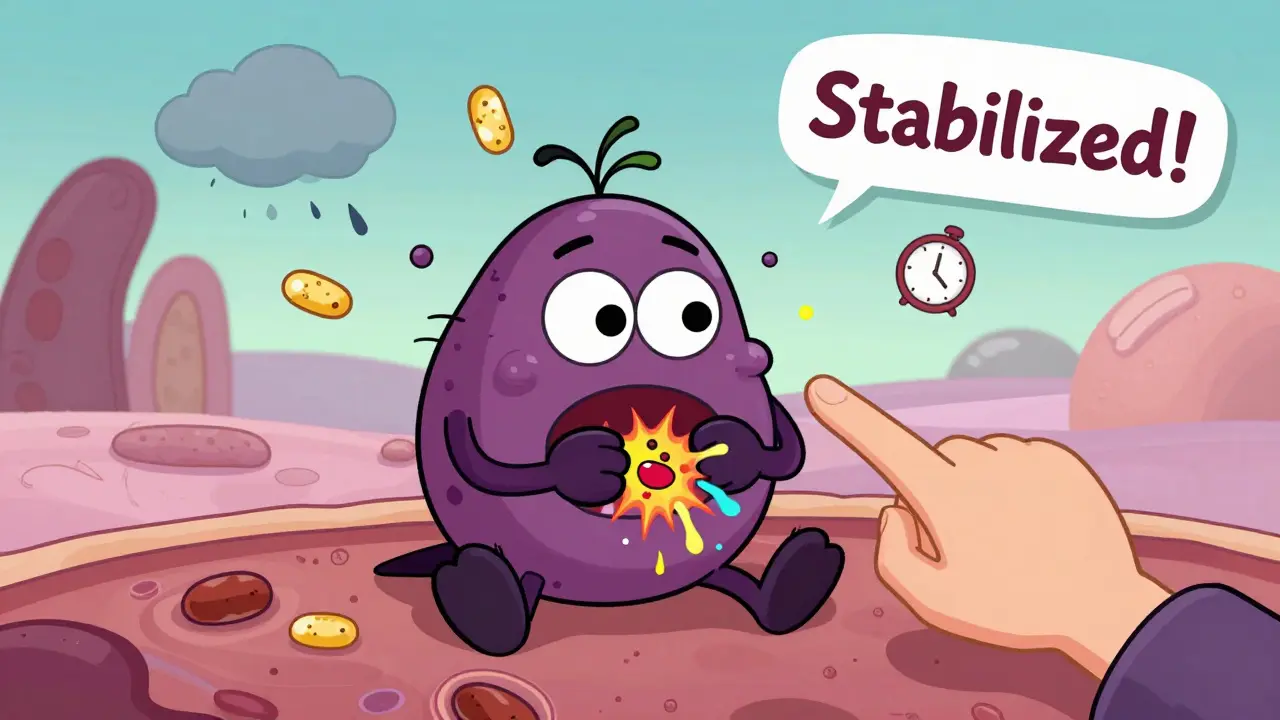
When your body overreacts to something harmless-like pollen, a food, or even stress-it’s often not the allergen itself causing the problem. It’s your mast cells. These tiny immune cells, scattered throughout your skin, lungs, gut, and other tissues, act like alarm systems. When they fire off incorrectly, they release a storm of chemicals that trigger everything from hives and stomach cramps to brain fog and anaphylaxis. This isn’t just allergies. It’s mast cell activation syndrome (MCAS), a condition affecting up to 1 in 1,000 people. And the key to managing it? Stopping the release of mediators before they hit the bloodstream.
What Happens When Mast Cells Activate
Mast cells sit quietly in tissues until something triggers them. That something could be IgE antibodies bound to an allergen, a bacterial toxin, a spicy food, heat, or even emotional stress. Once activated, they don’t just release one thing-they unleash a whole arsenal.Within seconds, pre-formed mediators burst out of granules inside the cell. Histamine, the most familiar, makes blood vessels leaky and nerves fire. Tryptase, a protein enzyme, is a key diagnostic marker-levels spike during severe reactions. Chymase and heparin follow, contributing to inflammation and tissue remodeling. These are the fast-acting culprits behind sudden flushing, itching, or wheezing.
Minutes later, new mediators begin to form. Prostaglandin D2 (PGD2) causes headaches and nasal congestion. Leukotriene C4 (LTC4) tightens airway muscles, worsening asthma. Platelet-activating factor (PAF) can drop blood pressure, pushing someone toward shock. These lipid mediators are why symptoms often worsen over time, even after the trigger is gone.
Hours later, the cell shifts gears again. Cytokines like TNF-α and IL-6 flood out, turning a local reaction into a systemic one. This is what turns a mild reaction into days of fatigue, joint pain, or brain fog. The timing matters: histamine hits in under a minute; cytokines take hours. That’s why antihistamines alone often fail-they only block one part of the storm.
Why Stabilizers Are Different from Antihistamines
Most people reach for antihistamines first. They work by blocking histamine receptors. But if mast cells release 30+ different chemicals at once, blocking just one is like trying to stop a flood with a sponge.Mast cell stabilizers do something smarter: they stop the cell from releasing anything at all. The most well-known is cromolyn sodium (a mast cell stabilizer first approved by the FDA in 1973 for asthma prophylaxis). It works by plugging calcium channels in the mast cell membrane. No calcium influx? No degranulation. No release of histamine, tryptase, or PGD2.
Another option is ketotifen (an oral mast cell stabilizer with antihistamine properties, approved in the U.S. in 1990). It’s slightly more potent and crosses into the brain, helping with neurological symptoms like brain fog. Studies show it reduces MCAS symptoms in 50-70% of patients at doses of 1-4 mg twice daily.
Here’s the catch: stabilizers don’t work like fast-acting rescue meds. They’re preventive. You have to take them before exposure-not after. If you’re already breaking out in hives, cromolyn won’t calm it down. It’s like locking the door after the burglar already broke in.
Compare that to newer drugs like omalizumab (anti-IgE), which blocks the trigger itself. Omalizumab works in 70-80% of MCAS patients, but it costs thousands per month. Stabilizers? A month’s supply of cromolyn runs under $100. They’re not perfect, but they’re accessible.
The Limits of Current Stabilizers
No mast cell stabilizer stops everything. That’s the hard truth.Even when cromolyn blocks degranulation, cytokines can still be made through alternative pathways. A 2014 PNAS study showed IL-4 can boost histamine release by 30-50%-and stabilizers don’t touch that. So even if you’re taking your pills, you might still have inflammation, fatigue, or pain.
Another problem: absorption. Oral cromolyn has terrible bioavailability. Only about 2% of the dose gets into your bloodstream. That’s why high doses are needed: 200 mg four times a day. Many patients report nausea, diarrhea, or cramping-side effects so bad that 15% quit treatment.
And timing? It takes weeks. One patient documented on MastAttack.org saw a 70% drop in anaphylactic episodes-but only after eight weeks of consistent dosing. There’s no quick fix. This isn’t a pill you take when you feel sick. It’s a daily ritual, like brushing your teeth.

Who Benefits Most from Stabilizer Therapy?
Not everyone with allergies has MCAS. But if you have:- Chronic hives that don’t respond to antihistamines
- Recurrent stomach pain, bloating, or diarrhea after eating
- Brain fog, headaches, or dizziness triggered by heat, stress, or certain foods
- Multiple systems involved (skin + gut + lungs + nervous system)
you might be in the 17% of chronic urticaria patients with MCAS, according to a 2019 Allergy study. These are the people who benefit most from stabilizers.
Research shows 87% of MCAS patients report improvement with stabilizers. But only 43% get full control. That’s why most use them alongside other tools: low-histamine diets, stress management, and sometimes antihistamines for breakthrough symptoms.
One big clue? If you react to NSAIDs (68% of MCAS patients) or alcohol (63%), stabilizers help. These triggers bypass IgE and activate mast cells directly-exactly what cromolyn and ketotifen are designed to block.
How to Start Stabilizer Therapy
Starting cromolyn isn’t simple. Most doctors don’t know how. Here’s what works:- Begin with 100 mg four times daily, 30 minutes before meals and at bedtime. This gives you four daily doses to cover food, stress, and environmental triggers.
- Wait 4-6 weeks. Don’t give up if you don’t feel better in a week. Mast cells need time to quiet down.
- Track symptoms. Use a daily log: what you ate, what you felt, and when.
- Test biomarkers. A 24-hour urine test for methylhistamine (normal <1.3 mg) and N-methyl-β-hexosaminidase (normal <1,000 ng/mg creatinine) shows if the treatment is working. A 30% drop means success.
- Adjust slowly. If tolerated, increase to 200 mg four times daily. Some need 400 mg four times daily-yes, that’s 1,600 mg per day.
Children often need the liquid form. But it tastes awful. A 2019 patient survey rated its flavor 2.1 out of 5. Many use feeding tubes. Others mix it with applesauce or juice. It’s not elegant-but it works.

What’s Coming Next
The future of mast cell therapy isn’t just stabilizers. In 2023, the FDA approved avapritinib (a targeted KIT inhibitor for advanced systemic mastocytosis), which blocks the mutated KIT receptor found in 95% of mastocytosis cases. It’s not for MCAS-but it’s a sign of things to come.Phase II trials are underway for SYK kinase inhibitors. One drug, at 100 mg daily, reduced mediator release by 75%. That’s huge. These drugs target the signaling pathway inside the mast cell, not just the membrane. They might block both degranulation and cytokine production.
Future treatments could include mast cell-specific monoclonal antibodies, gene therapies for KIT mutations, and drugs that reset mast cell sensitivity. By 2030, experts predict 80-90% symptom control will be possible-not just for mastocytosis, but for MCAS too.
Final Thoughts: It’s Not a Cure. But It’s a Lifeline.
Mast cell stabilizers aren’t magic. They don’t fix the root cause. They don’t cure MCAS. But they give people back control. They let someone eat a meal without fear. Walk outside without a flare-up. Sleep through the night.For many, stabilizers are the first step toward normalcy. They’re affordable. They’re available. And they work-if you give them time.
And if you’ve been told your symptoms are "just anxiety"? You’re not alone. The average MCAS patient sees 6-10 doctors over 3-5 years before getting a diagnosis. But now, 78% of academic medical centers have dedicated mast cell clinics. Awareness is growing. Treatment is improving.
Stabilizers won’t stop every flare. But they stop enough.
Can mast cell stabilizers cure MCAS?
No, mast cell stabilizers do not cure MCAS. They prevent mast cells from releasing mediators, which reduces symptoms, but they don’t address the underlying immune dysregulation. MCAS is a chronic condition that requires long-term management, often with a combination of stabilizers, diet, stress control, and other medications.
Why do mast cell stabilizers take weeks to work?
Mast cells store mediators for long periods and can remain active even without new triggers. It takes time for the cell population to reset. Stabilizers don’t destroy mast cells-they prevent new releases. As existing mediators clear from tissues and cells stop firing, symptoms gradually improve. This process typically takes 4-8 weeks.
Is cromolyn sodium the same as an antihistamine?
No. Cromolyn sodium is a mast cell stabilizer-it stops cells from releasing histamine and other mediators. Antihistamines block histamine after it’s released. Cromolyn works upstream; antihistamines work downstream. They can be used together, but they serve different roles.
Do mast cell stabilizers work for food allergies?
They can help if the reaction is driven by mast cell activation, such as in MCAS. For classic IgE-mediated food allergies (like peanut anaphylaxis), epinephrine is still the only emergency treatment. Stabilizers may reduce the frequency and severity of reactions but should never replace epinephrine for life-threatening allergies.
What are the most common triggers for mast cell activation?
Common triggers include NSAIDs (68% of MCAS patients), alcohol (63%), heat (57%), emotional stress (52%), certain foods (49%), strong smells, exercise, and insect stings. Many patients use a "mast cell trigger wheel" to identify their personal triggers and avoid them.
Robert Shiu
February 19, 2026 AT 07:33Caleb Sciannella
February 20, 2026 AT 04:10Davis teo
February 20, 2026 AT 10:56Michaela Jorstad
February 22, 2026 AT 05:22Chris Beeley
February 23, 2026 AT 21:06James Roberts
February 24, 2026 AT 03:02Marie Crick
February 25, 2026 AT 12:50Amrit N
February 25, 2026 AT 16:34Courtney Hain
February 26, 2026 AT 04:10Ellen Spiers
February 27, 2026 AT 14:33Scott Dunne
February 28, 2026 AT 10:14Danielle Gerrish
March 2, 2026 AT 02:20Liam Crean
March 3, 2026 AT 14:18