
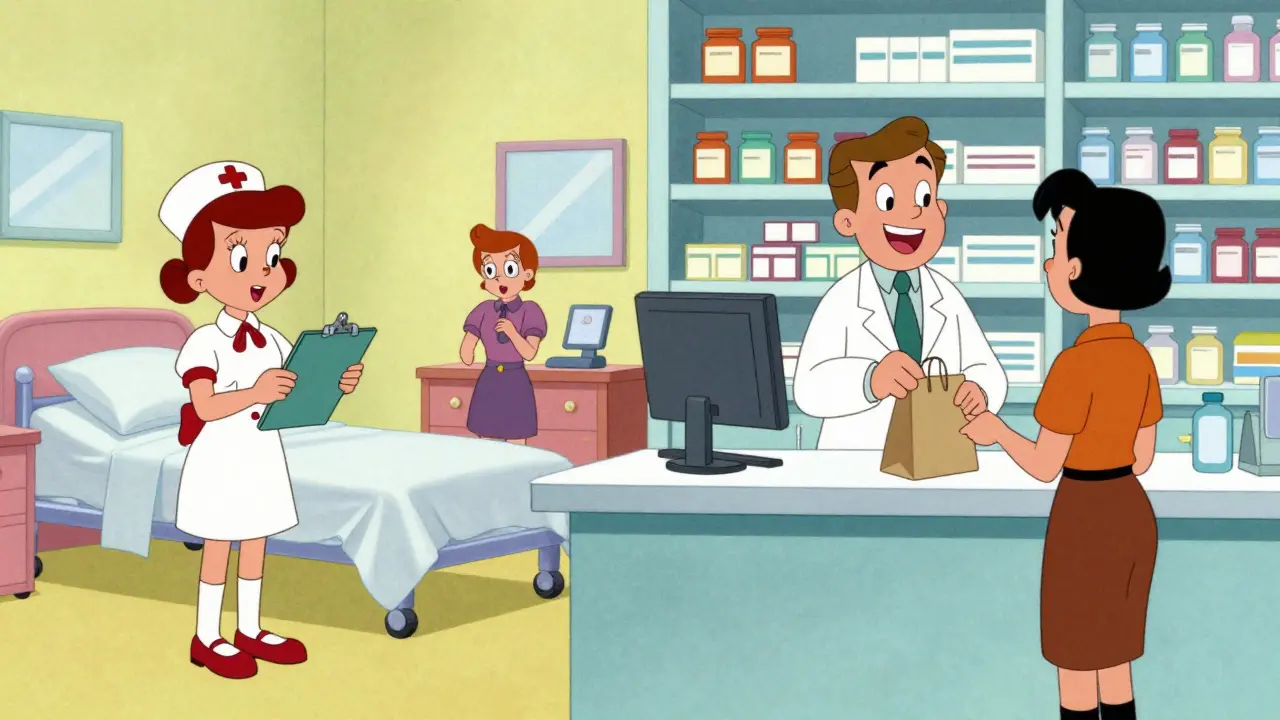
Imagine picking up a prescription at your local drugstore and realizing only after you've taken the first dose that the instructions say "twice a day" instead of "twice a week." Or, picture a patient in a hospital bed receiving a medication they are allergic to because a label was misread during a hectic shift change. These aren't just bad luck; they are dispensing errors, and they happen in every corner of healthcare. But the way these mistakes happen-and who catches them-is wildly different depending on whether you're in a hospital ward or standing at a retail pharmacy counter.
The Big Picture: Safety Nets and Statistics
At first glance, hospitals seem like the danger zone. Research shows that medication errors are alarmingly common in clinical settings. In fact, one study published in JAMA Internal Medicine found that nearly 20% of doses in typical hospitals and skilled nursing facilities contained some kind of error. That's roughly 1 in 5. Compare that to Retail Pharmacies, where a meta-analysis in the Journal of Patient Safety puts the dispensing error rate at about 1.5%.
Wait, does that mean your local pharmacy is safer? Not necessarily. Here is the catch: hospitals have layers of safety nets. In a hospital, a pharmacist dispenses the drug, but a nurse usually checks it again before administering it to the patient. In a retail setting, the pharmacist is often the final professional check. Once you walk out those sliding doors with your brown paper bag, you are the last line of defense. If the pharmacy makes a mistake, it's much more likely to actually reach the patient unchecked.
| Feature | Hospital Setting | Retail Pharmacy |
|---|---|---|
| Estimated Error Rate | Up to 20% of doses | Approx. 1.5% of prescriptions |
| Primary Checkpoint | Nursing personnel | The patient |
| Common Error Type | Administration & Timing | Transcription & Labeling |
| Reporting Culture | Established/Systemic | Historically limited/State-led |
Where Things Go Wrong in Retail Pharmacies
In the community pharmacy world, the pressure is often about volume and speed. Many errors are "cognitive," meaning they happen because of how a person perceives information under stress. A common culprit is the Transcription Error, where a prescription is written one way but entered into the computer another.
For example, a doctor might prescribe estradiol to be taken twice per week, but the pharmacy staff enters it as twice per day. This small clerical slip can lead to a massive overdose. According to the NIH, about half of these errors are clinical problems (like wrong dosage) and the other half are administrative. When you're filling 250 prescriptions a day, a 1.5% error rate actually means about four mistakes per day per pharmacy. Across the U.S., that adds up to millions of potential mishaps annually.
The Complexity of Hospital Errors
Hospitals are a different beast entirely. Errors here don't just happen at the pharmacy window; they happen during prescribing, transcribing, dispensing, and administration. Because patients in hospitals are often much sicker (higher acuity), the medications are more complex, and the environment is more chaotic.
The Administration Phase is where the most danger lies. This is when the medication actually enters the patient's body. Timing issues-giving a drug too early or too late-and dosage mistakes during the hand-off between nurses are frequent. However, hospitals have leaned heavily into technology to fight this. Barcode Medication Administration systems, which require scanning the patient and the drug, have been shown to slash error rates by as much as 86%.
The Financial and Human Cost
These mistakes aren't just scary; they are incredibly expensive. The Academy of Managed Care Pharmacy (AMCP) reported that the total cost of medication misadventures to the U.S. economy exceeds $177 billion annually. When a hospital error occurs, the immediate medical cost to treat the injury can be thousands of dollars per incident, totaling billions annually just for hospital-based injuries.
In retail settings, the cost often manifests as emergency room visits or unplanned hospitalizations. If a patient takes an incorrect dose of a high-risk medication like insulin or an anticoagulant, the result can be catastrophic, leading to permanent disability or death. The AHRQ notes that while retail errors are less frequent, their ability to reach the patient undetected makes them uniquely dangerous.
Stopping the Cycle: Modern Solutions
We are moving away from a "blame and shame" culture toward a system of safety. In the past, people hid mistakes for fear of losing their licenses. Now, there is a push for non-punitive reporting, where "near misses" are logged so the system can be fixed.
Technologically, we're seeing a shift toward Clinical Decision Support Systems (CDSS). These are software tools that act like a digital safety net, alerting a pharmacist if a dose looks suspiciously high for a patient's age or weight. On the corporate side, some large chains have implemented AI-powered verification that has reduced dispensing errors by over 30%. Similarly, integrated electronic health records (EHR) at places like the Mayo Clinic have helped cut hospital errors by half by ensuring the pharmacy and the doctor are looking at the exact same data in real-time.
Why are error rates higher in hospitals than in retail pharmacies?
Hospital environments are significantly more complex. Patients are often critically ill, requiring multiple high-potency medications with strict timing. Additionally, the process involves more hand-offs between doctors, pharmacists, and nurses, creating more opportunities for communication breakdowns compared to the relatively linear process of a retail prescription.
What is a "near miss" in pharmacy terms?
A near miss is an error that occurred but was caught before it reached the patient. For example, if a pharmacist fills the wrong medication but notices the mistake during the final check, that is a near miss. Tracking these is vital because they reveal flaws in the system without causing actual harm.
How can patients prevent retail pharmacy errors?
Patients should always verify the medication name and dosage on the label against what the doctor prescribed before leaving the pharmacy. Asking the pharmacist to explain the instructions and checking the physical appearance of the pills (color/shape) against previous refills can also catch errors before they cause harm.
Does AI actually help reduce medication errors?
Yes. AI-powered verification systems can scan prescriptions for patterns that humans might miss, such as unusual dosages or dangerous drug interactions. Some preliminary data suggests that AI monitoring in pharmacy workflows can reduce transcription errors by up to 63%.
What is the role of barcode scanning in hospitals?
Barcode Medication Administration (BCMA) requires nurses to scan the patient's wristband and the medication's barcode. This ensures the "Five Rights": right patient, right drug, right dose, right route, and right time. This technology has been shown to reduce administration errors by up to 86%.
Next Steps for Patient Safety
Whether you're a healthcare provider or a patient, the goal is the same: a closed-loop system. If you are a patient, don't be afraid to ask questions at the pharmacy counter. If you're a provider, focus on reducing distractions during the "critical window" of dispensing. The move toward standardized reporting and AI integration is promising, but until those systems are universal, a skeptical eye and a double-check are the best tools we have.