
Allergy Treatment Recommender
Based on the latest evidence, choose the treatment that best matches your symptoms:
The right choice depends on whether nasal congestion or eye symptoms are your main problem.
Select your main allergy symptoms:
What matters most to you?
When you'll feel relief:
Why this works:
Most people with seasonal allergies reach for an antihistamine when their nose starts running or their eyes itch. It’s quick, it’s easy, and it’s what doctors used to recommend. But what if the most common advice is outdated? For allergic rhinitis - hay fever, seasonal allergies - the real winner isn’t the pill you swallow. It’s the nasal spray you’ve been told to use only if other things fail.
Why Nasal Sprays Beat Pills for Nasal Symptoms
Intranasal corticosteroids aren’t just another option. They’re the most effective treatment for nasal congestion, runny nose, sneezing, and postnasal drip. Multiple studies, including a major 1999 meta-analysis of 16 trials with over 2,200 patients, show they outperform oral antihistamines across nearly every nasal symptom. The exception? Eye symptoms. For itchy, watery eyes, antihistamines work just as well. But if your main problem is a blocked nose or constant dripping, corticosteroid sprays are the clear choice.Here’s why: antihistamines only block histamine - one piece of the allergy puzzle. Intranasal corticosteroids go deeper. They calm inflammation at its source. They reduce swelling in the nasal lining, lower the number of immune cells that cause reactions, and cut down on the chemicals that trigger mucus and sneezing. This isn’t just theory. Studies measuring eosinophil counts and eosinophil cationic protein (ECP) in nasal secretions show a real, measurable drop in inflammation with corticosteroids - something antihistamines don’t do.
The Big Mistake: Taking Medication Only When You Feel Sick
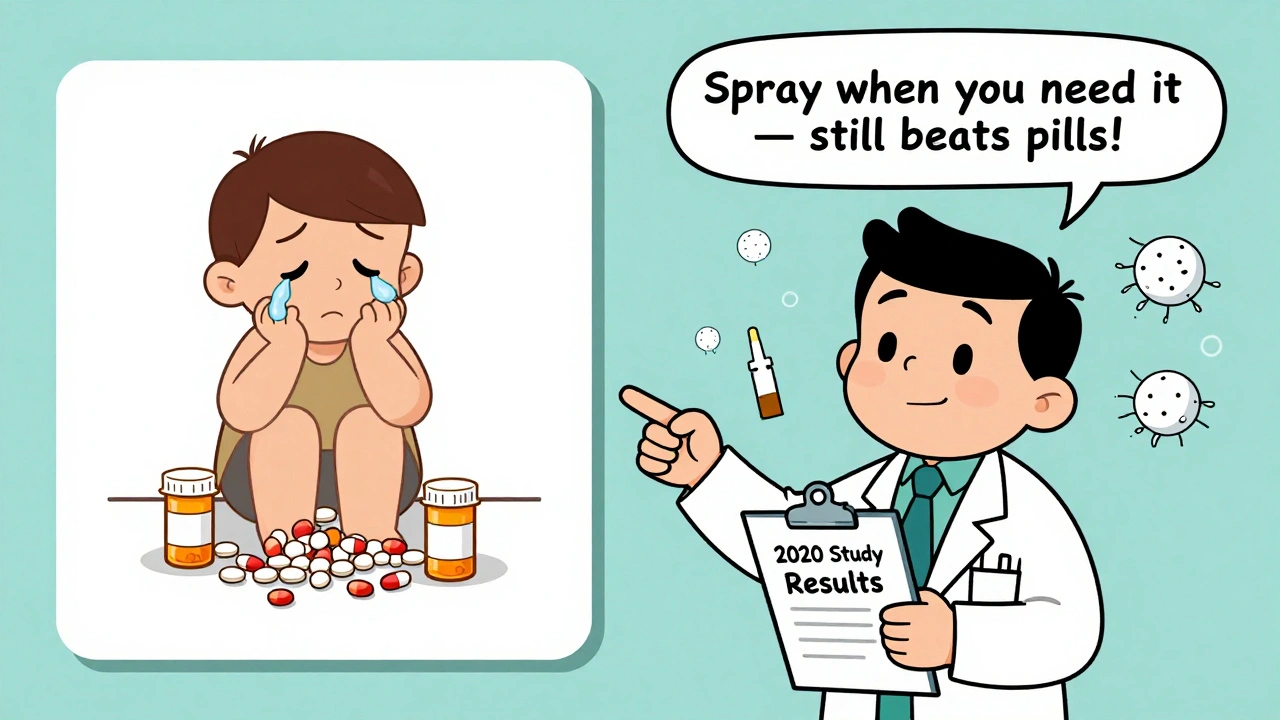
Most people don’t take their allergy meds every day. They wait until they feel awful - then reach for something. That’s the problem with how antihistamines are often prescribed. Oral antihistamines work fast, but their effect fades within hours. If you only take them after symptoms start, you’re always playing catch-up. Your nose stays swollen, your sinuses stay congested, and you never really get ahead of the allergy.Intranasal corticosteroids, on the other hand, still work better even when used this way. A landmark 2001 study from the University of Chicago found that patients using a corticosteroid spray only when symptoms appeared had far fewer symptoms over four weeks than those taking oral antihistamines on an as-needed basis. That’s huge. It means you don’t need to be perfect. You don’t need to spray every morning like clockwork. Just use it when you feel it coming - and you’ll still do better than with pills.
Timing Matters - But Not How You Think
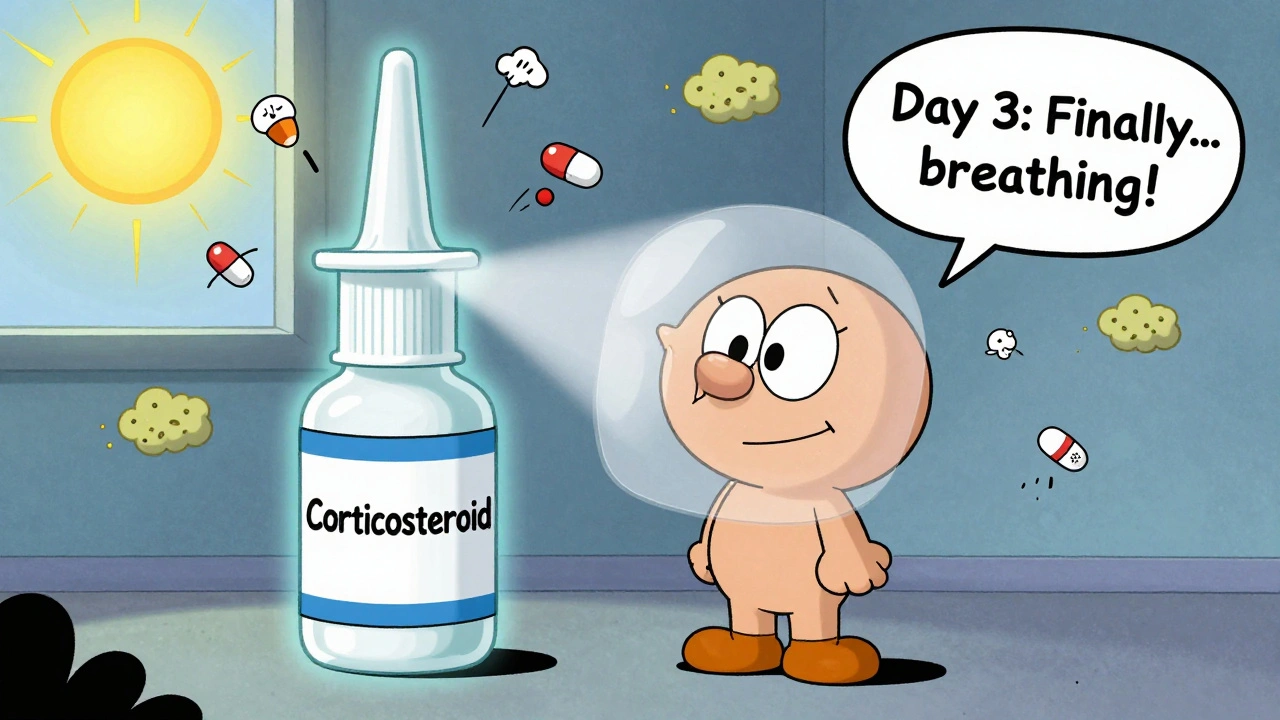
Some older studies said you need to use corticosteroid sprays daily for weeks before they work. That’s true if you’re trying to prevent symptoms before they start. But if you’re like most people - and you don’t plan your allergy season - you can still get strong relief by starting the spray when symptoms appear. The key difference? Corticosteroids build up their effect over a few days. You won’t feel better the first day. But by day three or four, the swelling starts to go down. That’s why people who stop after one or two sprays think it doesn’t work. It’s not magic. It’s medicine.Antihistamines give you relief in 30 to 60 minutes. But they wear off. Corticosteroids take longer to kick in, but their effect lasts. One spray in the morning can control symptoms all day. You don’t need to re-dose. You don’t need to remember to take a pill at lunch. And you won’t feel drowsy.
What About Eye Symptoms?
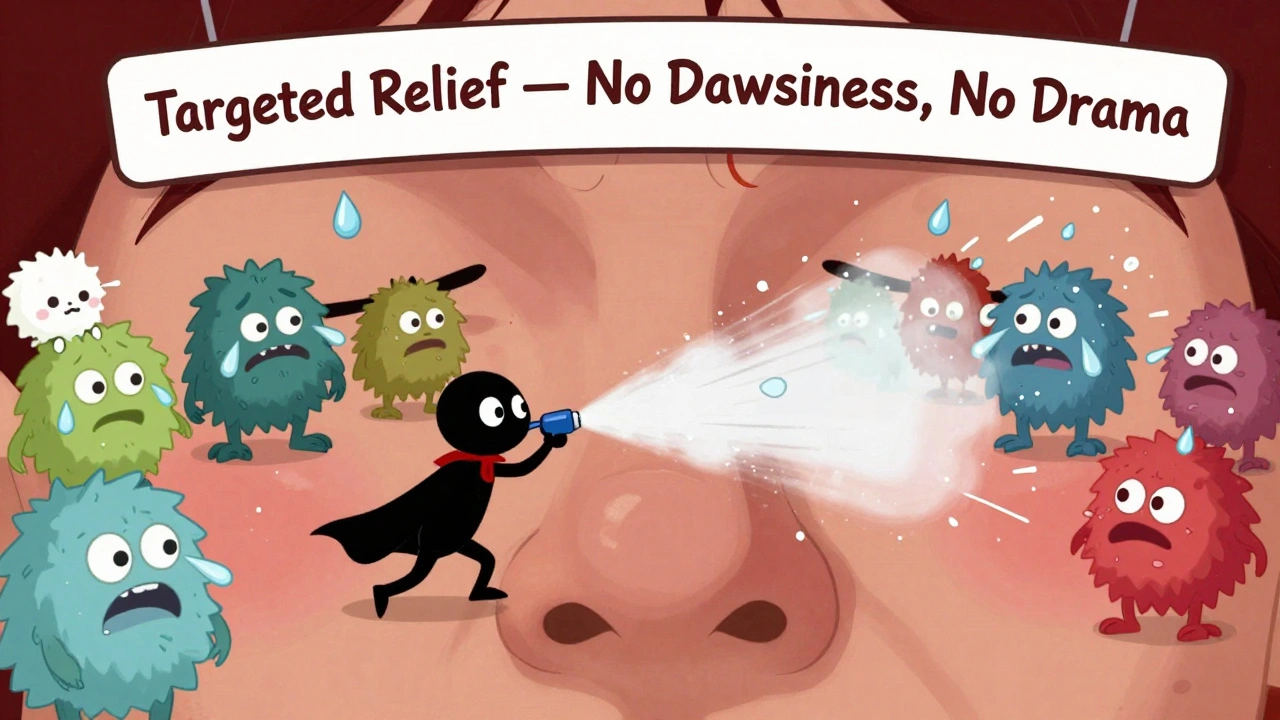
If your eyes are the worst part - burning, watering, itching - then yes, antihistamines hold their own. Oral antihistamines like loratadine or cetirizine help with that. But here’s the catch: they don’t help your nose much. And if you’re using them only for your eyes, you’re missing out on controlling the rest of your allergy.There’s a better way. If you’re already using a corticosteroid spray for your nose and your eyes still bother you, add an intranasal antihistamine spray - not an oral one. A 2020 study showed that when you combine a corticosteroid spray with a nasal antihistamine spray, you get better results than adding an oral antihistamine. The nasal spray hits the eyes and nose at the same time. It’s targeted. It’s more effective. And it avoids the drowsiness that comes with pills.
Cost, Safety, and the Steroid Myth
Many people avoid corticosteroid sprays because they think they’re like the steroids athletes use. They’re not. Intranasal corticosteroids are local. Less than 1% of the dose gets into your bloodstream. Studies tracking patients for five years found no serious side effects. No weight gain. No mood changes. No bone loss. Just a small chance of minor nosebleeds or dryness - easily fixed with saline spray.And they cost less. In the U.S., generic fluticasone or mometasone sprays often run under $10 for a 30-day supply. Brand-name oral antihistamines? Often $20 to $40. And you’re paying more for less relief.
Real-World Use: What Doctors Still Get Wrong
Despite all this evidence, antihistamines are still prescribed three times more often than nasal corticosteroids. Why? Tradition. Marketing. Misinformation. Many doctors still think of corticosteroids as a last resort. But the data doesn’t support that. The Rhinitis Working Group and multiple clinical guidelines now say corticosteroid sprays should be first-line - even for mild cases - if used as needed.The gap between science and practice is real. Patients are told to take pills daily. But they don’t. They’re told to use sprays every day. But they forget. The solution? Stop treating both the same way. Give people the tool that works even when they’re inconsistent. That’s the nasal spray.
What Should You Do?
If you have allergic rhinitis, here’s what works:- Start with a corticosteroid nasal spray. Use it once a day. If you forget, use it when symptoms appear. You’ll still do better than with pills.
- Don’t stop too soon. Give it 3-5 days. If you feel nothing after a week, talk to your doctor. It might be the wrong spray or the wrong technique.
- If your eyes are the main issue, add an intranasal antihistamine spray - not an oral one.
- Use saline rinse before the spray. It clears mucus and helps the medicine reach the lining.
- Don’t spray toward the septum. Aim the nozzle slightly outward, toward the ear on the same side. This avoids irritation and improves delivery.
There’s no need to suffer through every pollen season. The tools are here. The evidence is clear. You don’t need to take a pill every day. You don’t need to wait until you’re miserable. Just use the spray - even if it’s just when you need it.
Do intranasal corticosteroids work if I only use them when I have symptoms?
Yes. While daily use gives the best long-term control, studies show that using intranasal corticosteroids as-needed - meaning only when symptoms appear - still provides significantly better relief than taking oral antihistamines on the same schedule. You won’t get instant results, but within 2-4 days, nasal congestion and runny nose improve noticeably.
Are nasal corticosteroids safe for long-term use?
Yes. Multiple studies tracking patients for up to five years found no serious side effects from regular use of intranasal corticosteroids. Unlike oral steroids, these sprays deliver a tiny dose directly to the nasal lining, with less than 1% entering the bloodstream. Minor side effects like dryness or occasional nosebleeds are rare and usually mild.
Why do doctors still prescribe antihistamines more often?
Historical habits and marketing play a big role. Antihistamines were easier to recommend in the past because they worked fast and felt like a quick fix. Many doctors weren’t trained on the latest evidence showing corticosteroids are more effective, even with as-needed use. Also, patients often ask for pills because they’re familiar with them. But prescribing patterns are slowly changing as more research confirms the superiority of nasal sprays.
Should I use an oral or nasal antihistamine if I need extra help?
If you’re already using a corticosteroid spray and still have symptoms, choose a nasal antihistamine spray over an oral one. A 2020 study showed nasal antihistamines work better as an add-on because they target both the nose and eyes directly. Oral antihistamines can cause drowsiness and don’t improve nasal symptoms as much. Nasal sprays avoid those side effects and deliver higher concentrations where they’re needed.
How long does it take for a nasal corticosteroid to start working?
It usually takes 2 to 4 days to notice improvement, and full effect may take up to two weeks. That’s why people give up too soon. If you stop after one or two sprays, you won’t feel anything. But if you keep going for a few days, you’ll see a real drop in congestion, sneezing, and mucus. Think of it like treating a bruise - you don’t heal overnight, but the swelling goes down over time.
Ali Bradshaw
December 6, 2025 AT 11:26Been using fluticasone on and off for two years now. Honestly? Life-changing. I used to rely on Claritin like it was oxygen-until I realized my nose was still stuffed to the brim. Started spraying when I felt a tickle, not waiting for full-blown misery. By day three, I could breathe through my nose while watching TV. No drowsiness. No weird side effects. Just quiet, steady relief. Why are we still selling people pills like they’re magic bullets?
an mo
December 7, 2025 AT 06:40Let’s be real-the FDA hasn’t approved these sprays for as-needed use. The studies you cite? Funded by pharma. The 2001 Chicago study? Small sample, no placebo control. And don’t get me started on the ‘less than 1% systemic absorption’ claim-that’s lab-grade math, not real-world biology. Your sinuses are a gateway. Anything you put in there eventually finds its way to your adrenals. You’re just delaying the crash.
Harry Nguyen
December 8, 2025 AT 00:34Oh wow. So the solution to seasonal allergies is… more steroids? Brilliant. Next you’ll tell me we should spray cortisol into our eyes to fix ‘itchy’ and call it a ‘targeted delivery system.’ Meanwhile, people are actually getting better by moving to dry climates, eating fermented foods, and not living in a plastic bubble. But sure, let’s keep medicating our way out of nature’s little reminders.
Juliet Morgan
December 9, 2025 AT 10:47i just wanna say thank you for writing this. i’ve been using mometasone for 3 months now, only when i feel it coming, and i finally stopped feeling like a zombie with a clogged nose. i used to take cetirizine every day and still cried in the shower from sinus pressure. now i just spray once, wait a couple days, and boom-i’m human again. also, saline rinse before? game changer. no idea why no one told me that before.
Deborah Jacobs
December 11, 2025 AT 03:19My nose used to sound like a leaky garden hose during pollen season. I’d wake up with crusty eyes and a headache that felt like my skull was being squeezed by a bear. Tried everything-pills, eye drops, neti pots, even that weird essential oil blend from Etsy. Nothing stuck. Then I tried the spray like it was a secret spell-just one puff, morning and night, no panic. Day 4? I sneezed once. Day 7? I smelled coffee for the first time in years. It’s not magic. It’s just… medicine that doesn’t treat symptoms like a glitch. It fixes the damn system.
luke newton
December 11, 2025 AT 18:30People like you think you’re saving lives with your nasal spray gospel. But you’re just enabling a culture of chemical dependency. You don’t fix allergies-you mask them. And while you’re busy spraying your way to ‘relief,’ the real issue-the rot in your gut, the toxins in your home, the stress you ignore-is still there, laughing. You think this is health? This is just another way to avoid the truth: your body is screaming. And you’re answering with a spray bottle.
Katie Allan
December 13, 2025 AT 12:49Thank you for this. I’ve been telling my patients this for years, and they still walk out with a prescription for Zyrtec. I love that you mentioned the nasal antihistamine spray combo-it’s underused and so effective. Also, the technique tip? Gold. So many people spray straight back and blame the spray for burning. It’s not the medicine-it’s the aim. You’re not spraying into a wall. You’re guiding it to the lining. Think of it like watering a plant, not hosing down the sidewalk.
Jimmy Jude
December 13, 2025 AT 17:44Let’s be honest: this isn’t about allergies. It’s about control. We’ve been conditioned to believe that if we can’t feel it immediately, it doesn’t work. We want the pill that zaps the itch like a lightning bolt. But real healing? It’s slow. It’s quiet. It’s the kind of medicine that doesn’t make you feel like a superhero-it makes you feel like a human. And that terrifies people. So they keep reaching for the fast fix. The spray doesn’t cure your allergy. It teaches you patience. And that’s the real revolution.
Lynette Myles
December 15, 2025 AT 02:34Stop.