
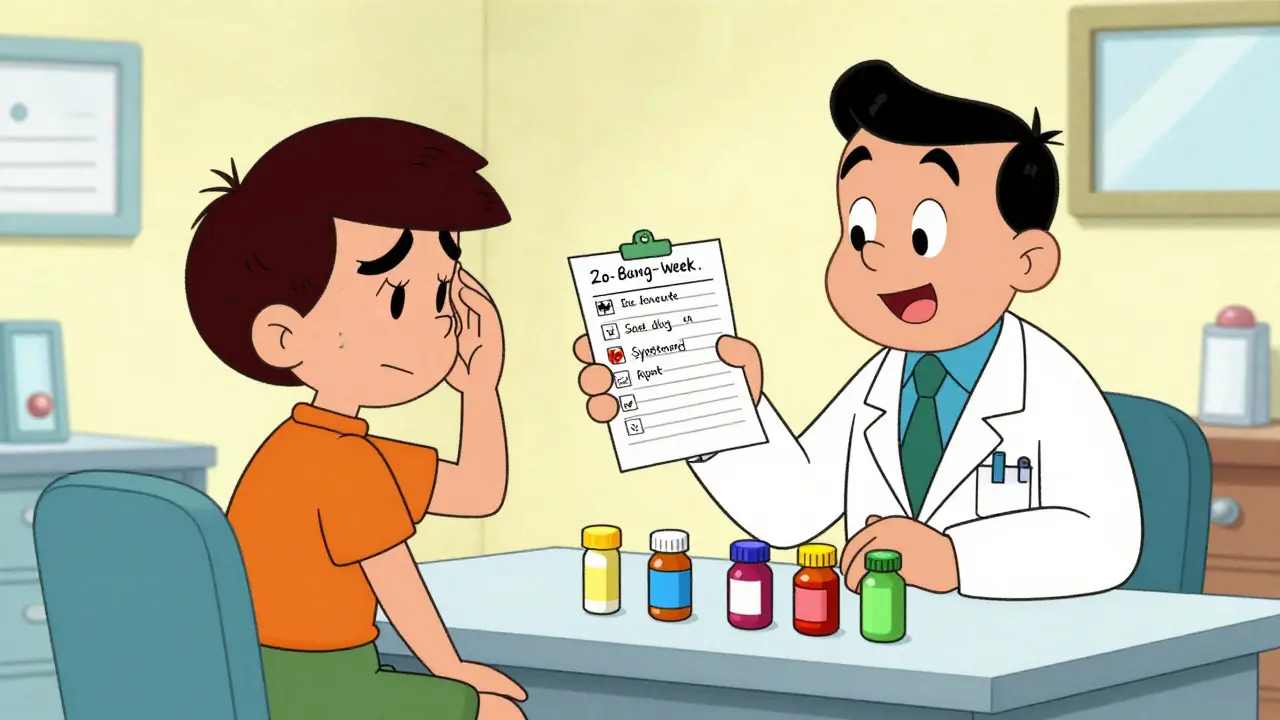
If a medication isn’t helping-or worse, it’s making things worse-you’re not alone. About one in four people stop taking their prescribed drugs because they don’t feel any better. But instead of quitting on your own, you can take control. The right conversation with your doctor can lead to a better solution. You don’t need to be pushy. You just need to be clear, prepared, and honest.
Start by Tracking What’s Really Happening
Don’t just say, “This medicine isn’t working.” That’s too vague. Your doctor needs details. Write down:- When you take the medicine (time of day, with or without food)
- What symptoms you still have (e.g., “My headaches happen every afternoon, even after taking the pill”)
- Any new side effects (dizziness, nausea, sleepiness, mood changes)
- How long you’ve been on it (and if it ever helped at all)
A 2022 study from University Health found that patients who brought a two-week symptom log to their appointment were 68% more likely to have their concerns taken seriously. One Reddit user, ChronicPainWarrior, shared that bringing a simple chart showing pain levels before and after medication led to an immediate switch to a more effective drug.
Bring Your Actual Medication Bottles
Don’t rely on memory. Bring every pill, supplement, and over-the-counter product you’re taking-even the ones you only use once in a while. This includes:- Prescription drugs
- Vitamins and herbal supplements
- Antacids, pain relievers, sleep aids
Why? Because interactions matter. A 2022 study showed that patients who brought their physical bottles to appointments reduced medication errors by 22%. Your doctor might spot a conflict you didn’t even know about-like how a common antacid can block absorption of your heart medication.
Ask These Specific Questions
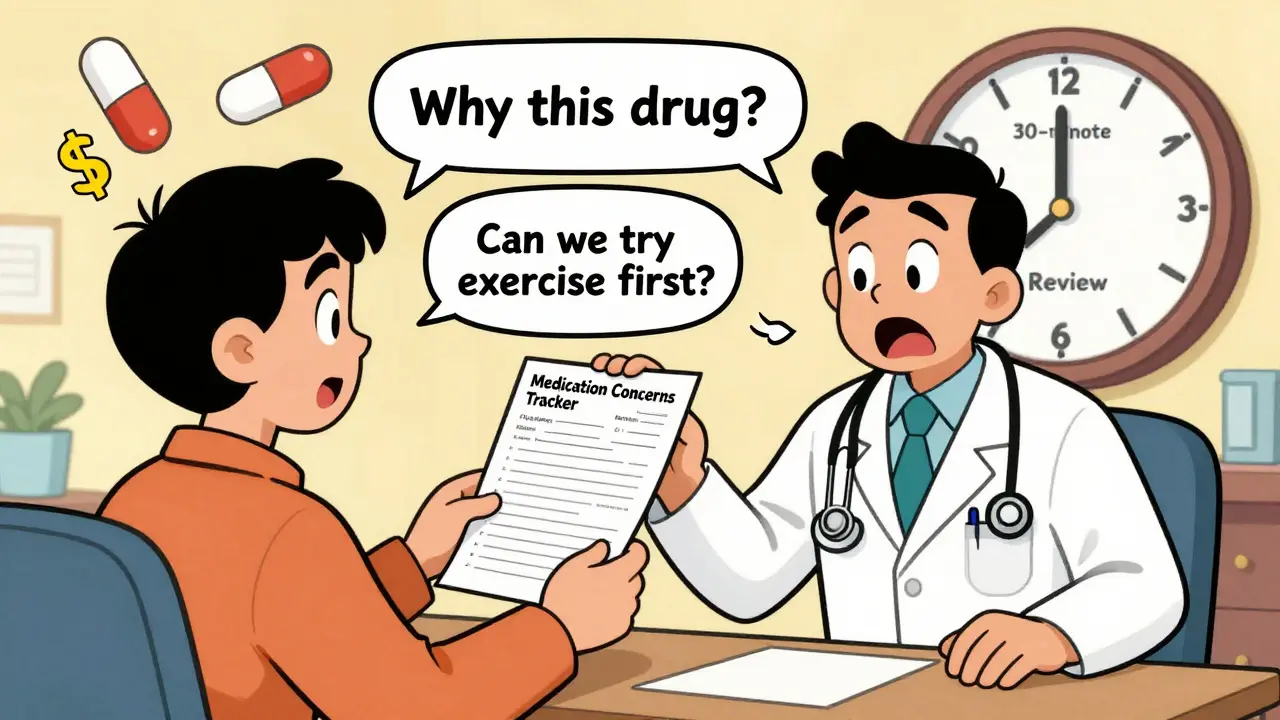
Prepare a short list of questions. Don’t wait for your doctor to bring it up. Say something like:- “Why am I taking this medication?” - Sometimes, you’re on a drug just because it was prescribed years ago and never reviewed.
- “What are the alternatives?” - There might be another pill, a different class of drug, or even a non-drug option.
- “What are the pros and cons of each option?” - You need to weigh side effects, cost, and how it fits your lifestyle.
- “Can I stop or reduce this dose?” - Not all medications need to be taken forever.
- “Would a different medication cause fewer side effects?” - Especially if you’re feeling worse, not better.
Harvard Health Publishing says asking “Why was this chosen for me?” helps you understand if the treatment matches your goals. For example, if you’re on an anxiety medication but your main concern is social situations-not sleep-you need a different approach.
Ask About Non-Medication Options
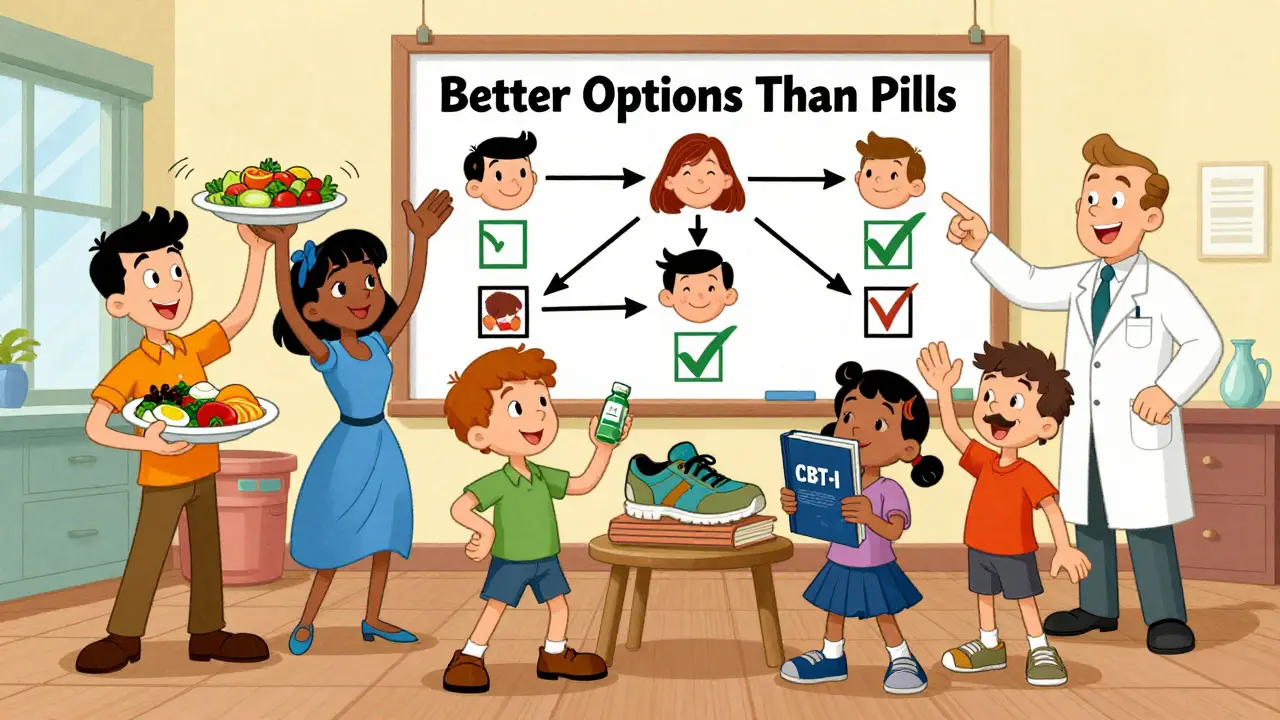
Medication isn’t the only path. Many conditions respond just as well-or better-to lifestyle changes:- For acid reflux: Losing 5-10% of body weight and avoiding late-night meals helped 55% of patients avoid proton-pump inhibitors altogether, according to the American Journal of Gastroenterology (2023).
- For type 2 diabetes: A 2022 study in Diabetes Care found that regular exercise, healthy eating, and weight loss matched metformin’s effectiveness in nearly 70% of cases.
- For insomnia: Cognitive behavioral therapy for insomnia (CBT-I) worked just as well as sleeping pills after 8 weeks, with fewer side effects and longer-lasting results (JAMA Internal Medicine, 2021).
- For back pain: Exercise, physical therapy, and acupuncture gave the same pain relief as NSAIDs for 61% of patients-with no stomach or heart risks (American College of Physicians, 2023).
These aren’t “alternative therapies.” They’re evidence-backed treatments. Ask your doctor: “Could I try one of these before switching to another drug?”
Bring Up Cost and Accessibility
If a medication isn’t working and it’s expensive, you’re stuck between two bad choices: keep paying or stop taking it. Don’t be embarrassed to say:- “Is there a generic version?”
- “Is there another drug that works the same but costs less?”
- “Can you help me find a patient assistance program?”
AARP reports that 62% of patients who asked about cheaper alternatives were offered a similar, lower-cost option. Some pharmacies even have $4 generic lists for common medications like statins or blood pressure pills.
Request Written Instructions
If your doctor suggests a change, ask for it in writing. A MedlinePlus survey found that patients who received written instructions understood their new regimen 40% better than those who only got verbal advice. Even a simple note with:- Drug name
- Dosage
- When to take it
- What to watch for
can prevent mistakes. Many patient portals now let you download your medication list after appointments. Use it.
Don’t Wait for Your Next Appointment
A 2022 JAMA Network Open study found that 32% of patients waited until their next scheduled visit to mention medication problems-even if they’d been feeling worse for weeks. That’s dangerous.If you’re having side effects or your condition is getting worse, call your doctor’s office. Ask if you can:
- Schedule a dedicated 30-minute “medication review” visit
- Talk to a pharmacist (many clinics have one on staff)
- Use your patient portal to send a message with your symptom log
Medicare now reimburses providers for 30-minute medication management sessions (CPT codes 99487-99489). That means your doctor has both the time and the incentive to have this conversation.
What If Your Doctor Dismisses You?
Some patients report feeling brushed off. One Healthline survey found that 41% felt dismissed when asking for alternatives. If this happens:- Ask: “Can you explain why you think this is still the best option?”
- Request a referral to a specialist or a pharmacist who does medication reviews.
- Consider a second opinion. You have the right to one.
Dr. Barbara Farrell, co-founder of the Deprescribing Network, says patients who actively participate in medication reviews are 3.2 times more likely to safely stop unnecessary drugs. You’re not being difficult-you’re being smart.
Use Tools to Stay Organized
Epic Systems launched “MyMedList” in late 2023, letting patients log concerns directly into their electronic health record before appointments. If your clinic uses this system, use it. Even if they don’t, you can create your own simple tracker:| Medication | Why I’m Taking It | How I Feel After | Side Effects | Cost per Month |
|---|---|---|---|---|
| Metformin | For type 2 diabetes | Energy improved, but bloating | Stomach cramps, diarrhea | $12 |
| Atorvastatin | For high cholesterol | No change in symptoms | Muscle aches | $15 |
This kind of tool helped 78% of patients in a Deprescribing Network trial feel more confident during consultations.
The Bigger Picture: You’re Part of the Team
Healthcare isn’t a one-way street. The American Medical Association, the National Institute on Aging, and the Patient-Centered Medical Home model all agree: treatment decisions must include your voice. When you understand your options, you’re 35% more likely to stick with them. And when you speak up, you’re not just helping yourself-you’re helping doctors improve care for everyone.Medication isn’t magic. It’s a tool. And like any tool, it only works if it fits the job. If it doesn’t, ask for another one. You’ve earned that right.
What if my medication is working but has bad side effects?
Side effects matter just as much as effectiveness. If you’re having dizziness, fatigue, or stomach issues, tell your doctor. Many medications have alternatives with fewer side effects. For example, if a blood pressure drug causes a dry cough, switching to a different class (like a calcium channel blocker) often solves it. Don’t suffer silently-there’s usually a better option.
Can I stop my medication on my own if it’s not working?
No. Stopping some medications suddenly can cause serious problems-like rebound high blood pressure, seizures, or worsening anxiety. Even if you think it’s not helping, talk to your doctor first. They can help you taper off safely or switch to something else. Never stop without medical guidance.
Is it worth asking about genetic testing for medications?
Yes-if you’ve tried several drugs that didn’t work or caused bad reactions. Pharmacogenomic testing looks at your genes to predict how your body will respond to certain medications. It’s not perfect, but it helps identify which drugs are more likely to work or cause side effects. Studies show it improves outcomes for 57% of patients. Ask if your doctor offers it or can refer you to a specialist who does.
How do I know if I’m on too many medications?
If you’re taking five or more medications regularly, you’re at higher risk for interactions and side effects. Ask your doctor: “Which of these are still necessary?” The American Geriatrics Society’s Beers Criteria lists 34 medications that pose higher risks for older adults-especially those affecting memory or balance. A medication review can help you safely stop drugs you no longer need.
What if my doctor says there are no alternatives?
That’s rarely true. Ask: “Can you explain why there are no other options?” Sometimes it’s because the doctor isn’t aware of newer choices. Request a referral to a specialist-like a cardiologist, neurologist, or pain management expert-who might have more tools. You can also ask for a consultation with a clinical pharmacist, who specializes in medication alternatives and safety.
Joseph Cooksey
February 5, 2026 AT 01:58Look, I’ve been on seven different SSRIs over the last decade, and let me tell you-most docs treat you like a vending machine. You press A3 and you get Zoloft. No thought. No curiosity. I brought a color-coded spreadsheet with my sleep cycles, mood swings, and coffee intake, and my psychiatrist actually paused. Said, ‘I’ve never seen this level of detail.’ Switched me to vortioxetine. My anxiety didn’t vanish, but now I can hold eye contact without wanting to scream into a pillow. Document everything. Even the weird stuff. Like that time you cried during a puppy video and thought, ‘Wait, why did that happen?’ That’s data. That’s power.
And don’t even get me started on supplements. I was taking ashwagandha ‘for stress’ while on propranolol. Turns out, it tanks your BP. Almost passed out at the grocery store. Your body isn’t a puzzle with one missing piece-it’s a goddamn symphony, and every pill’s a different instrument. Don’t assume the doc knows the whole score. Bring the sheet music.
Also, if your doctor says ‘it’s just side effects,’ ask them if they’d take it themselves. I did. They didn’t answer. That’s when I knew I needed a new doctor.
Stop being polite. Start being precise. You’re not being difficult-you’re being the only one who’s actually paying attention.
And yes, I still track my meds in Excel. And yes, I have a named tab called ‘Dr. Who Forgot My Name.’
Sherman Lee
February 5, 2026 AT 14:04They’re watching you. 🕵️♂️
Ever wonder why they push the same meds over and over? Big Pharma owns the algorithms. Your EHR? It’s not just a record-it’s a profile. Every time you say ‘it’s not working,’ they tag you as ‘non-compliant’ or ‘difficult.’ Then they upsell you to the next expensive brand-name drug because the algorithm thinks you’ll pay. I’ve seen it. My cousin got prescribed gabapentin for ‘anxiety’-but he doesn’t even have anxiety. He has chronic back pain. They didn’t care. They just wanted the script to go through.
And don’t get me started on the ‘$4 generic’ lie. The $4 is for the 10mg. The 50mg? $120. They hide the real cost. Your doc knows. They just don’t care.
Bring your bottles? Good. But also screenshot your pharmacy receipts. And if they say ‘no alternatives,’ ask for the FDA’s MedWatch report on that drug. See how many black box warnings they buried.
They don’t want you to know. But now you do. 🧠💣
Lorena Druetta
February 5, 2026 AT 20:00I just want to say how incredibly important this is. So many people feel alone when they’re struggling with medication side effects, and it’s not their fault. You are not weak for asking for help. You are brave. I’ve been there-on a medication that made me feel like a zombie, too afraid to speak up because I didn’t want to seem ‘ungrateful.’ But when I finally did, my doctor didn’t judge. She said, ‘Thank you for telling me.’ That’s the kind of care we all deserve.
Bring your bottles. Write it down. Ask the questions. You are not a burden. You are a partner in your health. And if your doctor doesn’t see you that way? Find one who does. You’ve earned it.
With so much love and respect,
Lorena
Coy Huffman
February 6, 2026 AT 09:54man i used to just take whatever they gave me till i got so dizzy i thought i was gonna fall outta my chair
then i started writing down what i ate before i took the pill, how much sleep i got, even if i had a fight with my sister that day
turns out, the meds weren't the problem-it was the grapefruit juice i was drinking with breakfast
doc was like 'wait you drink grapefruit juice with this?' like i'd just confessed to a crime
so yeah, dumb stuff matters. your body's a weird machine. treat it like a car you're trying to fix with duct tape and hope
also-ask about the 'why' like they said. i was on a blood thinner for 3 years because my grandpa had a clot. i never had one. i never asked. dumb move.
now i'm off it. and my liver thanks me.
Kunal Kaushik
February 8, 2026 AT 03:19bro this is so true. i was on sertraline for 2 years, felt like a ghost. didn’t say anything because i thought ‘maybe it’s just me.’ then i brought my sleep log and said ‘i haven’t felt awake since 2022.’ doc switched me to bupropion in 10 mins.
also-i started walking 20 mins a day. not because it’s ‘holistic’-but because i was tired of crying in the shower.
side note: if your doc says ‘it’s just depression’ and doesn’t ask about your job, your rent, your family… find a new doc. mental health isn’t a pill. it’s a life.
and yeah, bring the bottles. even that random melatonin you take once a month. they’ll notice.
you got this. 🙌
Nathan King
February 10, 2026 AT 01:34While the sentiment expressed herein is commendable, one must exercise caution in conflating anecdotal evidence with evidence-based medicine. The cited studies, while statistically significant, often suffer from small sample sizes and lack of longitudinal follow-up. Furthermore, the assertion that lifestyle interventions are ‘just as effective’ as pharmacotherapy for conditions such as type 2 diabetes is misleading without qualification: efficacy is contingent upon patient adherence, baseline metabolic health, and socioeconomic access to healthy food and exercise infrastructure. One cannot assume universal applicability where structural inequities persist. The role of the physician remains that of a gatekeeper to validated therapeutic modalities-not a concierge for wellness influencers. That said, the principle of shared decision-making is, indeed, ethically sound and aligned with contemporary medical ethics frameworks.
-N. King, MD, PhD (Columbia)
Wendy Lamb
February 11, 2026 AT 14:56Bring the bottles. Write it down. Ask the questions.
That’s it. That’s the whole guide.
Don’t overthink it. Just do it.
You’re not asking for a favor. You’re asking for your health.
And you deserve it.
Antwonette Robinson
February 13, 2026 AT 02:29Oh wow, a whole article about ‘how to ask nicely’ when you’re being ignored by doctors who treat you like a walking insurance claim.
Let me guess-you also brought a PowerPoint with pie charts and a printed copy of your birth certificate?
Newsflash: If your doctor doesn’t listen to you after you say ‘this isn’t working,’ it’s not your communication skills. It’s their laziness. Or their paycheck. Or their fear of liability.
And yes, I know someone who asked for alternatives. Got a referral to a specialist. Then the specialist said, ‘We don’t have time for this.’
So you know what? I stopped asking. I just Googled ‘what if I stopped this pill’ and weaned off cold turkey. Still alive. Still sane. Still not impressed by ‘evidence-based’ jargon.
Doctors aren’t wizards. They’re overworked. And you? You’re the only one who’s actually living your body.
Good luck.
Ed Mackey
February 13, 2026 AT 04:18hey i just wanted to say thanks for this. i read it last night and brought my meds to my appt today. i had a 30-min slot for ‘med review’-never even knew that was a thing.
doc looked at my list and said ‘oh wow, you’ve been on this for 7 years?’ i said ‘yeah, i thought i had to.’ he said ‘nope. we can stop it.’
we cut out one med today. gonna taper the other in 2 weeks.
i didn’t know i could do that.
thank you. really.
ps: i spelled ‘medication’ wrong in my notes. i hope that’s okay.
Demetria Morris
February 13, 2026 AT 22:17It’s so irresponsible to encourage people to just ‘ask for alternatives’ without understanding the risks. Some medications are prescribed for life-saving reasons. If you’re on blood thinners, anticonvulsants, or immunosuppressants, you don’t get to treat your body like a Netflix show you can binge and then quit because you ‘don’t feel like it.’
People who skip meds because they ‘feel fine’ end up in the ER. Or worse.
And don’t get me started on ‘natural remedies.’ I had a neighbor stop her statin because ‘turmeric is better.’ She had a heart attack at 52.
This article reads like a wellness blog written by someone who’s never had a real medical emergency.
Don’t be reckless. Trust your doctor. If you’re still unsure, get a second opinion-but don’t self-diagnose with Google and a CBD tincture.
Prajwal Manjunath Shanthappa
February 15, 2026 AT 11:43Let us not forget the fundamental epistemological flaw inherent in the very premise of this article: the assumption that the patient possesses sufficient cognitive, linguistic, and epistemic capital to navigate a system explicitly designed to obfuscate, commodify, and depersonalize care. The notion that ‘bringing bottles’ or ‘tracking symptoms’ is a sufficient act of resistance is, frankly, bourgeois delusion. In a healthcare landscape where the average visit lasts 7.3 minutes, and where 89% of prescribing decisions are influenced by pharmaceutical detailing, the burden of documentation is not empowerment-it is exploitation.
Moreover, the romanticization of ‘lifestyle interventions’ ignores the material reality that 37% of Americans cannot afford fresh produce, let alone cognitive behavioral therapy sessions priced at $150/hour.
This is not a conversation about communication. It is a conversation about power. And power does not yield to polite questions.
-Prajwal, PhD (Harvard, Dept. of Critical Medical Humanities)
Joseph Cooksey
February 16, 2026 AT 17:24Re: @7440 - You’re right. It’s not about being polite. It’s about being relentless.
I didn’t just bring my bottles. I printed out the FDA’s black box warnings for each drug and highlighted the ones that matched my symptoms. I handed it to my doc like a subpoena.
She sighed. Said, ‘You’re the third person this week to do this.’
I said, ‘Good. That means I’m not crazy.’
She switched me the next day.
So yeah. It’s a system designed to crush you.
But you? You’re the glitch in the algorithm.
Keep glitching.