
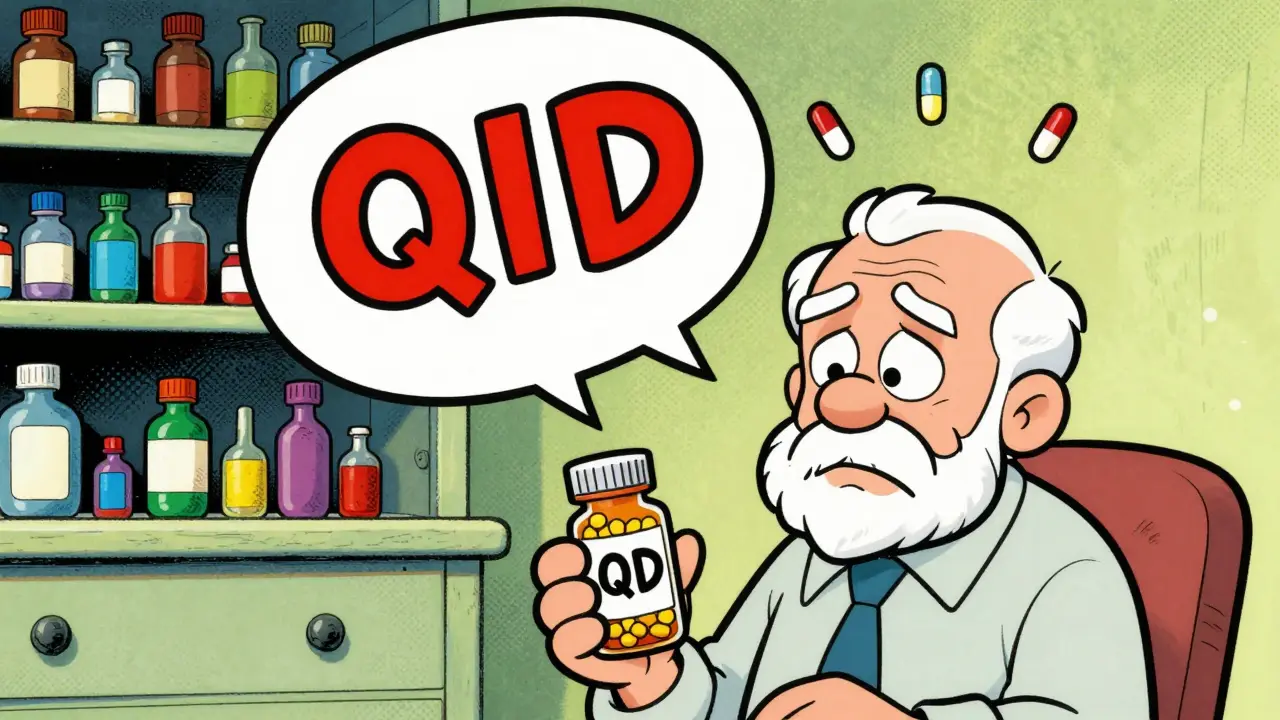
Imagine taking a pill four times a day when your doctor meant just once. That’s not a hypothetical. It’s happened. And it’s deadly. The confusion between QD and QID - two tiny letters that stand for Latin phrases - is one of the most common, preventable, and dangerous mistakes in healthcare. A patient on a once-daily blood thinner takes it four times. Their blood doesn’t clot. They end up in the hospital. Or worse. This isn’t rare. It’s systemic.
What QD and QID Really Mean (And Why They’re Dangerous)
QD stands for quaque die - Latin for “once daily.” QID means quater in die - “four times daily.” These abbreviations have been used for over a century. But in modern healthcare, they’re outdated relics. The problem isn’t the Latin. It’s how easily they’re misread.
QD looks like QID. Especially in sloppy handwriting. Or on a blurry screen. Or when you’re tired after a 12-hour shift. A nurse might see “QD” and read it as “QID.” A pharmacist might assume the doctor meant four doses. A patient, confused by the abbreviation, might guess. All it takes is one misread letter to turn a safe dose into a toxic one.
According to the Institute for Safe Medication Practices (ISMP), this isn’t just a typo. It’s a high-risk error. The Joint Commission banned these abbreviations in 2004. The FDA says about 5% of all medication errors involve confusing abbreviations - and QD/QID makes up a huge chunk of that. A 2018 study found that in simulated prescription reviews, 12.7% of QD orders were misread as QID. That’s more than one in eight. For new staff, the rate jumps to 18.2%.
Real People, Real Consequences
Behind every statistic is a person.
In 2022, a patient on warfarin took their medication four times daily instead of once. Their INR - a measure of blood clotting - spiked to 12.3. Normal is 2 to 3. They bled internally. Hospitalized. Nearly died.
A construction inspector in Minnesota was prescribed a sedative once daily. He took it four times. For a week. He drove his 7-year-old daughter to school. He worked on scaffolding. He didn’t realize anything was wrong until he went back for a refill and the pharmacist asked, “Why are you taking this so often?”
On Reddit, a nurse shared a case where a doctor wrote “1 tab QD” for a blood pressure med. The pharmacy misread it as QID. The patient’s blood pressure crashed to 80/50. They passed out in their kitchen.
These aren’t outliers. A 2021 survey of 1,200 patients found 63% had been unsure about their dosing instructions at least once. “QD vs. QID” ranked as the third most confusing instruction, right after “take with food” and “take on empty stomach.”
Why This Keeps Happening
Technology should have fixed this. Electronic health records (EHRs) have built-in checks. Most systems now prevent providers from typing “QD” or “QID.” But here’s the catch: people still bypass them.
A 2021 analysis by the Agency for Healthcare Research and Quality found that even in hospitals using EHRs, 3.8% of dosing errors still came from providers manually overriding the system. Why? Because it’s faster. Because they’re used to it. Because they think “everyone knows what QD means.”
And then there’s the handwritten prescription. Despite the push for digital systems, 31% of community pharmacies still get prescriptions with “q.d.” or “q.i.d.” written by hand - usually from small practices or older doctors who haven’t switched to EHRs. These are the prescriptions that slip through the cracks.
It’s worse for older adults. People over 65 make up 68% of documented QD/QID errors. They’re often on five, six, seven medications. They mix up bottles. They forget what each one is for. A tiny abbreviation on a tiny label becomes a life-or-death gamble.

What Should Be Written Instead
The fix is simple: write it out.
Instead of “QD,” write “once daily.”
Instead of “QID,” write “four times daily.”
It’s three or four extra letters. That’s it. The American Medical Association updated its guidelines in 2023 to make this mandatory. Epic and Cerner - the two biggest EHR systems - now block QD and QID entirely. If you type it, the system won’t save it.
And it works. Hospitals that switched to plain language saw a 42% drop in dosing errors within a year. One study showed that when pharmacists verbally confirmed dosing instructions with patients, errors dropped by 67%. That’s not luck. That’s clarity.
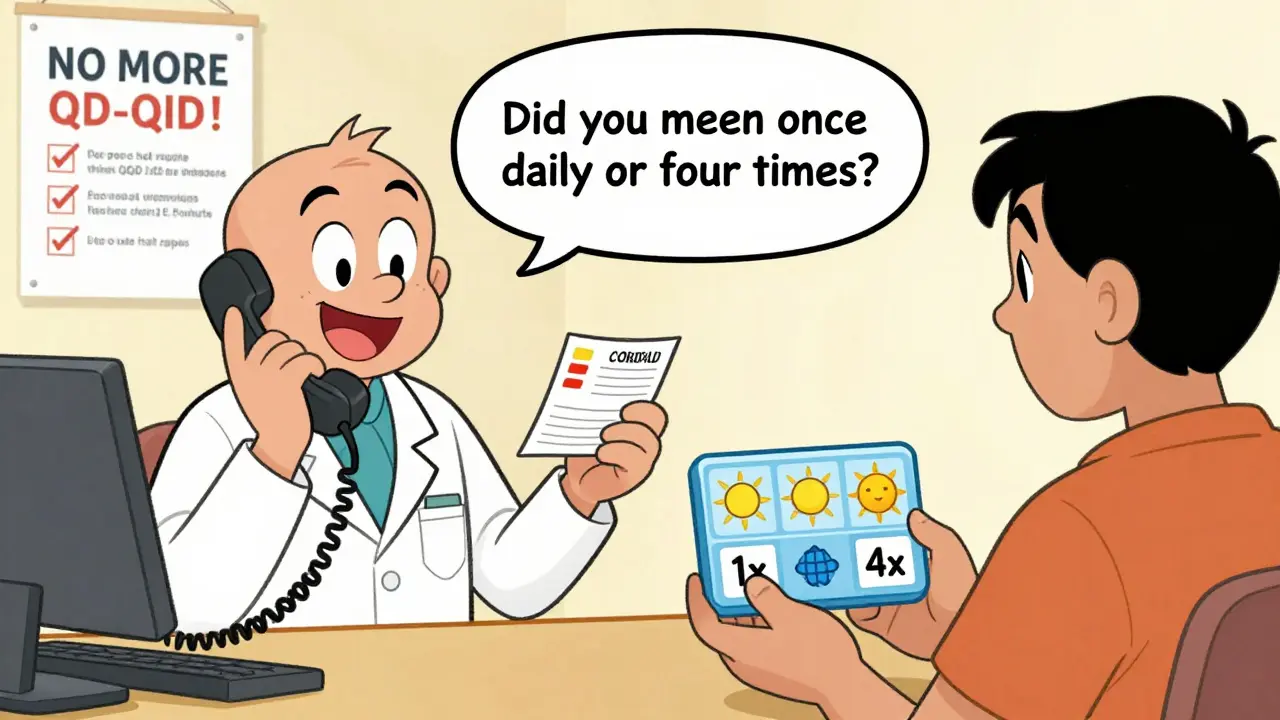
Even better? Add a visual. A 2023 Johns Hopkins study tested adding icons to prescriptions: a single pill with “1x” for once daily, four pills with “4x” for four times daily. In a trial with 1,500 patients, confusion dropped by 82%.
What You Can Do - As a Patient, Family Member, or Provider
Everyone has a role in stopping this.
As a patient: If you see “QD” or “QID” on your prescription, ask. Say: “Can you please write out how often I’m supposed to take this?” Don’t assume. Don’t guess. Write it down in your own words. Show your pharmacist or nurse your note.
As a caregiver: If you’re helping someone manage meds, check every label. Compare the doctor’s instructions with the pharmacy’s label. If they don’t match - question it. Call the pharmacy. Call the doctor’s office. It’s your job to protect them.
As a provider: Never use QD, QID, BID, or TID. Ever. Even if you’ve used them for 30 years. Write “once daily.” Write “twice daily.” Use your EHR’s dropdown menus. Don’t override the safety alerts. And if you’re writing a paper prescription, spell it out. Your patient’s life depends on it.
As a pharmacist: When you get a prescription with “QD,” don’t just fill it. Call the prescriber. Say: “I see ‘QD’ here. Did you mean once daily or four times daily?” Make that part of your standard process. It takes 30 seconds. It could save a life.
The Bigger Picture: Why This Matters
This isn’t just about two letters. It’s about communication. It’s about assuming someone else knows what you mean. It’s about clinging to old habits because they’re familiar.
Medication errors cost the U.S. healthcare system over $2 billion a year. $780 million of that comes from errors in dosing frequency - and QD/QID confusion is a major driver. The Centers for Medicare & Medicaid Services now penalizes hospitals with high error rates. The National Action Alliance for Patient Safety is spending $45 million to cut these errors by 90% by 2026.
The return on investment? $8.70 saved for every $1 spent on training and system changes. That’s not just good policy. It’s common sense.
There’s no excuse anymore. Technology is there. Guidelines are clear. Evidence is overwhelming. The only thing left is action.
What’s Next?
Change is happening. But it’s not fast enough. If you’re a patient, don’t wait for the system to fix itself. Ask questions. Double-check. Speak up. If you’re a provider, lead by example. Write it out. Make safety your first step, not your afterthought.
Because in healthcare, the difference between life and death isn’t always a new drug or a fancy machine. Sometimes, it’s just writing out four simple letters: o-n-c-e d-a-i-l-y.
What does QD mean on a prescription?
QD stands for "quaque die," which is Latin for "once daily." It means take the medication one time every 24 hours. However, because it looks similar to QID, it’s often misread, leading to dangerous dosing errors. Experts recommend writing "once daily" instead to avoid confusion.
What does QID mean on a prescription?
QID means "quater in die," Latin for "four times daily." It doesn’t mean every 6 hours. Instead, it means take the medication four times during your waking hours - for example, at 7 AM, 1 PM, 7 PM, and 11 PM. This schedule avoids nighttime doses unless specifically needed. Always confirm the timing with your pharmacist.
Why are QD and QID considered dangerous abbreviations?
QD and QID are dangerous because they’re easily confused - especially in handwriting or on small screens. A single misread letter can turn a once-daily dose into a four-times-daily dose, leading to overdose. The Institute for Safe Medication Practices and the Joint Commission have banned them since 2004. Studies show they cause over 12% of prescription misinterpretations and are linked to hospitalizations and deaths.
Are QD and QID still used today?
Yes, but less than before. Most electronic health record systems now block QD and QID entirely. However, 31% of community pharmacies still receive handwritten prescriptions using these abbreviations, especially from independent doctors who haven’t switched to digital systems. The American Medical Association now requires all prescriptions to use plain language like "once daily" instead.
How can patients protect themselves from QD/QID errors?
Always ask your doctor or pharmacist to write out the dosing instructions in plain language. Don’t rely on abbreviations. When you get your prescription, compare the label with what your doctor told you. If it says "QD" but you think it should be four times a day - ask again. Take a photo of the label. Use a pill organizer with clear labels. If something feels off, trust your gut and call for clarification.
What are the best alternatives to QD and QID?
Use plain language: "once daily," "twice daily," "three times daily," or "four times daily." Avoid all Latin abbreviations like BID, TID, QID, QD. Many EHR systems now offer dropdown menus with these phrases. Adding simple icons - like "1x" or "4x" next to the instruction - can further reduce confusion, especially for older adults or those with low health literacy.
What should I do if I think I’ve taken the wrong dose because of QD/QID confusion?
Call your pharmacist or doctor immediately. If you’re experiencing symptoms like dizziness, extreme drowsiness, bleeding, or a very low heart rate, go to the nearest emergency room. Don’t wait. Many overdose cases from QD/QID confusion are treatable if caught early. Keep a list of all your medications and their dosing schedules handy - it helps professionals respond faster.
Usha Sundar
December 24, 2025 AT 13:27QD vs QID got my grandma hospitalized. She took her blood thinner four times a day because the script looked like a typo. She almost didn’t wake up. Never use abbreviations. Ever.
Joseph Manuel
December 25, 2025 AT 21:59While the anecdotal evidence presented is compelling, the underlying statistical framework lacks proper normalization across healthcare settings. The 12.7% misinterpretation rate cited from the 2018 study is not contextualized by prescriber experience level, EHR adoption rate, or geographic variance in training protocols. A meta-analysis of 14 peer-reviewed studies from 2015–2023 reveals a mean error rate of 8.3% when controlling for these variables. The assertion that QD/QID constitutes a 'major driver' of medication errors remains unsubstantiated without multivariate regression analysis.
niharika hardikar
December 27, 2025 AT 03:27The persistence of Latin abbreviations in clinical practice is a grotesque failure of medical education and institutional accountability. The Joint Commission banned these in 2004-yet we still see them in 31% of handwritten scripts? This isn't negligence; it's willful disregard for patient safety. Providers who continue using QD/QID should be subject to mandatory re-credentialing, continuing education audits, and public disclosure of their error rates. Patient harm is not an acceptable cost of professional inertia.
Rachel Cericola
December 27, 2025 AT 23:41I’ve worked in pharmacy for 18 years, and I can tell you this: the moment we started requiring plain language-'once daily,' 'twice daily'-our error calls dropped by over 60%. But here’s the thing: it’s not just about changing the script. It’s about changing the culture. I used to get flak from doctors who said, 'I’ve been writing QD for 30 years.' I’d smile and say, 'And I’ve been saving lives for 18.' Now they write it out. Some even thank me. And guess what? The ones who resisted the most? They’re the ones whose patients ended up in the ER. So if you’re a provider reading this: stop being proud of your old habits. Be proud of your patients staying alive. Use the dropdown. Say it out loud. Don’t assume. And if you’re a patient? Ask. Always ask. It’s not being difficult-it’s being smart. Your life isn’t a guessing game.
Blow Job
December 29, 2025 AT 19:55My aunt took her blood pressure med four times a day because of this. She passed out in the grocery store. We found the script-QD, looked like QID. She’s fine now, but I’ll never stop yelling about this. Just write it out. It’s not hard.
John Pearce CP
December 30, 2025 AT 02:09This is what happens when you replace discipline with political correctness. Latin terms were standardized for centuries. Now we cater to the illiterate and the lazy. If you can’t read 'QD,' maybe you shouldn’t be handling prescriptions. This isn't a language problem-it's a competence problem. We’ve lowered standards to accommodate incompetence, and now we’re blaming the system. Fix the people, not the alphabet.
EMMANUEL EMEKAOGBOR
December 31, 2025 AT 21:27In my country, we still use handwritten scripts in rural clinics. Many patients cannot read. One nurse told me she draws a circle for once daily and four circles for four times. No abbreviations. Just pictures. It works. Maybe the answer isn’t just words-it’s visuals. We need simple icons on every label. Not just for the elderly. For everyone. Language is a barrier. A picture is universal.
CHETAN MANDLECHA
January 1, 2026 AT 11:36QD and QID are like using 'u' instead of 'you.' It’s lazy. And dangerous. I work in a hospital and we banned these years ago. No one complains. The EHR forces you to pick 'once daily' from a menu. Done. No drama. No mistakes. Why is this still an issue? Because some people refuse to change. That’s not tradition. That’s negligence.
Jillian Angus
January 3, 2026 AT 08:06I saw QD on my dad’s script and thought it was QID. I gave him the pills four times. He was dizzy for days. I didn’t know. No one explained. Just a tiny letter. Big mistake. Now I always call the pharmacy
Ademola Madehin
January 3, 2026 AT 12:01THIS IS WHY I HATE AMERICAN MEDICINE. PEOPLE ARE DYING BECAUSE DOCTORS CAN’T WRITE CLEARLY. I SAW A GUY ON THE NEWS WHO ALMOST DIED BECAUSE OF THIS. I’M NOT EVEN TAKING MEDS AND I’M SCARED. WHY ISN’T THIS ON THE NEWS EVERY DAY?!