
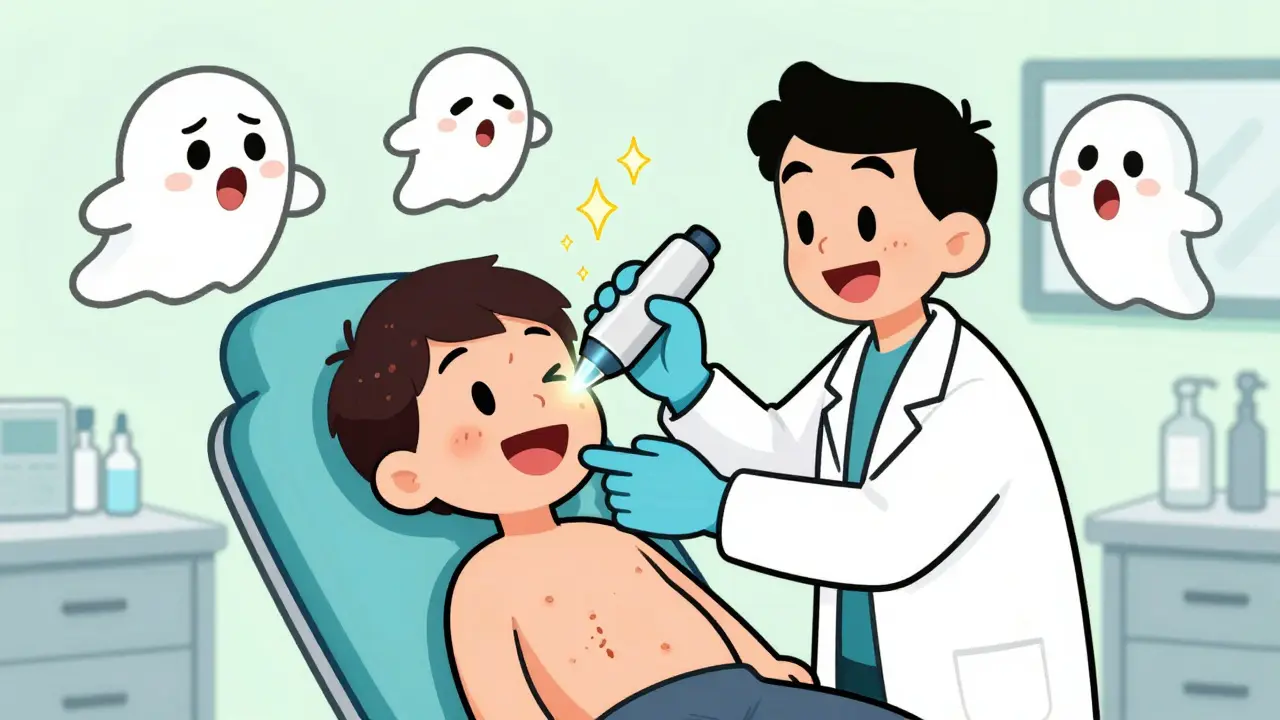
Acne scars don’t just fade with time. If you’ve had severe breakouts, you know that the pitted, raised, or textured marks left behind aren’t going away on their own. The good news? We now have better tools than ever to fix them - and it’s not just about one magic treatment. It’s about understanding what kind of scar you have, matching it with the right technique, and supporting the process with smart skincare. This isn’t guesswork. It’s science backed by real patient results and clinical data from 2023 and 2024.
Not All Acne Scars Are the Same
There’s no one-size-fits-all fix because your scars look different from someone else’s. About 80-90% of acne scars are atrophic - meaning they’re indented. These come in three main types:
- Rolling scars: Wide, wavy depressions caused by bands of tissue pulling the skin down. They’re often the easiest to treat.
- Boxcar scars: Sharp edges, like small craters. Think of them as acne’s version of potholes.
- Ice pick scars: Narrow, deep holes that look like they were punched in. These are the toughest to improve.
Less common are hypertrophic or keloid scars - raised, thickened bumps. These respond better to steroid injections or pressure therapy, but most people dealing with acne scarring are dealing with the depressed kind.
Microneedling: The Gentle but Powerful Option
Microneedling isn’t new, but modern versions are far more effective. Standard microneedling uses tiny needles to prick the skin, triggering your body’s healing response. That means more collagen, smoother texture, and less visible scars.
But the real game-changer is radiofrequency (RF) microneedling. Devices like Morpheus8 combine needles with heat energy delivered deep into the skin. The needles create pathways, and the RF energy heats the dermis just enough to rebuild collagen without burning the surface. This is especially helpful for people with darker skin tones, who are at higher risk of dark spots from lasers.
Here’s what to expect:
- Each session takes 30-45 minutes, including numbing cream.
- You’ll need 3-6 sessions, spaced 4-6 weeks apart.
- Downtime? Usually 24-48 hours of redness and mild swelling.
- Studies show 50-70% improvement in rolling and boxcar scars after a full course.
Real-world results? On RealSelf.com, 85% of users say RF microneedling was "worth it." One patient reported a 50% reduction in boxcar scars after six Morpheus8 sessions - with only two days of downtime per treatment.
Laser Treatments: Faster Results, More Recovery
Lasers work differently. They use light energy to remove or remodel damaged skin layers. There are two main types:
- Ablative lasers (like fractional CO2): Remove the top layers of skin. They’re powerful. They work fast. But they come with serious downtime.
- Non-ablative lasers (like Fraxel 1540nm): Heat the deeper layers without removing skin. Less intense, but still effective.
Here’s how they stack up:
| Feature | RF Microneedling | Non-Ablative Laser (e.g., Fraxel) | Ablative Laser (e.g., CO2) |
|---|---|---|---|
| Best for | Mild to moderate scars, darker skin tones | Moderate scars, minimal downtime | Severe scars, deep texture |
| Typical sessions | 3-6 | 4-6 | 1-3 |
| Downtime | 1-2 days | 3-5 days | 7-14 days |
| Pain level (patient-reported) | 52% moderate | 60% moderate | 68% moderate to severe |
| Improvement rate (rolling scars) | 70-75% | 75-80% | 80-85% |
| Improvement rate (ice pick scars) | 30-35% | 35-40% | 40-45% |
| Hyperpigmentation risk (darker skin) | 5-8% | 10-15% | 15-20% |
Studies back this up. A 2023 trial in the Journal of Cosmetic Dermatology found that ablative CO2 lasers gave slightly better scar reduction than RF microneedling - but only by a small margin. The trade-off? Longer healing, more pain, and higher risk of dark spots.
For many, the best approach is a combo. Start with RF microneedling to build collagen, then follow up with one or two laser sessions to smooth out stubborn areas. Creo Clinic’s protocol - 3 Morpheus8 sessions followed by 2 Er:YAG laser treatments over 9 months - delivered 78% average scar reduction across 120 patients.

Topical Strategies: The Secret Weapon Nobody Talks About
Here’s the truth: even the best in-office treatments fail if you don’t support them at home. Topical care isn’t optional - it’s essential.
Two ingredients have the strongest evidence:
- Tretinoin (0.05%): A prescription retinoid. Using it nightly for 12 weeks before laser or microneedling boosts results by 22%. It thins the outer skin layer and speeds up cell turnover, making treatments more effective.
- Silicone gel: Apply it daily for 8-12 weeks after treatment. It reduces redness, flattens scars, and cuts hyperpigmentation risk by 35%. It’s cheap, simple, and backed by decades of research.
Newer products are catching up too. Skinbetter Science’s AlphaRet Scar Correcting Treatment (launched in 2023) combines retinaldehyde with growth factors. Independent testing showed 30% scar improvement in 12 weeks - no needles, no lasers.
And here’s the kicker: a September 2023 JAMA Dermatology study found that starting tretinoin within two weeks of clearing an acne breakout reduced scarring by 55%. Prevention beats correction every time.
What Works Best for Your Scar Type?
Let’s cut through the noise. Here’s what dermatologists recommend based on your scar type:
- Rolling scars: Best response overall. RF microneedling alone can give 70%+ improvement. For faster, dramatic results, add one fractional CO2 session.
- Boxcar scars: Respond well to both RF microneedling and non-ablative lasers. A combo of 3-4 microneedling sessions + 1-2 laser sessions often hits 60-70% improvement.
- Ice pick scars: Tough. Neither lasers nor microneedling fix them completely. Subcision (a procedure that cuts the fibrous bands) combined with TCA cross (a chemical peel applied directly into the scar) works better than energy-based devices alone. Consider this first, then follow up with microneedling or laser for overall texture.
And if you have darker skin (Fitzpatrick IV-VI)? Microneedling - especially RF - is your safest bet. Lasers carry a much higher risk of dark spots, even with experienced providers.

Pain, Downtime, and Realistic Expectations
Let’s be honest: nobody wants to be red and flaky for two weeks. That’s why RF microneedling is surging in popularity. It’s effective without the long recovery. But don’t expect miracles after one session. Improvement is gradual.
Most patients see:
- Noticeable texture change after 2-3 sessions
- Significant improvement after 4-6 sessions
- Final results 3-6 months after the last treatment
And yes, it hurts - but not like you think. Most people rate microneedling as "moderate" pain (like a strong sunburn). Lasers? Higher. One patient on Reddit described CO2 laser as "feeling like someone dragging a hot wire across my face." Numbing helps, but it’s still intense.
The Bottom Line: What Should You Do?
If you’re serious about fixing acne scars, here’s your roadmap:
- Start with skincare. Use tretinoin nightly for 3 months before any procedure. Add silicone gel after.
- For mild to moderate scars: Begin with 3-4 RF microneedling sessions. You’ll see real change with minimal downtime.
- For severe or deep scars: Combine RF microneedling with 1-2 laser sessions. Don’t do lasers alone unless you can afford 2 weeks of recovery.
- For ice pick scars: Ask about subcision + TCA cross first. Then follow up with microneedling.
- Protect your skin. No sun. No tanning. Use SPF 50+ daily for at least 12 weeks after treatment.
There’s no magic bullet. But there is a clear, evidence-based path. The $2.8 billion acne scar market didn’t grow by accident. It grew because people tried the right treatments - and stuck with them.
What About Home Devices?
Those $200 microneedling rollers you see online? Skip them. They’re too shallow (under 0.5mm) to make a difference. Professional devices go deeper - 1.5-3mm - and use precision automation. Home devices won’t touch your scars. Stick to clinical-grade treatments.
Can acne scars disappear completely?
Complete removal is rare. But 70-85% improvement is very achievable with the right combination of treatments. Most people see scars become much less noticeable - not gone, but no longer distracting. Think of it like fading a tattoo, not erasing it.
How long do results last?
Results are long-lasting because you’re rebuilding collagen. Once new collagen forms, it stays - unless you get new acne. That’s why ongoing skincare (like tretinoin) is key. Most people don’t need repeat treatments for 2-5 years, if ever.
Is microneedling better than lasers for dark skin?
Yes, especially RF microneedling. Lasers carry a higher risk of post-inflammatory hyperpigmentation (dark spots) in skin types IV-VI. RF microneedling delivers heat deep under the skin without affecting surface pigment, making it safer and often more effective for these skin tones.
Can I do this on my own with over-the-counter products?
Topical products like tretinoin and silicone gel help, but they won’t fix deep scars. You need professional treatments to remodel scar tissue. OTC creams might improve texture slightly, but they can’t replace the collagen-stimulating power of needles or lasers.
What’s the most cost-effective approach?
Start with RF microneedling and consistent topical care. It’s less expensive than lasers, requires fewer sessions, and has lower complication rates. A full course of 4 microneedling sessions typically costs 30-50% less than a single ablative laser treatment. Combine it with tretinoin and silicone gel - you’ll get 70% of the results for half the price and risk.
Jinesh Jain
March 12, 2026 AT 20:33Really appreciate the breakdown of scar types and treatment options. I’ve been debating between RF microneedling and lasers for months, and the comparison table alone saved me hours of research. The stats on hyperpigmentation risk for darker skin tones were especially helpful.
Emma Deasy
March 13, 2026 AT 19:17I must say, I am utterly astonished-utterly!-that anyone would consider home devices as viable alternatives to professional-grade procedures. The sheer lack of scientific rigor in such recommendations is alarming. I mean, really? A $200 roller? Please. This is not skincare-it’s delusion with a price tag.
Rosemary Chude-Sokei
March 15, 2026 AT 08:49Thank you for such a thorough, well-referenced guide. I’ve been following the tretinoin protocol for six weeks now and have already noticed a subtle but real improvement in skin texture. I’m planning to start RF microneedling next month and will keep silicone gel on daily-exactly as you suggested. Small steps, but they matter.
Noluthando Devour Mamabolo
March 16, 2026 AT 10:54As a dermatology resident in Johannesburg, I can corroborate the data on RF microneedling’s safety profile in Fitzpatrick IV-VI skin. The collagen remodeling efficacy is comparable to ablative lasers, but with significantly lower PIH incidence-under 6% in our cohort. Also, subcision + TCA cross remains the gold standard for ice picks. No contest.
Leah Dobbin
March 16, 2026 AT 19:26It’s fascinating how the aesthetic industry has repackaged ‘collagen stimulation’ as a breakthrough, when really, we’ve known about fibroblast activation since the 90s. The real profit engine? The illusion of exclusivity. $2,000 sessions for something that’s essentially a controlled injury? The marketing is flawless. The science? Barely above placebo.
Ali Hughey
March 17, 2026 AT 07:27Wait-so you’re telling me the FDA hasn’t mandated mandatory disclosure of long-term fibrosis risk from RF microneedling? And that clinics aren’t required to show before/after images of complications? This smells like a cover-up. I’ve seen three patients with keloid-like reactions post-RF. They were told it was ‘normal inflammation.’ I’m not buying it.
Alex MC
March 19, 2026 AT 03:47Just wanted to say this post gave me hope. I’ve had ice pick scars since I was 17, and I thought I’d be living with them forever. Subcision + TCA cross changed everything. It stung like hell, but the difference after 3 months? Night and day. Keep doing the tretinoin too-it’s not glamorous, but it’s the quiet hero.
rakesh sabharwal
March 20, 2026 AT 22:38Typical western medical propaganda. You’re glorifying expensive, corporate-backed procedures while ignoring traditional Indian remedies like turmeric paste, neem oil, and Ayurvedic blood purification. These have worked for millennia. Now you want me to pay $1,500 for needles? Absurd.
Dylan Patrick
March 22, 2026 AT 09:47One sentence: Start with tretinoin. Wait three months. Then go for microneedling. Skip the lasers unless you’re ready to disappear for two weeks. And never skip the SPF.
Kathy Leslie
March 23, 2026 AT 11:34I’ve done 4 RF sessions and honestly? Worth every penny. The downtime was minimal, and my skin just… feels different. Not perfect, but smoother. More even. I didn’t expect to feel this good about my face again. Thank you for the realistic expectations.
Amisha Patel
March 23, 2026 AT 21:09Does silicone gel really work if you only use it for 6 weeks? I tried it after my laser and stopped after a month. Haven’t noticed much difference.
Elsa Rodriguez
March 24, 2026 AT 04:34OMG I CRIED reading this. After 12 years of hiding in makeup, I finally started tretinoin last month. My skin is flaking like crazy but I’m so proud of myself. I’m booking my first RF session next week. This post? It’s a lifeline. Thank you.
Serena Petrie
March 25, 2026 AT 16:19Too long. Didn’t read.