
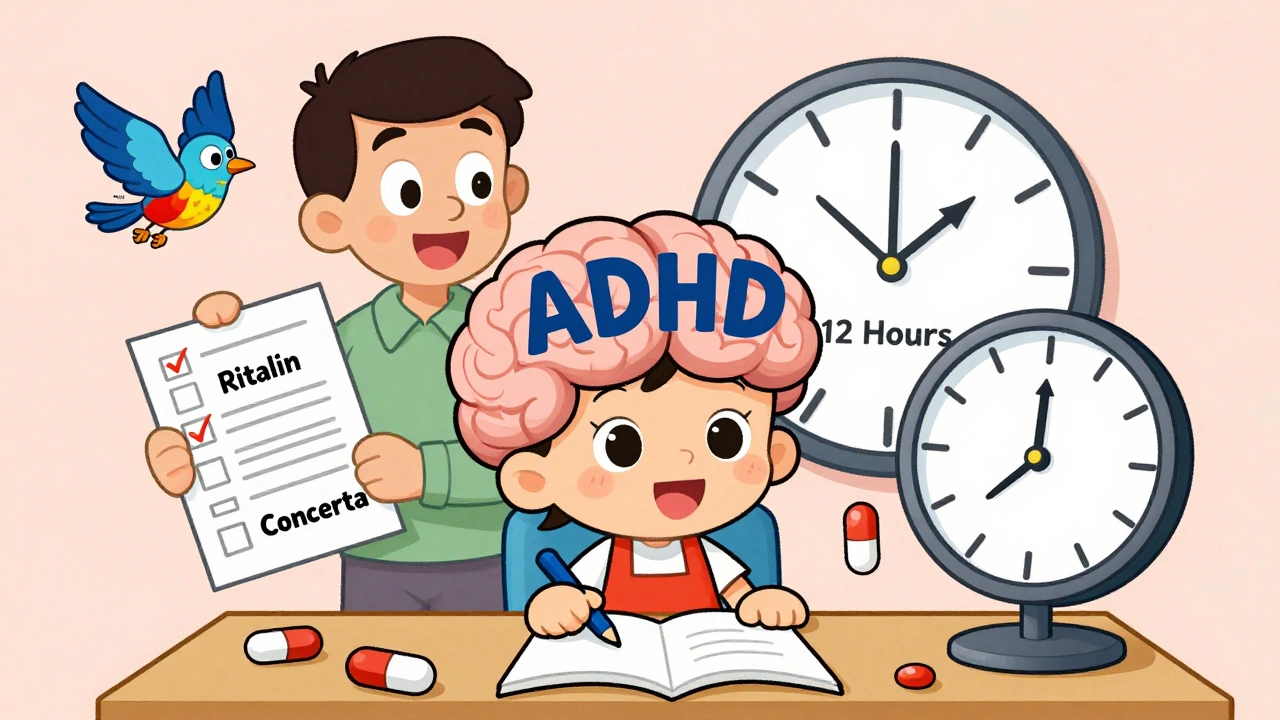
When you’re living with ADHD, the right treatment can make all the difference between feeling stuck and feeling in control. For many, it’s not just about taking a pill-it’s about building a system that works with your brain, not against it. Around 9.4% of U.S. children and a growing number of adults rely on a mix of medication and behavioral tools to manage symptoms. But with so many options, how do you know what’s right for you-or your child?
Stimulants: The Fast-Acting Gold Standard
Stimulants are still the most common first-line treatment for ADHD. About 70-80% of people who try them see clear improvements in focus, impulse control, and task completion. These medications don’t make you hyper; they help calm the overactive parts of your brain. How? They boost dopamine and norepinephrine in the prefrontal cortex-the area responsible for planning, attention, and self-control.
The two main types are methylphenidate and amphetamine derivatives. Methylphenidate includes brands like Ritalin, Concerta, and Focalin. Amphetamine-based options include Adderall, Vyvanse, and Dexedrine. While both work similarly, some people respond better to one than the other. For example, Vyvanse is a prodrug, meaning it converts slowly in the body, leading to fewer crashes and less potential for misuse. Concerta’s extended-release design keeps levels steady for up to 12 hours, so you don’t need to take a pill at school or work.
But stimulants aren’t without trade-offs. Appetite suppression hits 50-60% of users, especially kids. Many parents report their child eats less at lunch or skips meals entirely. Sleep problems are common too-around 30-50% struggle to fall asleep, especially if the last dose is too late. Headaches, stomachaches, and mood swings are also frequent. Some adults describe feeling emotionally flat, like they’re going through the motions without the usual spark.
Side effects aren’t the same for everyone. Studies show girls and women report side effects at 1.4 times the rate of boys and men. Preschoolers often tolerate stimulants better than older kids, with lower rates of irritability and appetite loss. And while some worry about long-term growth suppression, research shows most kids catch up by age 10-12 after a temporary dip in height or weight gain.
Non-Stimulants: Slower, But Safer for Some
If stimulants don’t work-or cause too many side effects-non-stimulants are the next step. These aren’t quick fixes. It can take 4 to 6 weeks to feel their full effect. But they come with fewer risks of abuse, fewer sleep disruptions, and better heart profiles.
Atomoxetine (Strattera) is the most common non-stimulant. It works by blocking norepinephrine reuptake, similar to some antidepressants. It’s often chosen for people with anxiety, tics, or a history of substance use. About 50-60% of users see improvement, which is lower than stimulants, but still meaningful. Side effects include nausea, fatigue, and occasional increases in liver enzymes-so blood tests are sometimes needed.
Guanfacine (Intuniv) and clonidine (Kapvay) are alpha-2 agonists originally used for high blood pressure. In ADHD, they help regulate the brain’s impulse control circuits. They’re especially helpful for emotional outbursts, aggression, or sleep problems. Many parents report their child becomes calmer, less reactive, and sleeps better on these meds. Unlike stimulants, they don’t suppress appetite. But drowsiness is common, especially at first. Dosing usually starts low and increases slowly to avoid dizziness or low blood pressure.
One big advantage? No abuse potential. You won’t find these drugs on the street. That’s why they’re often recommended for teens with a history of substance use or adults in recovery. They’re also safer for people with heart conditions-though blood pressure still needs monitoring.
Behavioral Strategies: The Missing Piece
Medication helps you focus. Behavioral strategies help you stay organized, follow through, and manage emotions over time. Research shows combining both leads to better outcomes than either alone. The MTA study found kids on combined treatment improved more in academics, social skills, and family life than those on meds only.
For kids, parent training is key. Programs like the New Forest Parenting Programme teach parents how to use clear instructions, consistent rewards, and calm consequences. It’s not about being stricter-it’s about being predictable. One parent told me, “I used to yell because I thought he was being defiant. Turns out, his brain just couldn’t hold the task long enough to finish it.” After 12 weekly sessions, 40-50% of parents saw noticeable changes in behavior.
School accommodations matter too. A 504 Plan or IEP can give a child extra time on tests, seating near the front, or permission to move around. Teachers who understand ADHD don’t see a “bad kid”-they see a brain that needs structure, not punishment.
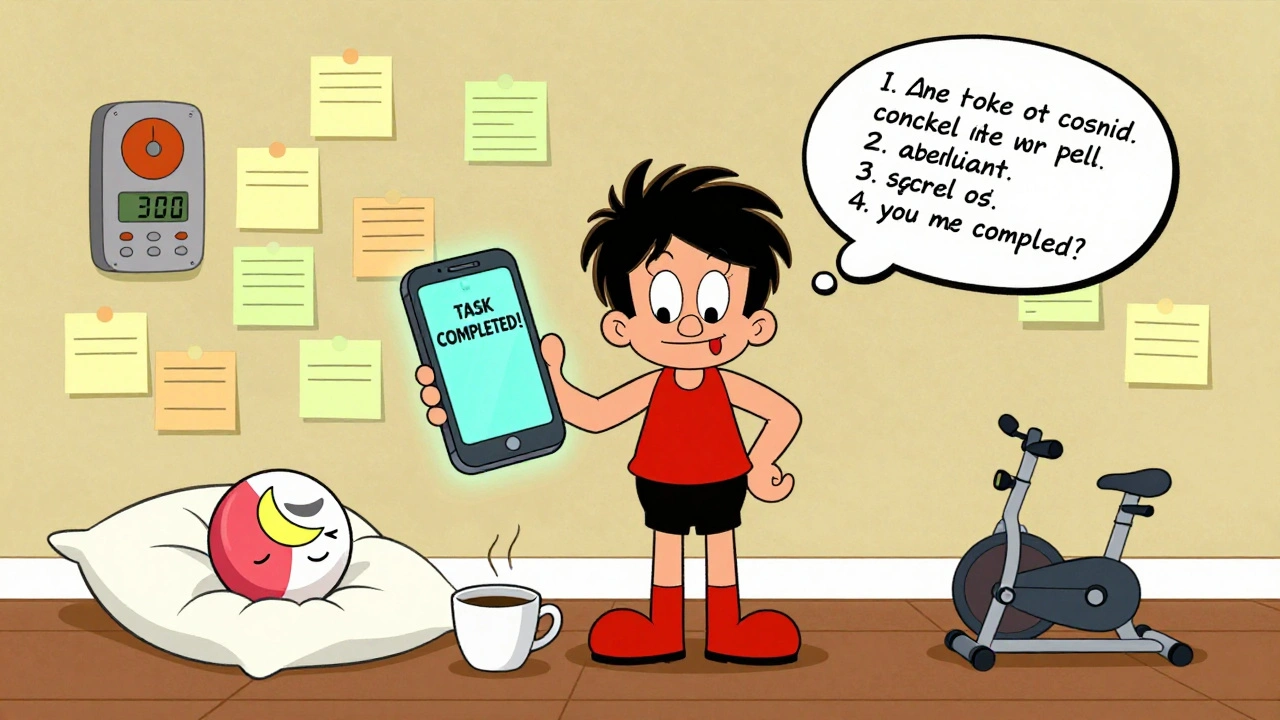
For adults, organizational tools are lifesavers. Digital calendars with alerts, task lists broken into tiny steps, and external reminders (like sticky notes or voice memos) compensate for working memory gaps. Time blindness-a common ADHD trait-means you might think you have 20 minutes to get ready, when really you need 45. Using alarms for every step helps.
Exercise isn’t just good for health-it’s a natural dopamine booster. A 30-minute walk or bike ride before work or school can improve focus for hours. Mindfulness practices, even just 5 minutes of breathing, help reduce impulsivity and emotional reactivity.
Choosing the Right Mix: What Works for Whom?
There’s no one-size-fits-all. Here’s how to think about it:
- Start with stimulants if symptoms are severe, you need quick results, and there’s no history of substance abuse or heart issues.
- Try non-stimulants if you have anxiety, tics, sleep problems, or worry about side effects like appetite loss or mood swings.
- Add behavioral tools no matter what-medication alone doesn’t teach you how to plan, prioritize, or handle frustration.
- Watch for rebound-that cranky, irritable period as meds wear off. Switching to extended-release formulas or adjusting timing can help.
- Monitor growth and heart health-especially in kids. Measure height and weight every 6 months. Check blood pressure before starting and every 3 months after.
Some people do best on a combination: a low-dose stimulant in the morning with guanfacine at night to help with sleep and emotional regulation. Others ditch meds entirely and rely on routines, coaching, and digital tools. It’s not all or nothing.
What’s New in ADHD Treatment?
The field is evolving fast. In 2023, the FDA approved AZSTARYS-a new extended-release stimulant designed to be harder to misuse. It’s a mix of two forms of methylphenidate that release at different times, giving steady focus for up to 13 hours.
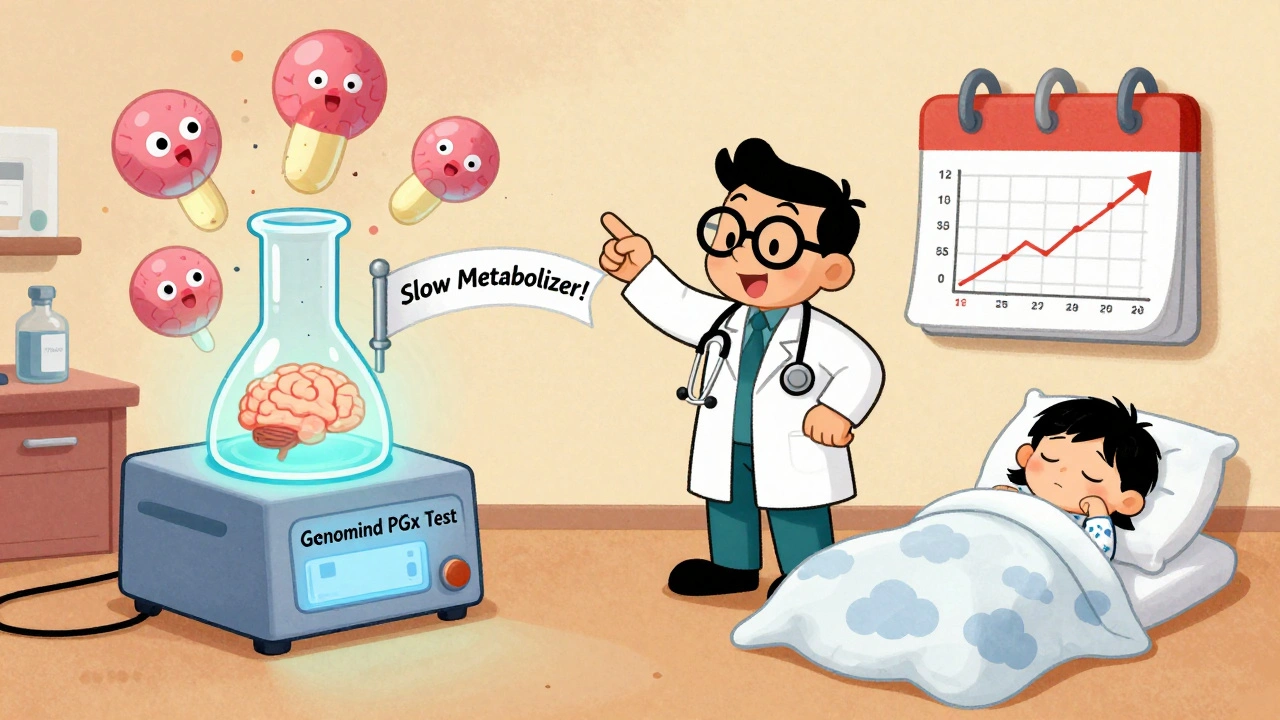
Genetic testing is starting to play a role. Tests like Genomind’s PGx Express can predict whether you’re likely to respond to certain stimulants based on your CYP2D6 and CYP2C19 genes. If you’re a slow metabolizer, you might need lower doses. If you’re a fast one, standard doses might not work at all. This isn’t mainstream yet, but it’s coming.
Digital therapies are also gaining ground. EndeavorRx, an FDA-cleared video game for kids aged 8-12, trains attention networks through gameplay. Early data shows it can improve attention scores as much as some medications-without side effects. Virtual reality programs are now in phase 3 trials, aiming to simulate real-world distractions to build focus under pressure.
The American Academy of Pediatrics now recommends screening for eating disorders before starting stimulants. Why? New data shows a 12% higher risk in people already predisposed. Appetite loss isn’t just inconvenient-it can become dangerous.
What to Do Next
If you’re considering treatment:
- Talk to your doctor-be honest about side effects, past failures, and what you’re hoping to change.
- Track symptoms-use a simple journal or app to note focus, mood, sleep, and appetite daily.
- Start low, go slow-especially with stimulants. A 5mg dose of methylphenidate is often enough to start.
- Build your support system-parent training, school accommodations, therapy, or ADHD coaching can make a huge difference.
- Give it time-meds take weeks to fine-tune. Behavioral changes take months. Don’t give up after one bad week.
ADHD isn’t a flaw. It’s a different way of processing the world. The goal isn’t to make you normal-it’s to help you thrive on your own terms. Whether you use medication, strategies, or both, the right mix exists. You just have to find it-and you’re not alone in the search.
Are stimulants addictive?
When taken as prescribed for ADHD, stimulants are not addictive. The risk of addiction comes from misuse-like crushing pills to snort or taking higher doses for energy. People with ADHD who take these medications regularly have lower rates of substance abuse than those who go untreated. The brain of someone with ADHD responds differently to stimulants; they calm rather than stimulate.
Can ADHD meds stunt growth?
Some children experience temporary slowing of growth-especially in the first year of treatment. Height and weight gains may slow by about 1-2 cm per year. But studies show most kids catch up by age 10-12. Regular monitoring by a doctor helps catch this early. If growth slows too much, switching to a non-stimulant or adjusting timing can help.
Do non-stimulants work as well as stimulants?
On average, stimulants are more effective-helping 70-80% of users. Non-stimulants help 50-60%. But effectiveness isn’t just about numbers. For someone with severe anxiety, tics, or sleep issues, a non-stimulant might be far more effective overall-even if core symptoms improve less. The goal is function, not just symptom reduction.
How long does it take for behavioral strategies to work?
Behavioral changes take time. Parent training programs show results after 12-16 weeks. For adults, building new habits like using calendars or breaking tasks into steps can take 6-8 weeks to feel natural. The key is consistency-not perfection. Small wins add up. One study found people who stuck with behavioral tools for 6 months saw 40% fewer daily meltdowns and 30% better task completion.
Is it safe to take ADHD meds long-term?
Long-term studies, including the 20-year follow-up of the MTA trial, show no serious harm from continued use. Heart risks are rare when monitored properly. The biggest concern is not the medication itself, but what happens if ADHD goes untreated-lower academic achievement, higher risk of accidents, depression, or job loss. For most, the benefits outweigh the risks.
Can I stop taking ADHD meds once I feel better?
Some people can reduce or stop meds after building strong behavioral habits, especially in adulthood. But for many, ADHD is lifelong. Stopping suddenly can cause symptoms to return quickly. Never stop without talking to your doctor. A slow taper, paired with ongoing strategies, gives you the best chance to see if you still need it.
What if meds don’t work at all?
About 20-30% of people don’t respond well to the first stimulant. That doesn’t mean nothing will work. Trying a different class-like switching from methylphenidate to amphetamine, or adding a non-stimulant-often helps. Behavioral strategies become even more critical here. Some people find success with coaching, neurofeedback, or digital therapies. It’s not failure-it’s part of the process.
Final Thoughts
ADHD treatment isn’t a one-time decision. It’s a living plan that changes as you do. What works at 10 might not work at 25. What helps in school might not help in a high-pressure job. The goal isn’t to fix you-it’s to give you the tools to manage your brain on your own terms. Medication gives you the focus. Behavioral strategies give you the structure. Together, they give you back control.
michael booth
December 4, 2025 AT 13:02Stimulants changed my life. I used to forget meetings, lose keys, and feel like my brain was stuck in molasses. Now I finish tasks. Not perfect, but functional. No more guilt.
Karl Barrett
December 4, 2025 AT 14:22The neuropharmacology here is sound, but I'd argue the real paradigm shift isn't pharmacological-it's epistemic. We've moved from a deficit model to a neurodivergent framework, wherein executive dysfunction isn't pathology but a different cognitive architecture. The dopamine modulation hypothesis still holds, but the behavioral scaffolding is what enables neuroplastic adaptation. The MTA data supports this, but we need more longitudinal fMRI studies to confirm cortical reorganization.
Jake Deeds
December 6, 2025 AT 05:21People act like ADHD meds are some kind of magic potion, but let's be real-this is just chemical compliance for a society that doesn't want to accommodate different brains. You don't need Vyvanse, you need less homework, less noise, less pressure to sit still for 8 hours. But no, let's drug the kids instead of fixing the system. Classic.
Isabelle Bujold
December 7, 2025 AT 01:42It's important to note that while stimulants are effective for many, the side effect profile can be particularly challenging for women and girls, especially around appetite suppression and emotional blunting, which are often underreported in clinical trials. I've seen clients who lost 15% of their body weight in six months on Adderall and were told it was 'normal.' Also, the emotional flattening effect-many describe it as losing their sense of humor, their passion, their spark. That’s not just a side effect; it’s a loss of identity. Non-stimulants like guanfacine can be gentler, but they require patience. And behavioral strategies? Absolutely non-negotiable. I’ve had adults tell me they only started thriving when they stopped trying to ‘fix’ their brain and started building systems around it-like voice-to-text for task lists, timers for every single step, and walking meetings instead of sitting ones. It’s not about being lazy. It’s about designing for neurology, not conformity.
John Filby
December 7, 2025 AT 03:19Biggest win for me? Using Google Calendar with alarms for EVERYTHING. Even 'brush teeth' and 'drink water.' I used to think I was lazy. Turns out I just needed external memory. Also, 20-min walk before work = 4 hrs of focus. Game changer. 😊
Elizabeth Crutchfield
December 8, 2025 AT 12:46i had no idea non stimulants took 4-6 wks to kick in… i gave up on strattera after 2 weeks and felt like a failure. now i know its not me, its the med. ty for this post.
Chad Handy
December 8, 2025 AT 18:15Let’s be honest-most of you are just looking for an excuse to be medicated. ADHD is overdiagnosed. Kids these days can’t sit still because they’re on TikTok 12 hours a day. You don’t need Adderall, you need boundaries. And parents? You’re enabling this. Let your kid fail once in a while. It’ll teach them more than any stimulant ever could. This whole industry is a scam. The pharmaceutical companies are laughing all the way to the bank.
Joe Lam
December 8, 2025 AT 20:11That ‘behavioral strategies’ section is laughably naive. You think a sticky note and a calendar fix executive dysfunction? You’re talking to a population that can’t remember to *open* their calendar. No amount of ‘systems’ compensates for a neurochemical deficit. The real solution is pharmacological. Everything else is just coping. And if you think non-stimulants are ‘safer,’ you’ve never dealt with the lethargy of Strattera or the dizziness of clonidine. Stimulants are the only thing that actually *works.* The rest is placebo with side effects.
Jenny Rogers
December 9, 2025 AT 00:28It’s not about medication. It’s about moral responsibility. The rise in ADHD diagnoses correlates directly with the collapse of discipline in parenting and education. We’ve replaced structure with pharmacology. We’ve replaced accountability with chemical crutches. The fact that you’re even considering this as a ‘lifestyle choice’ rather than a failure of character is deeply troubling. Children need boundaries, not stimulants. Adults need willpower, not Vyvanse. This is not medicine-it’s moral surrender.
Jessica Baydowicz
December 9, 2025 AT 17:31Y’all are underestimating the power of movement. I used to be a mess-late, scattered, emotional tornado. Then I started doing 45 mins of HIIT before work. Boom. Focus. Calm. Energy. Not a pill in sight. ADHD isn’t broken-it’s just wired for motion. Stop sitting. Start moving. Your brain will thank you. 💪🧠
Shofner Lehto
December 11, 2025 AT 09:13To anyone new to this: don’t compare your chapter 2 to someone else’s chapter 10. Finding the right mix takes time. I tried 4 meds, 3 therapists, 7 planners. Finally found my groove: low-dose methylphenidate + daily walk + task batching. No magic. Just persistence. You’re not broken. You’re just unoptimized.
Yasmine Hajar
December 12, 2025 AT 04:20As a Black woman with ADHD, I want to say: this guide is helpful, but it ignores the racial and cultural layers. Black kids are more likely to be disciplined than medicated. Black women are dismissed as ‘emotional’ instead of being tested. My doctor told me I was ‘too intense’ for years before he even considered ADHD. If you’re reading this and you’re BIPOC-your experience matters. Advocate for yourself. Find a specialist who gets it. You’re not too much. You’re just misunderstood.
val kendra
December 12, 2025 AT 12:43Biggest myth: meds make you ‘normal.’ Nah. They make you *you*-but without the fog. I still forget things. Still get overwhelmed. But now I can catch myself before I spiral. That’s the win. And behavioral tools? They’re not optional. They’re the scaffolding. Meds give you the bricks. You still have to build the house.