
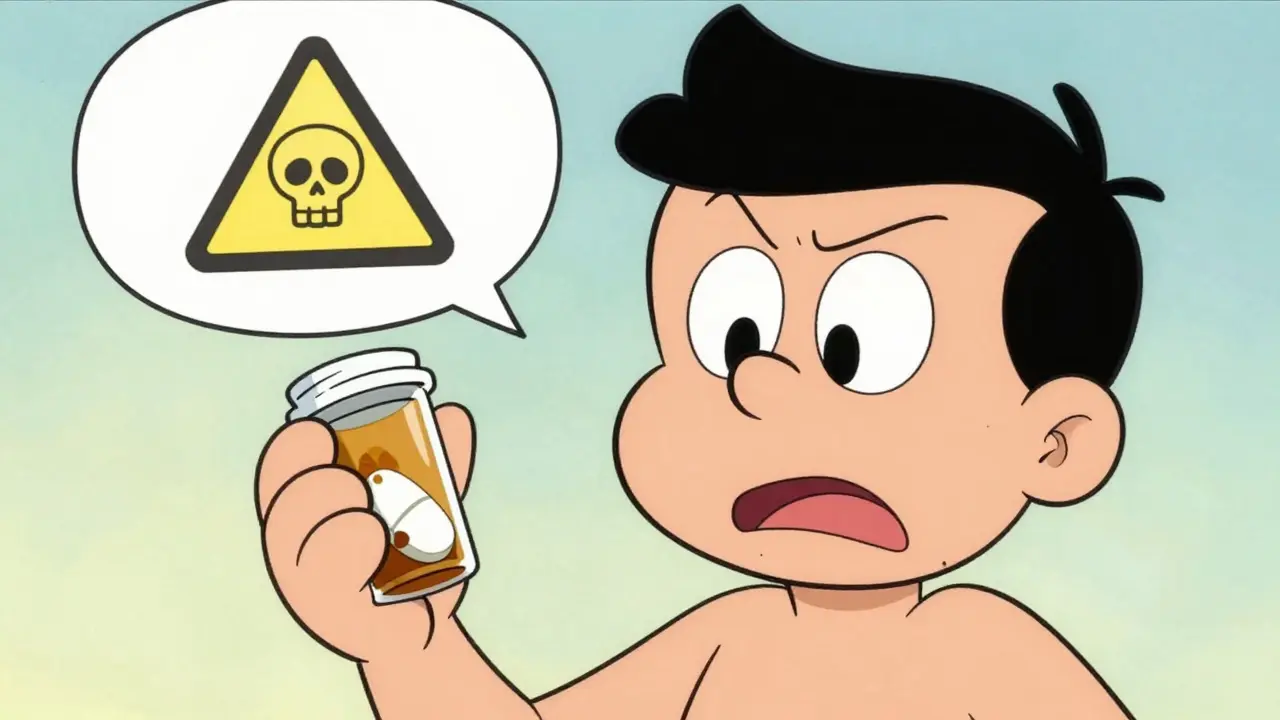
Why You Should Never Ignore Changes in Expired Drugs
Most people know not to take medicine past its expiration date-but what if the pill still looks fine? What if the cream hasn’t separated, the liquid hasn’t clouded, and there’s no weird smell? That doesn’t mean it’s safe. The truth is, expired drugs can degrade without obvious signs, but when they do show changes in color, odor, or texture, those are red flags you can’t afford to ignore.
Take tetracycline, for example. When it expires, it doesn’t just lose strength-it turns yellow to brown. That’s not a cosmetic issue. That’s a chemical reaction called epimerization, and taking it can damage your kidneys. Or consider nitroglycerin, a heart medication. It’s supposed to be a clear liquid. If it turns yellow-brown, it’s broken down and won’t work when you need it most. These aren’t rare cases. Studies show over 68% of expired medications show visible changes, and 1 in 10 have safety risks.
What Changes to Look For in Solid Medications
Tablets and capsules are the most common forms of medication, and they’re also the most likely to show physical signs of decay. Start by holding them under good lighting-natural daylight or a 500-lux lamp works best-against a white surface. Look for:
- Discoloration: A white tablet with brown spots, a yellow pill that’s now dark orange, or a blue capsule turning gray. Tetracycline, doxycycline, and some antidepressants are especially prone to this. Don’t assume it’s just dirt-this is chemical breakdown.
- Cracking or crumbling: If a tablet breaks apart easily or leaves dust on your fingers, it’s lost its structural integrity. This happens when moisture gets in or the binding agents degrade. A tablet that used to be hard enough to withstand 6-8 kiloponds of pressure might now crumble under light touch.
- Caking or clumping in capsules: Open a capsule carefully. If the powder inside is stuck together in lumps, it’s absorbed moisture. This is common with amoxicillin and other hygroscopic drugs. Moisture turns the powder into a sticky paste, which can alter how your body absorbs it.
- Odor: A faint chemical or musty smell isn’t normal. Most pills have no smell at all. If you catch a sour, rancid, or ammonia-like odor, it’s a sign of decomposition. This is especially common in liquid-filled capsules or those with animal-derived gelatin.
Don’t rely on memory. Keep the original packaging. Compare your pill to the image on the bottle or the manufacturer’s website. If you’re unsure, don’t guess-discard it.
Spotting Degradation in Creams, Ointments, and Gels
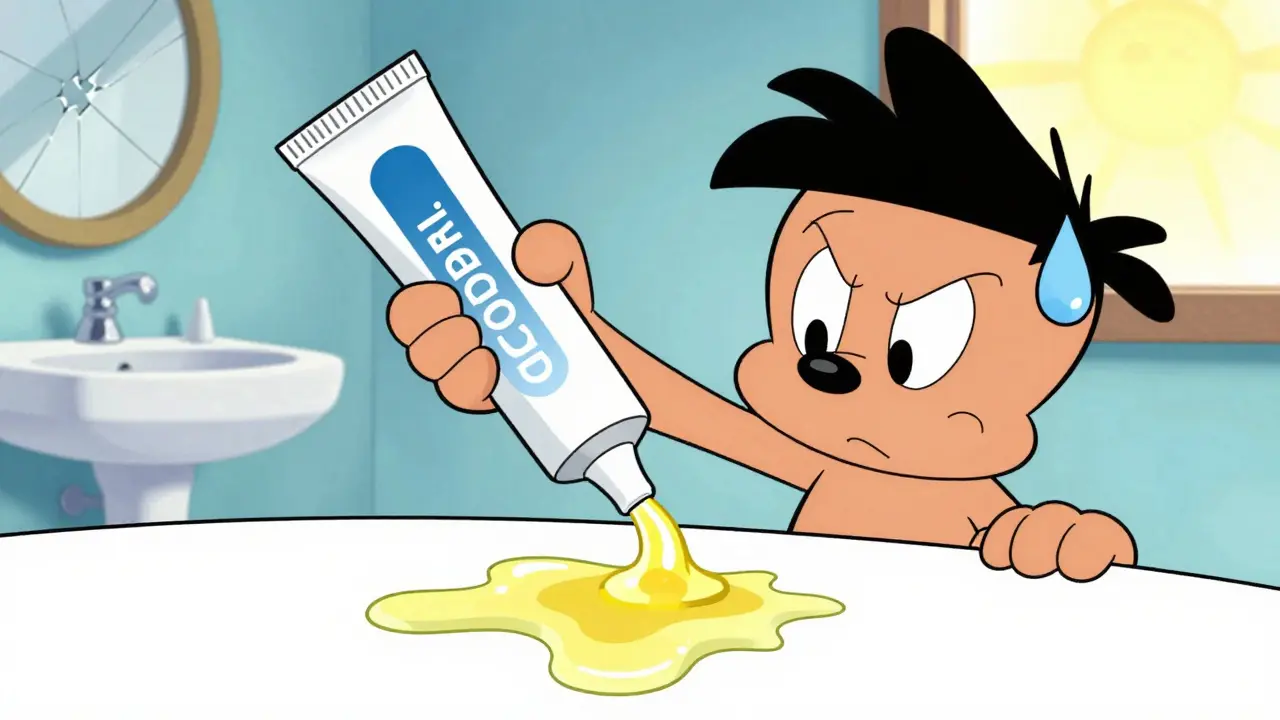
Topical medications like hydrocortisone, clotrimazole, or mupirocin are trickier because their texture changes are subtle at first. A cream that’s been sitting for months might look fine-but if you squeeze it out and it separates into oily and watery layers, that’s phase separation. It means the emulsion has broken down. The active ingredient is no longer evenly distributed.
- Oil-off or water-off: If you see a clear liquid pooling on top or the cream looks greasy and uneven, it’s degraded. This is common after exposure to heat. A tube left in a hot bathroom or car can ruin it in weeks.
- Hardening or drying: If the ointment feels gritty or has a crusty surface, it’s lost moisture. That means the active drug is concentrated in certain spots-too much in one area, too little in another.
- Change in spreadability: A good cream should glide on smoothly. If it’s now stiff, rubbery, or sticks to the tube, it’s no longer stable. Even if the label says it’s good for another month, if it doesn’t feel right, it’s not safe to use.
Some products, like clotrimazole cream, have been shown to separate visibly after just 880 days past expiration-even in ideal storage. Don’t wait for it to look bad. If it’s expired and you notice any texture shift, toss it.
What to Watch for in Liquid Medications
Liquids are the most vulnerable. They’re exposed to air, light, and temperature swings. Check for:
- Cloudiness or particles: A clear liquid turning cloudy? That’s a red flag. You might see tiny floating specks, threads, or crystals. This isn’t normal sediment-it’s chemical breakdown or microbial growth. Ciprofloxacin eye drops, for example, can form fine crystals after expiration. One hospital misread this as normal and caused 14 adverse events.
- Color change: Insulin, epinephrine, and nitroglycerin are light-sensitive. If clear insulin turns pale yellow or brown, it’s degraded. Epinephrine auto-injectors should remain clear. If they’re pink or brown, they’re useless.
- Odor: Liquid antibiotics like amoxicillin suspension can develop a sour, yeasty smell when they spoil. That’s bacterial growth. Even if the bottle hasn’t been opened, once past expiration, it’s a risk.
- Separation: Some suspensions are meant to be shaken. But if you shake it and the particles don’t dissolve evenly, or if you see a thick sludge at the bottom, it’s degraded. The drug won’t be absorbed properly.
Use a flashlight to check for particles. Hold the bottle up to the light. If you see anything floating, don’t use it. The FDA says even small particles can cause inflammation or block small blood vessels.
Why Visual Checks Alone Aren’t Enough
You might think, “If it looks okay, it’s fine.” But that’s dangerous. Studies show human eyes catch only about 65% of degraded drugs. Some pills, like PMZ (a painkiller), can lose potency without changing color at all. Others, like certain antibiotics, might look perfect but have turned toxic.
That’s why professionals use tools. Hospitals use color charts like the Munsell system to compare pills against known standards. Labs use spectrophotometers to measure exact color shifts. Even a $100 portable device can detect changes invisible to the naked eye.
But you don’t need fancy gear. You need awareness. If a drug looks, smells, or feels off-no matter how small the change-don’t take it. The risk isn’t worth it. A few dollars for a new prescription is nothing compared to a hospital visit from a bad reaction.
How to Prevent Problems Before They Happen
Don’t wait for signs of degradation. Prevent them:
- Store properly: Keep meds away from heat, moisture, and light. Don’t leave them in the bathroom or on a windowsill. A cool, dry drawer is best.
- Check dates monthly: Set a reminder on your phone. Every first of the month, go through your medicine cabinet. Toss anything expired.
- Use the RARC method: Some clinics use colored dots on bottles-red for 2024, blue for 2025, etc. You can do the same with masking tape and a marker. Write the expiration date on the bottle.
- Don’t stockpile: Only buy what you need. If you have leftover antibiotics from last year, don’t save them for next time. They’re not guaranteed to work.
- Ask your pharmacist: If you’re unsure about a drug’s appearance, take it in. Pharmacists see hundreds of pills every day. They’ll know if something’s off.
What to Do If You’ve Already Taken a Degraded Drug
If you accidentally took a pill that looked strange and now feel unwell-nausea, dizziness, rash, or unusual fatigue-seek medical help immediately. Don’t wait. Bring the bottle and the remaining pills with you.
If you didn’t have a reaction but suspect you took a bad drug, stop using it. Call your pharmacy or doctor. They can advise whether you need a replacement or monitoring.
And if you’re ever in doubt? When in doubt, throw it out. Medications are cheap. Your health isn’t.
Final Reminder: Expired Doesn’t Always Mean Inactive-But It Always Means Unreliable
The FDA says most drugs retain some potency past expiration-but they don’t say how much. And they don’t say if it’s safe. Degradation doesn’t follow a schedule. One bottle might be fine. Another, from the same batch, could be dangerous.
Color, odor, and texture changes are your body’s early warning system. Don’t ignore them. They’re not just signs of age-they’re signs of risk. When a drug looks wrong, smells wrong, or feels wrong, it is wrong. Trust your senses. Your life depends on it.
Eli Kiseop
February 3, 2026 AT 19:46Ellie Norris
February 4, 2026 AT 14:44Marc Durocher
February 6, 2026 AT 10:48Bro. I’ve seen people take expired meds like it’s a survival challenge. My aunt took expired antibiotics because ‘they’re just sugar pills’. She ended up in the ER.
Don’t be that person. Don’t be that relative. Don’t be that guy who thinks ‘it’s probably fine’ while your kidneys throw a protest.
larry keenan
February 6, 2026 AT 17:40Empirical studies from the USP indicate that even under controlled storage conditions, the potency loss of tetracycline derivatives exceeds 15% beyond the labeled expiration date, with epimerization as the primary degradation pathway.
Visual inspection is a low-sensitivity screening method with a false-negative rate exceeding 35% in community settings.
Nick Flake
February 8, 2026 AT 06:05Some pills are like old milk. They don't scream 'I'm bad!'... they just... quietly ruin your whole day.
That yellow tetracycline? That's not a vintage filter. That's your kidney screaming for mercy.
Don't be the person who turns a $12 pill into a $12,000 hospital bill.
When in doubt... throw it out. 💩💊
Bridget Molokomme
February 9, 2026 AT 18:11Meanwhile, my neighbor takes expired Adderall like it's cereal. She says 'it's just caffeine now'. I say... let her live her best life.
Matt W
February 11, 2026 AT 10:37Now I write the date I open it on the box. No more guessing.
Also, if your cream feels like Play-Doh? Toss it. No exceptions.
Monica Slypig
February 13, 2026 AT 06:37Also your 'FDA says' is just corporate propaganda. I've taken 10-year-old antibiotics. Still alive. Still typing.
Becky M.
February 15, 2026 AT 05:34Then I remembered she passed last year.
So I threw it out.
Not because of the science.
Because I didn't want to take something she once held.
jay patel
February 15, 2026 AT 17:35One guy brought me a 7-year-old antibiotic for a sore throat. I asked him if he even had a prescription. He said 'no, but the bottle says it's for infection'.
Bro. The bottle says 'tetracycline'. It doesn't say 'magic fairy dust'.
And yes, the powder inside was clumped like wet cement. I threw it out. He cried. I gave him a free lollipop.
Ansley Mayson
February 17, 2026 AT 11:44Dan Pearson
February 17, 2026 AT 21:27You're acting like a 5-year-old pill is going to turn you into a zombie.
Have you seen the ingredients list on your cereal? That stuff is a science experiment.
Meanwhile, your grandma’s aspirin from 2012? Probably more pure than your protein powder.
Stop being scared of chemistry. It's not the enemy. Big Pharma is.
Solomon Ahonsi
February 19, 2026 AT 12:35Woke up fine.
So I guess I win.
George Firican
February 21, 2026 AT 10:32And now it sits in a drawer, forgotten, like a letter you never sent.
We hoard medicine like it’s gold. But we forget: the real value isn’t in the chemical compound. It’s in the trust we place in time. In science. In the hands that filled that bottle.
When we ignore the signs - the color, the smell, the texture - we’re not just risking our bodies. We’re ignoring the quiet dignity of care.
Throw it out. Not because the FDA says so.
Because someone once cared enough to give you that medicine.
And you owe them that much.
Marc Durocher
February 22, 2026 AT 17:46Meanwhile I’m over here Googling 'how to dispose of pills without flushing them' because I don’t want to poison the river.
Thanks, George. You just made me cry while holding a bottle of expired ibuprofen.