

Why Your Eczema Won’t Improve-Even With Moisturizer
You’ve tried every moisturizer on the shelf. You’ve skipped the hot showers. You’ve avoided fragrances. But your skin still cracks, itches, and flares up. Why? Because most moisturizers don’t fix the real problem: your skin’s barrier is broken. In eczema, the outer layer of skin-called the stratum corneum-loses its ability to hold water and block irritants. This isn’t just dryness. It’s a structural failure. And the fix isn’t more lotion. It’s ceramides-used the right way.
What Ceramides Actually Do for Eczema Skin
Your skin is like a brick wall. The bricks are dead skin cells. The mortar between them? That’s lipids-fats that keep everything sealed. Ceramides make up about half of that mortar. In healthy skin, ceramides, cholesterol, and fatty acids sit in a perfect 3:1:1 ratio. In eczema? That ratio is shattered. Ceramide levels drop by 30-50%. The remaining ones are the wrong type. This creates gaps. Water escapes. Irritants get in. That’s why your skin feels tight, burns, and itches nonstop.
Not all ceramide products are equal. Some OTC creams have just a trace amount-enough to look good on the label, not enough to work. Effective barrier repair needs real ceramides in the right mix. Prescription formulas like EpiCeram® and TriCeram® are designed to match your skin’s natural lipid structure. They don’t just cover up dryness-they rebuild it from the inside out.
Why Regular Moisturizers Fall Short
Traditional moisturizers like petrolatum or mineral oil act like plastic wrap. They trap water already in your skin. That gives temporary relief. But they don’t fix the broken mortar. In fact, using them alone can make things worse over time. Research shows that applying just ceramides, or just cholesterol, without the full 3:1:1 mix, actually slows healing by 15-25%. Your skin needs all three components together.
Compare this to ceramide-dominant emulsions. In clinical trials, they reduce water loss (TEWL) by 35-50% and keep skin protected for over 72 hours. That’s not luck. That’s science. They restore the lipid layers so your skin can function like it should. And unlike steroid creams that numb inflammation, ceramides fix the root cause. No more guessing why flares keep coming back.
The Right Way to Bathe for Eczema Repair
Bathing isn’t the enemy-it’s your best tool-if you do it right. Most people with eczema bathe wrong. Hot water? Too long? Harsh soaps? All of that strips what little lipid protection you have left.
Here’s what works:
- Use lukewarm water-no hotter than 90°F (32°C). Hot water breaks down ceramides.
- Limit baths to 10-15 minutes. Longer doesn’t help-it dries you out.
- Use a gentle, fragrance-free cleanser with pH 5.5. Avoid anything with sodium lauryl sulfate above 0.5%. Higher concentrations spike water loss by 25-40% in just one hour.
- Pat your skin dry-not rub. Leave it slightly damp.
- Apply your ceramide cream within 3 minutes of getting out. Damp skin absorbs 50-70% more active ingredients.
This is called the “soak and seal” method. It’s not new. But it’s underused. Done consistently, it turns bathing from a trigger into a repair session.

Choosing the Right Ceramide Product
Not all ceramide creams are created equal. Here’s how to tell the difference:
- Prescription (EpiCeram®, TriCeram®): Formulated with the exact 3:1:1 lipid ratio. Proven in clinical trials. Used by dermatologists for moderate-to-severe eczema. Costs $25-$35 for a 200g tube.
- OTC (CeraVe, Vanicream): Many contain ceramides, but often in lower concentrations or incomplete ratios. Still helpful for mild cases. CeraVe holds 60% of the OTC sensitive skin market. Works well for maintenance, not flares.
- Watch out for “pseudo-ceramides”: These are synthetic mimics. They may feel nice but don’t repair like real ceramides. Look for “ceramide NP,” “ceramide AP,” or “ceramide EOP” on the label. That’s real.
Check the ingredient list. If ceramides are buried near the bottom, skip it. The first few ingredients should be water, then lipids-not fragrances, parabens, or alcohol.
What to Expect-And What Not to Expect
Ceramides aren’t magic. They don’t stop a flare overnight. Steroid creams can calm redness in 3-7 days. Ceramides take 4-6 weeks. That’s why so many people give up too soon.
But here’s what happens if you stick with it:
- By week 2: Less tightness after bathing.
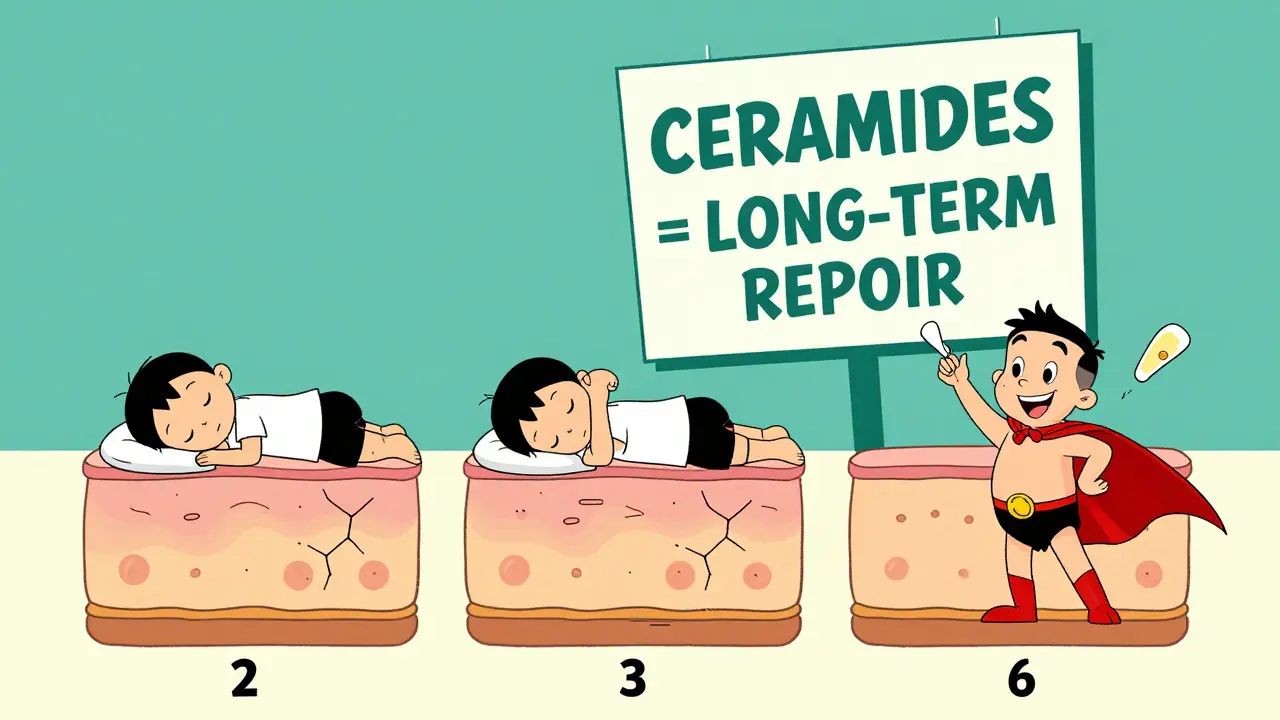
- By week 3: Fewer nighttime scratches. Some users report going from 8-10 scratches a night to 1-2.
- By week 6: Less reliance on steroids. One patient in a 2021 study cut steroid use from daily to once a week.
- By 3 months: Skin stays smoother longer. Flares become milder and less frequent.
And yes, some products feel greasy. That’s because they’re packed with lipids. It’s not a flaw-it’s the point. If it feels light and watery, it’s probably not doing enough.
Real People, Real Results
On Reddit’s r/eczema community, 78% of 1,243 users reported noticeable improvement within 2-4 weeks of switching to a proper ceramide cream. One user wrote: “I tried 10+ moisturizers. EpiCeram cut my scratching in half.”
On Amazon and Trustpilot, 68% of 5-star CeraVe reviews mention “barrier repair” specifically. Negative reviews? Most say: “Too slow for bad flares.” That’s true. Ceramides aren’t for emergency relief. They’re for long-term rebuilding.
People who combine ceramides with proper bathing see the best results. One woman in a dermatology journal case study reduced her SCORAD score (a measure of eczema severity) from 42 to 18 in 8 weeks-without steroids.
When to Talk to Your Dermatologist
If you’ve tried ceramide creams for 6 weeks with no change, talk to your doctor. You might need a prescription formula. Or you might have a specific ceramide deficiency-like low ceramide 1-which newer tests can detect. LEO Pharma and others are developing personalized ceramide blends based on individual lipid profiles.
Also, check insurance coverage. Only 42% of U.S. plans cover prescription barrier repair creams. If cost is a barrier, ask about samples or patient assistance programs. Some brands offer them.
The Bigger Picture
Eczema isn’t just about itching. It’s about a broken skin barrier that lets allergens in and triggers immune responses. That’s why kids with eczema are more likely to develop food allergies or asthma-the “atopic march.” Fixing the barrier early may help stop that chain.
Today, 85% of pediatric dermatologists recommend ceramide creams as first-line care for children. That’s because the evidence is clear: repair the barrier, and you repair the disease.
The future is personalized. Soon, we’ll be able to test your skin’s lipid profile and match you with the exact ceramide mix your skin needs. But for now, the basics work: use real ceramides, in the right ratio, after a short, cool bath. Do it every day. Be patient. Your skin will thank you.
Can I use ceramide cream with steroid cream?
Yes. Apply the steroid first, wait 15 minutes, then apply the ceramide cream. Steroids reduce inflammation quickly. Ceramides repair the barrier over time. Using them together is safe and often more effective than either alone.
Do I need to use ceramides forever?
Think of it like brushing your teeth. Once your barrier is repaired, you don’t stop. You maintain it. Most people with eczema use ceramide creams daily as part of long-term skin care-even during clear periods. Stopping often leads to flares returning.
Are plant-based ceramides as good as human-identical ones?
Not always. Plant-derived ceramides (like those from rice or wheat) are structurally different. Clinical trials show human-identical ceramides repair the barrier 40% better than plant-based versions. Look for “ceramide NP” or “ceramide EOP”-these are lab-made to match your skin’s natural structure.
Can I use ceramide cream on my face?
Yes. Many ceramide creams are safe for the face. Avoid ones with heavy oils if you’re acne-prone. Look for lightweight, non-comedogenic formulas. CeraVe Facial Moisturizing Lotion is a popular choice for facial use.
Why does my skin tingle when I apply ceramide cream?
Mild tingling for the first few days is normal. It means the product is penetrating the damaged barrier. If it burns, stings, or causes redness beyond 3-4 days, stop using it. You might be reacting to another ingredient, not the ceramides.
Next Steps for Better Skin
Start with a simple routine: lukewarm bath, 10 minutes, gentle cleanser, pat dry, apply ceramide cream within 3 minutes. Do this twice a day. Stick with it for 4 weeks. Track your symptoms-itching, redness, flaking. If you see improvement, keep going. If not, talk to your dermatologist about prescription options. This isn’t a quick fix. It’s a long-term reset. And for many, it’s the only thing that truly works.
Kathy Scaman
January 27, 2026 AT 16:18Rhiannon Bosse
January 27, 2026 AT 20:24Timothy Davis
January 29, 2026 AT 18:21Colin Pierce
January 30, 2026 AT 18:37Mark Alan
January 31, 2026 AT 03:23doug b
February 1, 2026 AT 05:50Mel MJPS
February 2, 2026 AT 10:06Katie Mccreary
February 3, 2026 AT 15:01