
Drug-Supplement Interaction Checker
Check Your Medication-Supplement Interactions
Results will appear here after checking your selection.
Many people think if it’s natural, it’s safe. That’s not true-especially when it comes to herbal supplements. The FDA doesn’t approve these products before they hit store shelves. That means you could be taking something that interacts dangerously with your prescriptions, contains hidden drugs, or even poisons your liver. And most people have no idea.
Why You Must Tell Your Doctor About Herbal Products
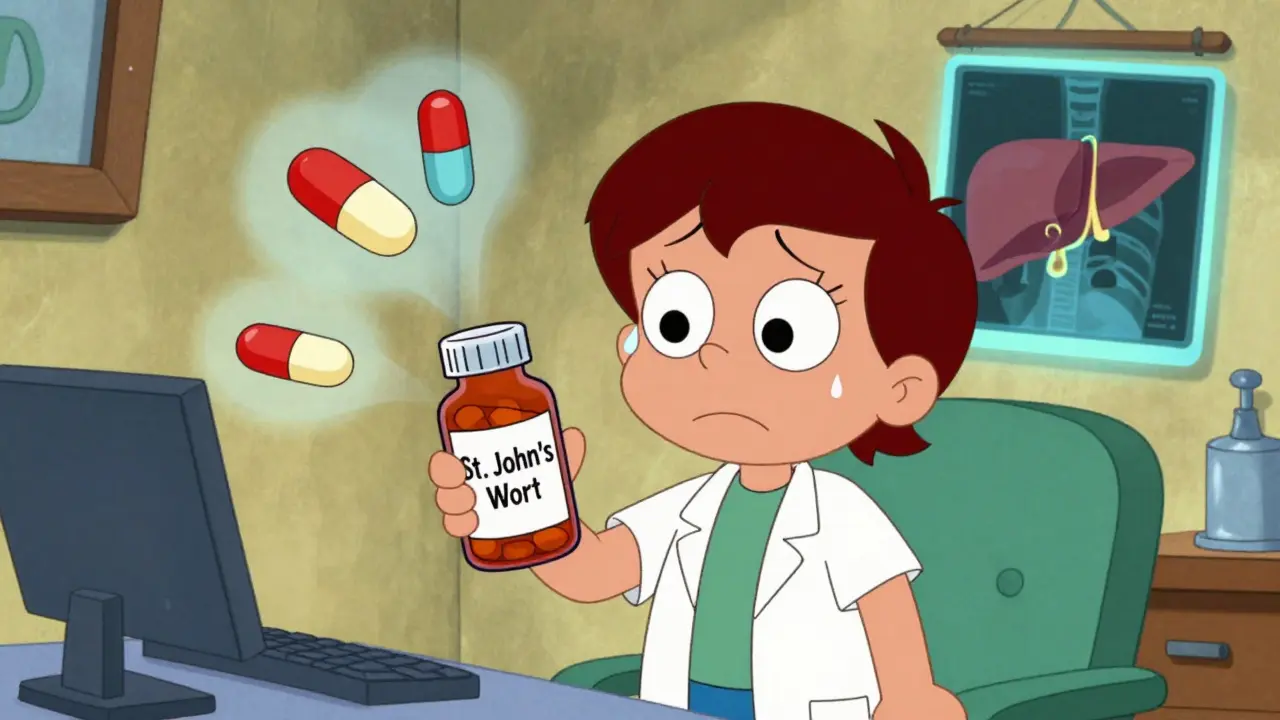
If you’re taking blood thinners like warfarin, antidepressants, or blood pressure meds, your herbal supplement could be quietly sabotaging your treatment. St. John’s Wort, for example, is sold as a natural mood booster-but it can slash the effectiveness of birth control pills, antidepressants, and even HIV medications. One 2021 case report documented a patient on warfarin who started ginkgo biloba for memory and ended up in the ER with internal bleeding. The doctor had no idea the patient was taking it. You wouldn’t skip telling your doctor about your prescription meds. But 68% of physicians say patients never mention supplements during appointments. Why? Because most people believe supplements are harmless. They’re not. The FDA has found that 15% of tested herbal products contain undeclared pharmaceuticals-like sildenafil (the active ingredient in Viagra) or steroid-like compounds-hidden in weight loss or sexual enhancement pills. These aren’t mistakes. They’re deliberate frauds.What the FDA Actually Does (and Doesn’t Do)
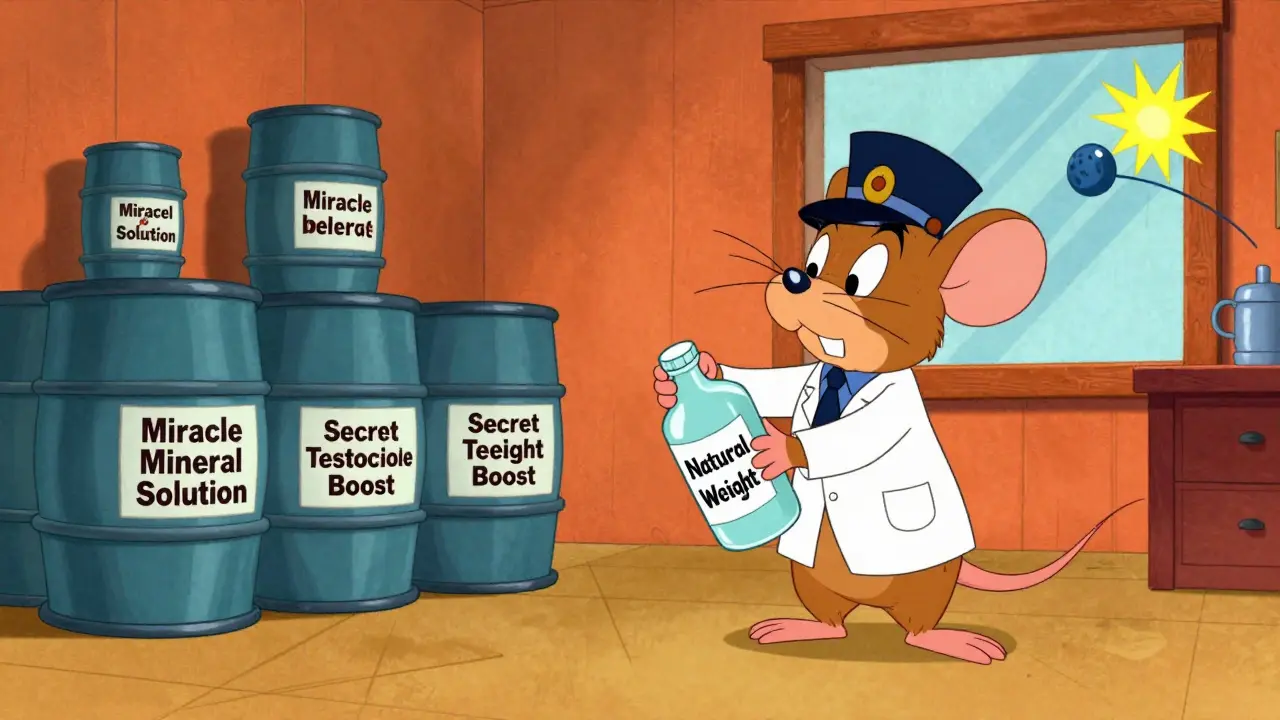
The FDA doesn’t test herbal supplements before you buy them. Under the Dietary Supplement Health and Education Act of 1994, companies can sell anything they want as long as they don’t claim it cures diseases. That’s why you see labels saying, “This product is not intended to diagnose, treat, cure, or prevent any disease.” It’s a legal loophole, not a safety guarantee. The FDA only steps in after someone gets hurt. Since 2002, they’ve sent over 1,800 warning letters to supplement makers for things like contaminated batches, false claims, or adding prescription drugs to their products. In 2023 alone, the FDA warned a company for selling “Miracle Mineral Solution”-a 28% bleach solution marketed as a cure for autism and cancer. That’s not science. That’s poison. And here’s the kicker: the FDA has only banned two dietary ingredients since 1994. Ephedra in 2004. Methylsynephrine in 2022. That’s it. Meanwhile, over 80,000 supplements are on the market. The agency has 45 staff members to oversee an industry worth $50 billion. You’re essentially on your own.Herbal Products That Are Most Dangerous
Some herbs are riskier than others. The FDA and medical experts flag these as top concerns:- St. John’s Wort: Interacts with over 50 medications, including antidepressants, birth control, and heart drugs. Can cause serotonin syndrome-a life-threatening condition.
- Ginkgo Biloba: Increases bleeding risk, especially with aspirin, NSAIDs, or blood thinners. Linked to multiple ER visits for unexplained bruising and internal bleeding.
- Kava: Used for anxiety, but linked to severe liver damage. Banned in Canada and Europe. Still sold in the U.S.
- Green Tea Extract: Concentrated pills (not tea) have caused acute liver failure in otherwise healthy people. Over 100 cases reported to the FDA since 2010.
- Weight Loss & Bodybuilding Supplements: 42% of FDA warning letters target these. Often contain hidden stimulants like DMAA or synthetic steroids. Can trigger heart attacks, strokes, or psychosis.
How to Spot a Dangerous Supplement
You can’t trust the label. But you can look for clues:- No Latin names: If it just says “green tea extract” instead of Camellia sinensis, the manufacturer may be cutting corners.
- Too good to be true claims: “Lose 20 pounds in 2 weeks,” “Cure diabetes,” or “Boost testosterone like steroids.” These are red flags. The FDA bans these claims for a reason.
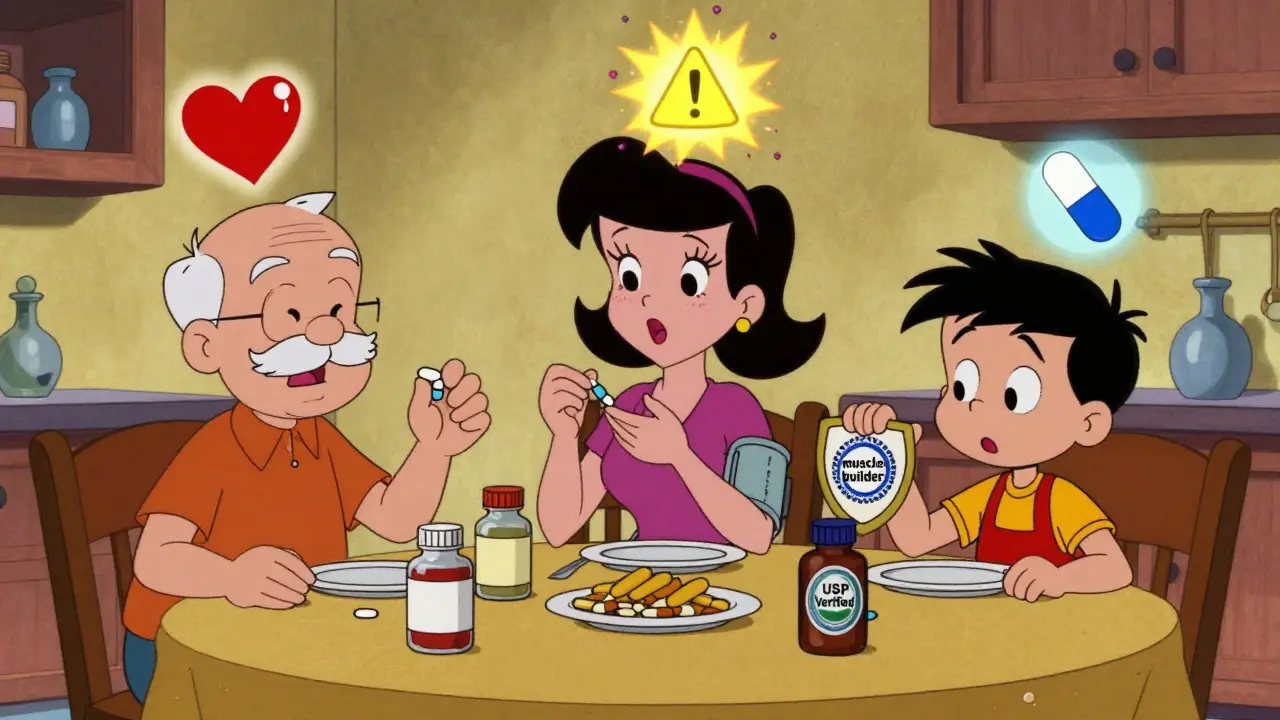
- No third-party seal: Look for USP Verified, NSF Certified, or ConsumerLab.com Tested. These organizations test for purity and actual ingredient amounts. Products with these seals are 94% accurate. Non-certified ones? Only 67%.
- Hidden ingredients: If the label lists “proprietary blend,” that’s a red flag. It hides the exact amounts. Legitimate brands list everything clearly.
Check the FDA’s warning letter database (updated weekly). Search the company name. If they’ve been warned before, walk away.
What You Should Do Right Now
Don’t wait for a crisis. Take action today:- Make a list: Write down every supplement, herb, or vitamin you take-including dosage and frequency.
- Bring it to your next appointment: Tell your doctor. Don’t wait for them to ask. Say: “I’m taking these. Are they safe with my other meds?”
- Stop risky products: If you’re taking anything for weight loss, sexual performance, or muscle gain, stop it. The risk of hidden drugs is too high.
- Use verified brands: Choose products with USP or NSF seals. They cost a little more, but they’re tested. You’re not gambling with your health.
- Report bad products: If you feel sick after taking something, report it to the FDA’s Safety Reporting Portal. Even if you think it’s minor, your report could save someone else’s life.
Why This Matters More Than You Think
You might think, “I’m healthy. I don’t take drugs. I’m fine.” But what if your mom is on blood pressure meds? What if your brother is on antidepressants? What if you’re taking supplements to avoid seeing a doctor? That’s the trap. Herbal supplements aren’t just harmless teas. They’re potent biochemicals. They interact with your body’s chemistry in ways you can’t predict. And without proper disclosure, your doctor can’t protect you. The truth is, the system is broken. The FDA is overwhelmed. The industry is unregulated. But you have control. You can choose what you put in your body. And you can choose to be honest with your healthcare team.Frequently Asked Questions
Do herbal supplements need FDA approval before being sold?
No. Unlike prescription drugs, herbal supplements don’t need FDA approval before being sold. Manufacturers only need to notify the FDA about new ingredients, but they don’t have to prove safety or effectiveness. The FDA only steps in after a product causes harm or makes illegal claims.
Can herbal supplements interfere with prescription medications?
Yes, and it’s more common than you think. St. John’s Wort reduces the effectiveness of birth control, antidepressants, and heart medications. Ginkgo biloba increases bleeding risk when taken with blood thinners. Even garlic and ginger can thin your blood. Always disclose all supplements to your doctor.
Are supplements labeled as “natural” safer?
No. “Natural” doesn’t mean safe. Many toxic substances come from plants-like poison ivy or belladonna. Herbal supplements can contain heavy metals, pesticides, or even hidden prescription drugs. The term “natural” is not regulated and has no legal meaning on labels.
How can I tell if a supplement is safe?
Look for third-party verification seals like USP Verified, NSF Certified, or ConsumerLab.com Tested. These organizations test for purity, potency, and accurate labeling. Avoid products with “proprietary blends” or vague ingredient lists. Check the FDA’s warning letter database for the brand name.
What should I do if I experience side effects from a supplement?
Stop taking it immediately. Contact your doctor. Then report the reaction to the FDA’s Safety Reporting Portal. Even if you think it’s minor, your report helps the FDA identify dangerous products. Between 2018 and 2022, over 14,000 adverse events were reported-many involving liver damage, heart issues, or neurological symptoms.
Is it safe to buy herbal supplements from Amazon or online retailers?
It’s risky. A 2021 study found that 18% of Amazon supplement reviews mentioned adverse effects. Many online sellers offer unverified, contaminated, or counterfeit products. Stick to reputable brands with third-party verification. If it’s too cheap, it’s probably fake or unsafe.
Are there any herbal supplements that are generally safe?
Some, like ginger for nausea or peppermint for IBS, have decent evidence and low risk when used short-term. But even these can interact with medications. Always check with your doctor. No supplement is risk-free if you’re on other drugs or have chronic conditions.
Steven Mayer
December 24, 2025 AT 09:20The regulatory gap here is staggering. Under DSHEA, manufacturers aren't required to demonstrate safety or efficacy-only to avoid making explicit disease claims. That’s a legal fiction masquerading as consumer protection. The burden of proof is inverted: the FDA must wait for harm, then prove intent or contamination, while the industry operates in a gray zone of liability avoidance. This isn’t oversight. It’s systemic negligence wrapped in bureaucratic euphemisms.
When a supplement contains undeclared sildenafil or synthetic steroids, it’s pharmaceutical-grade fraud. Yet the FDA’s entire supplement division has fewer staff than a single mid-sized hospital pharmacy. The math doesn’t lie: 80,000 products, 45 regulators. That’s 1,777 products per inspector. We’re not talking about oversight. We’re talking about a free-for-all.
And don’t get me started on ‘proprietary blends.’ That’s not marketing-it’s obfuscation. If a company won’t disclose the dose of an active ingredient, they’re not selling a supplement. They’re selling a lottery ticket with your liver as the prize.
The fact that ginkgo biloba has been linked to ER visits for spontaneous hemorrhage, yet remains on every shelf in Target, speaks volumes about the failure of consumer education. People assume ‘natural’ means ‘safe.’ It doesn’t. It means ‘unregulated.’
Third-party certifications like USP or NSF aren’t luxuries. They’re the only functional safety net we have. And even then, 33% of non-certified products are mislabeled. That’s not a risk. That’s a public health hazard dressed in vitamin bottles.
Until Congress amends DSHEA to require pre-market safety data, we’re all playing Russian roulette with our meds and our microbiomes.
And yes-I’ve seen patients on warfarin with INRs over 12 because they ‘took some ginkgo for focus.’ It’s not anecdotal. It’s epidemic.
Joe Jeter
December 25, 2025 AT 04:01Everyone’s acting like this is a new problem. It’s not. The FDA has been this underfunded since the 90s. And guess who voted for the law that made this possible? You did. Or your parents did. Or your grandparents. We wanted cheap supplements and we got a regulatory vacuum. Now we’re mad? Grow up.
St. John’s Wort isn’t dangerous-it’s just misunderstood. People take it with SSRIs because they don’t read labels. That’s on them. Not the FDA. Not the manufacturer. Them.
Also, ‘natural’ doesn’t mean safe? Tell that to poison ivy. Or botulism. Or arsenic. Nature’s full of killers. We just stopped calling them ‘natural’ when we learned how to isolate them.
Stop treating supplements like they’re pharmaceuticals. They’re not. They’re dietary aids. If you want a drug, get a prescription. Stop blaming the system for your own ignorance.
Lu Jelonek
December 27, 2025 AT 00:35I’ve worked in integrative medicine for 18 years, and I’ve seen firsthand how dangerous this gap is. I had a patient-72, on lisinopril and aspirin-start a ‘heart health’ blend with hawthorn and garlic extract. Two weeks later, she had a minor stroke. Her INR was 5.8. She didn’t tell her cardiologist because she thought ‘herbs don’t count.’
What’s worse is that many practitioners don’t ask. They assume patients will volunteer it. They won’t. We need standardized intake forms that list supplements as explicitly as prescriptions. Not ‘anything else?’ But ‘list every herb, tincture, capsule, and tea you take daily.’
And yes-green tea extract pills are a disaster. I’ve had three cases of acute hepatitis in otherwise healthy women under 30. All took ‘fat burner’ pills. None drank tea. The concentration is the killer.
USP certification isn’t perfect, but it’s the best we’ve got. I only recommend brands with it. And I tell every patient: if it’s not on the FDA warning list, check it anyway. The list is incomplete. The real danger is what they haven’t caught yet.
claire davies
December 27, 2025 AT 20:30Oh honey, I wish I’d known all this when I was 28 and popping ‘natural testosterone boosters’ because some Instagram guy said they’d make me ‘a beast.’ Spoiler: I didn’t become a beast. I became a very confused woman with a liver enzyme reading that looked like a stock market crash.
My mum’s on blood pressure meds and takes ashwagandha ‘for stress.’ She swears it’s ‘just a root.’ I had to sit her down with a printout of the FDA’s warning on kava and ginkgo. She cried. Then she threw out her entire cabinet. Now she takes a daily walk instead.
And don’t even get me started on Amazon. I bought a ‘miracle turmeric’ capsule last year. Turned out it had celecoxib in it-the same stuff in Celebrex. I almost ended up in the ER with stomach bleeding. I reported it. No one ever called back.
But here’s the thing-I’m not mad at the companies. I’m mad at the silence. No one told us this was a minefield. We were sold a dream: ‘natural healing,’ ‘ancient wisdom,’ ‘no side effects.’ It’s a fairy tale wrapped in a bamboo pouch.
So now I tell everyone: if you’re taking something that promises to ‘unlock your potential,’ stop. If it’s not on the USP list, don’t touch it. And if your doctor looks confused when you mention your ‘herbal stack’? That’s your cue to do more research. Not less.
Chris Buchanan
December 29, 2025 AT 12:08Let’s be real: the FDA is a paper tiger with a 1994 mandate and a budget that hasn’t kept up with inflation since the Y2K panic. Meanwhile, supplement companies are out here running multi-billion-dollar empires on a loophole that lets them sell bleach as a cure for autism.
And yet, people still buy it. Why? Because they’d rather swallow a ‘miracle’ pill than face the fact that their health problems require real work-diet, sleep, stress management, actual medical care.
‘Natural’ is the new ‘free.’ People think they’re being smart by avoiding Big Pharma. But they’re just getting scammed by Big Herbal. The difference? At least with pharma, you know what’s in the pill.
Also, if you’re taking something labeled ‘proprietary blend,’ you’re not supplementing. You’re funding a magic trick. Stop it.
And yes-your ‘herbal testosterone booster’ probably contains hidden steroids. And yes, your ‘weight loss tea’ probably has sibutramine. It’s not a rumor. It’s the FDA’s 2023 annual report.
Do yourself a favor: if you’re taking it for sex, muscle, or weight loss, stop. Your body isn’t a TikTok trend.
Raja P
December 30, 2025 AT 01:10I come from India, where ayurveda is part of daily life. We’ve used turmeric, ashwagandha, and neem for centuries. But we also have elders who know how to use them-dosage, timing, contraindications. Here, people treat herbs like candy. Buy it, pop it, forget it.
My uncle took ginkgo with his blood thinner. He got dizzy, fell, broke his hip. No one told him it could interact. He didn’t know to ask.
It’s not that herbs are bad. It’s that we’ve lost the wisdom of context. In India, you don’t take herbs without a practitioner. Here, you get it from a gas station.
I think we need more education-not regulation. Teach people how to ask: ‘Is this safe with my meds?’ Not ‘Is this natural?’
And yes-USP seal matters. I only buy those now. Even if they cost 2x more. My health isn’t a bargain.
Delilah Rose
December 30, 2025 AT 19:40I used to think supplements were harmless until my roommate started taking green tea extract pills for weight loss. She was 24, fit, ate clean. Then she started vomiting, jaundiced, confused. Hospital. Liver transplant evaluation. Turns out the pills had a concentrated dose of EGCG-over 1,000 mg per capsule. The label said ‘500 mg.’ It was a lie.
She’s fine now. But she’s on lifelong liver monitoring. And she’s terrified of anything that comes in a capsule.
What breaks my heart is that she didn’t even know it was dangerous. She thought ‘green tea’ meant ‘safe.’ She didn’t know the difference between tea and extract. Neither did her doctor. He just said, ‘Oh, you took something herbal? That’s probably it.’
So now I carry a printed list of dangerous herbs in my purse. I hand it out at parties. I tell my coworkers. I even left one on my boss’s desk after she mentioned taking ‘herbal mood boosters.’
Knowledge is the only real safety net. And if you’re not sharing it, you’re part of the problem.
Abby Polhill
December 31, 2025 AT 05:32The DSHEA loophole is a masterclass in regulatory capture. The supplement industry lobbied hard to avoid pre-market testing because they knew if they had to prove safety, they’d go out of business. So they redefined ‘dietary supplement’ as something that doesn’t need proof-just a disclaimer.
It’s not just St. John’s Wort or ginkgo. It’s the ‘energy boosters’ with hidden DMAA. The ‘male enhancement’ pills with sildenafil analogs. The ‘detox teas’ with laxatives that cause electrolyte imbalances.
The FDA’s 1,800+ warning letters since 2002? That’s the tip of the iceberg. Most products never get tested. Most adverse events never get reported. And most consumers don’t know how to report them.
Third-party verification is non-negotiable. If a brand doesn’t have USP or NSF, it’s not worth the shelf space. And if your doctor doesn’t ask about supplements? Find a new one. They’re not doing their job.
Rachel Cericola
December 31, 2025 AT 22:59Let me tell you what I tell my patients: if you’re taking something for sexual performance, weight loss, or muscle gain, it’s not a supplement-it’s a gamble. And the house always wins.
I had a 35-year-old man come in with chest pain. He’d been taking a ‘natural testosterone booster’ for six months. ECG showed myocardial ischemia. Bloodwork showed elevated liver enzymes. Toxicology screen? Hidden synthetic steroid-similar to trenbolone. He didn’t know. The label said ‘proprietary blend.’
He thought he was being smart. He thought ‘natural’ meant ‘safe.’ He was wrong.
And here’s the thing: I don’t blame him. I blame the system. The FDA doesn’t have the resources to police this. The companies know it. They exploit it. And the public? They’re just trying to get healthier.
So I give my patients a rule: no ‘proprietary blends.’ No ‘miracle’ claims. No Amazon purchases unless it’s USP-certified. And if you’re not sure? Don’t take it.
Also, report anything weird. Even if you think it’s ‘just a headache.’ One report might be ignored. Ten thousand? That’s how they shut down a factory.
Christine Détraz
January 1, 2026 AT 08:51I used to take ashwagandha for anxiety. Felt great. Then I started having heart palpitations. My cardiologist asked if I was taking anything else. I said ‘just a little herb.’ He turned pale. Said it could interfere with my beta-blocker. Turned out I had a mild arrhythmia triggered by the supplement.
I stopped. No more herbs unless they’re on the USP list. And I tell everyone I know.
It’s not that I’m anti-herb. I’m pro-awareness. Natural doesn’t mean gentle. It means untested. And in medicine, untested is dangerous.
CHETAN MANDLECHA
January 2, 2026 AT 20:36Supplements are not food. They are not medicine. They are a regulatory grey zone where profit overrides precaution. The FDA is not the problem. The law is. And until Congress acts, we are all collateral damage.