
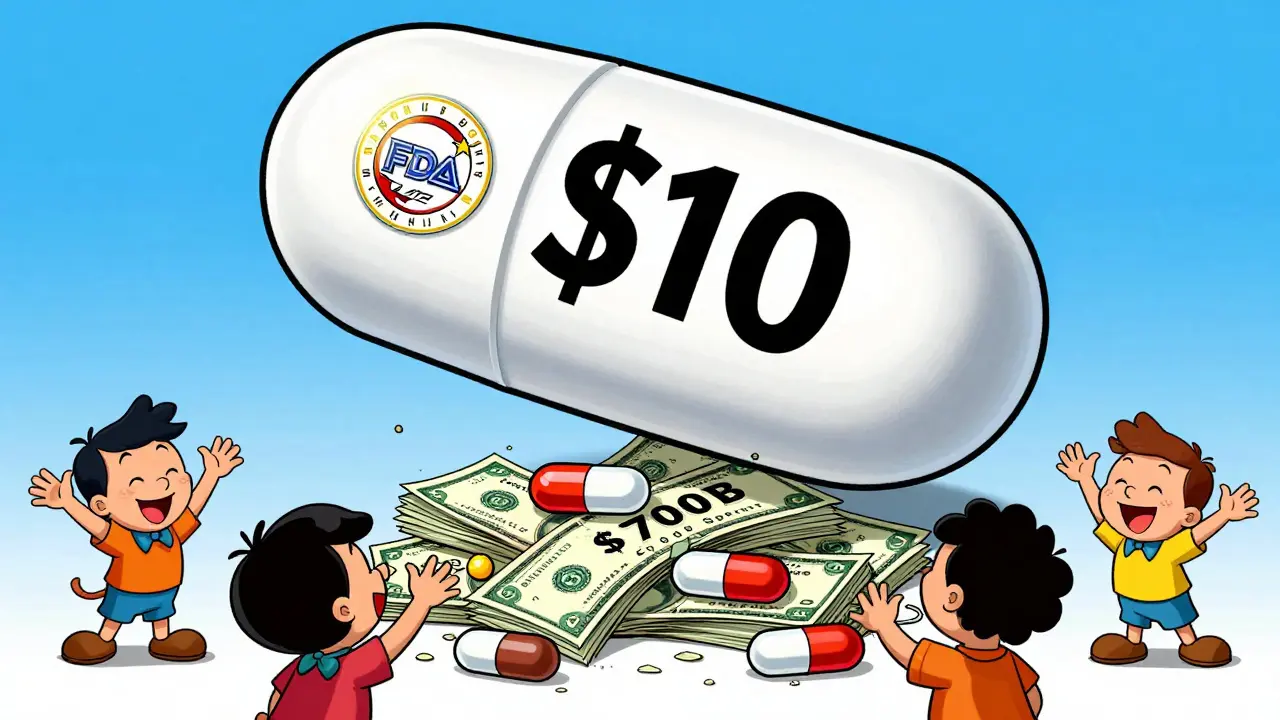
Every year, Americans fill over 3.9 billion prescriptions for generic medications. That’s nine out of every ten prescriptions written. And yet, these drugs account for just 12% of total spending on prescription drugs. The rest? Over $700 billion spent on brand-name drugs. This isn’t just a small difference-it’s the reason the U.S. healthcare system has saved trillions over the past decade.
How Generics Cut Costs Without Cutting Corners
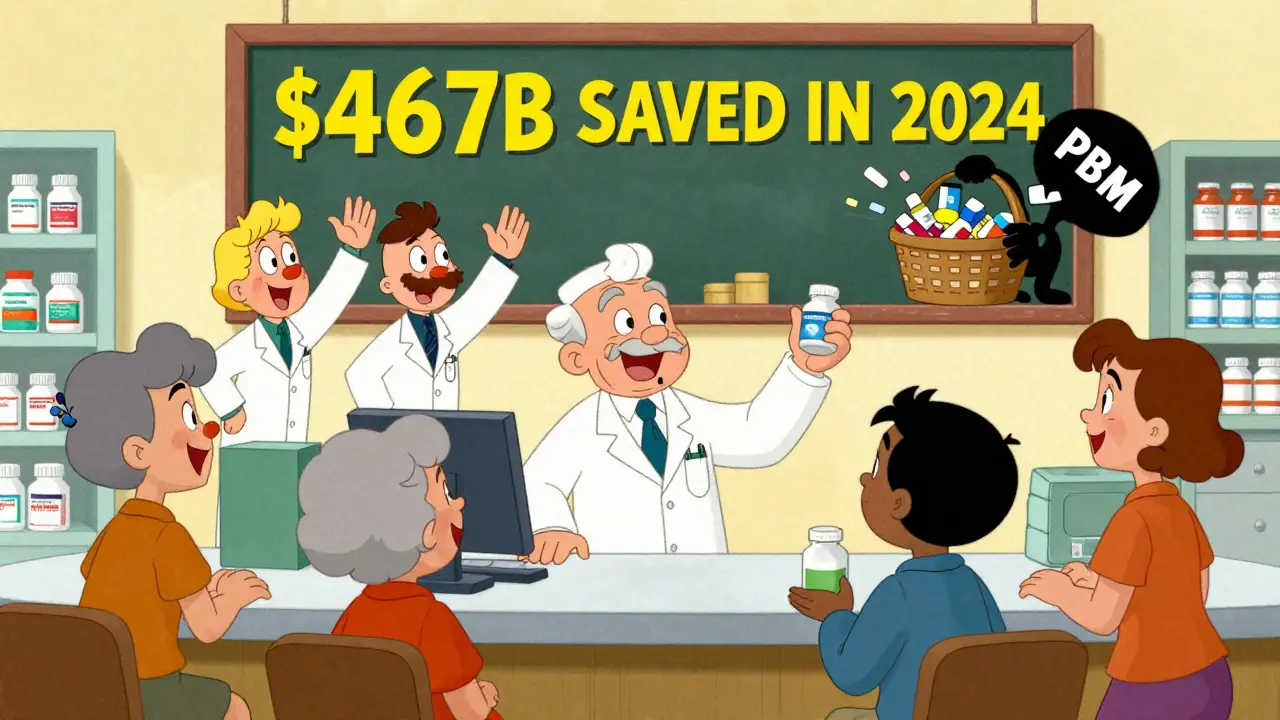
Generic drugs aren’t cheap knockoffs. They’re exact copies of brand-name medications, approved by the FDA to work the same way, in the same dose, and with the same safety profile. The only difference? Price. Because generic manufacturers don’t need to repeat expensive clinical trials, they can offer the same medicine for a fraction of the cost. In 2024 alone, generics saved patients and the healthcare system $467 billion. That’s more than the entire annual GDP of countries like Poland or Argentina.The savings aren’t random. They come from competition. When a brand-name drug’s patent expires, multiple generic makers enter the market. The first generic company gets a 180-day exclusivity period, but after that, prices drop fast. For example, the generic version of Lipitor-once one of the most expensive pills in the world-now costs less than $10 a month. That’s down from over $300 when it was still under patent.
Some of the biggest savings come from treating chronic conditions. The top 10 generic drugs in 2024 treated high blood pressure, diabetes, high cholesterol, and depression. Together, they saved $216.5 billion. Imagine if every person with high blood pressure had to pay $150 a month for the brand version instead of $5 for the generic. The financial burden would crush families and insurers alike.
Biosimilars: The Next Wave of Savings
Biosimilars are the next frontier. Unlike traditional generics, they’re not exact copies of brand-name drugs-they’re highly similar versions of complex biologic medications, like those used to treat cancer, rheumatoid arthritis, and Crohn’s disease. These drugs used to cost $10,000 to $20,000 a year. Now, biosimilars are bringing those prices down by 30% to 50%.In 2024, biosimilars saved $20.2 billion in the U.S. alone. Since the first one hit the market in 2015, total savings have reached $56.2 billion. That’s not just a win for patients-it’s a lifeline for Medicare and Medicaid. In 2024, biosimilars helped cut Medicare spending by $6.1 billion and Medicaid by $2.8 billion. As more biosimilars gain interchangeability status-meaning pharmacists can substitute them without a doctor’s approval-savings will climb even higher.
Why the U.S. Leads the World in Generic Use
The U.S. fills 90% of prescriptions with generics. Most European countries? Around 60% to 80%. Why the difference? It’s not because Americans are more willing to take generics. It’s because the system was built to make it happen.The 1984 Hatch-Waxman Act created the legal pathway for generic drugs to enter the market. It balanced patent protection for innovators with a clear process for generics to prove they’re safe and effective. That law turned the U.S. into the world’s largest generic drug market. Today, companies like Teva, Viatris, and Amneal produce over half of all generics used in America. Teva alone controls 16% of the market.
But even with this advantage, the U.S. still pays more for both brand and generic drugs than any other developed country. Why? Because pricing isn’t regulated. In Canada, the UK, or Germany, governments negotiate drug prices. In the U.S., it’s a free-for-all. Pharmacy Benefit Managers (PBMs) control which drugs are covered and at what price. Sometimes, they push patients toward more expensive brand drugs-even when generics are available-because they get kickbacks from the manufacturers.
The Hidden Barriers to Savings
You’d think with 90% of prescriptions being generic, everyone would be saving money. But that’s not always the case. Many patients still face roadblocks.One major issue? Patent thickets. Brand drug companies file dozens of secondary patents-on packaging, dosage forms, or delivery methods-to delay generic entry. A 2024 study found that just four drugs used patent thickets to block generics for over two years, costing the system $3.5 billion. Another tactic? “Product hopping.” That’s when a company slightly changes a drug-say, from a pill to a capsule-and pushes patients to the new version, which is still under patent. The old version goes generic, but the new one doesn’t.
Then there’s pay-for-delay. Sometimes, brand companies pay generic makers to hold off on launching their cheaper version. The Congressional Budget Office estimates this costs federal programs $3 billion a year. Blue Cross Blue Shield says these deals inflate drug costs by $12 billion annually.
Even when generics are available, patients can’t always get them. Prior authorization requirements for generics jumped 47% between 2019 and 2023. Some insurance plans require doctors to jump through hoops just to prescribe a generic. In Texas, 87% of prescriptions are filled with generics. In California, where mandatory substitution laws are in place, it’s 98%.
What Patients Really Think
Do people trust generics? Most do. A Drugs.com analysis of over 15,000 reviews showed 87% of users rated the cost of generics as excellent or good. But only 63% said they felt the effectiveness was just as good as brand names.That gap isn’t always about science. Sometimes it’s about perception. A patient who’s been on a brand-name drug for years might feel like the generic “doesn’t work as well”-even when clinical studies show no difference. In rare cases, differences in inactive ingredients (like fillers or dyes) can cause minor side effects, especially in people with allergies or sensitivities. But these are exceptions, not the rule.
On Reddit, one user shared how switching from a $800 brand-name drug to a $10 generic saved their life. Others reported confusion when pharmacies switched their medication without notice. Some Medicare Part D plans still steer patients toward brand drugs because of how their formularies are structured. That’s not about savings-it’s about profit.
Where the Money Goes
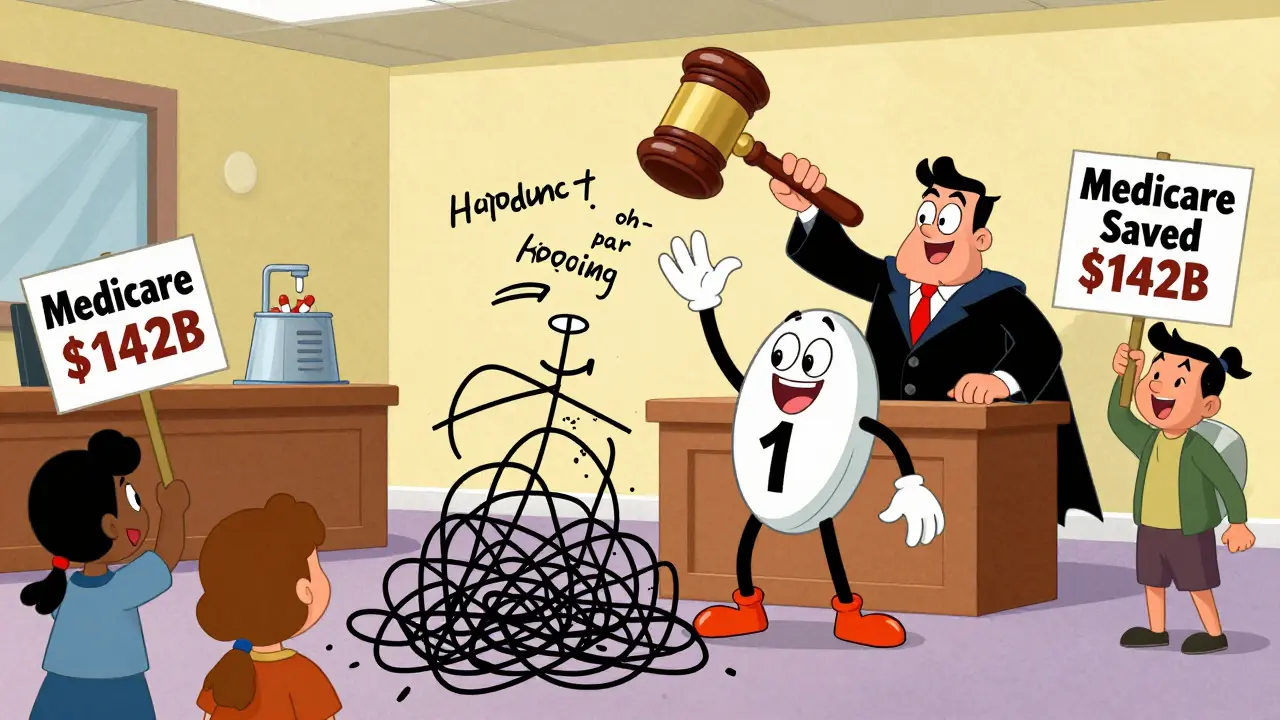
In 2024, Americans spent $98 billion on generics and $700 billion on brand drugs. That’s a 7-to-1 ratio. But here’s the twist: generics made up 90% of prescriptions. That means for every dollar spent on prescription drugs, just 12 cents went to generics. The rest? Over $700 billion for brand-name drugs that are often no better.Medicare saved $142 billion in 2024 thanks to generics. Medicaid saved $62.1 billion. Private insurers saved even more. Without generics, many of these programs would have collapsed under the weight of drug costs.
The generic drug market itself was worth $135.7 billion in 2024. That’s not small change. But it’s a fraction of what the system would have spent without them. The FDA approved 1,145 new generic drugs last year-a 7.3% increase from 2023. Many of these are complex injectables and inhalers, which used to be prohibitively expensive.
What’s Next? The Road to $5 Trillion in Savings
The IQVIA Institute projects that by 2034, generics and biosimilars will have saved the U.S. healthcare system a total of $5.1 trillion. That’s more than the entire federal budget in 2024.But that projection depends on fixing broken systems. Right now, 287 generic medications are in short supply. That’s because manufacturing is concentrated in a few countries, and consolidation has left just 10 companies controlling 63% of the market. If one factory shuts down, dozens of drugs disappear.
Legislation like S.1041, the Affordable Prescriptions for Patients Act, could fix this. It targets patent abuse and pay-for-delay deals. The Congressional Budget Office estimates it could save $7.2 billion a year. That’s not a drop in the bucket-it’s enough to cover free insulin for millions of Americans.
The real question isn’t whether generics save money. They do. The question is: why are we still letting barriers stand in the way? Why do patients still pay hundreds of dollars for pills that cost pennies to make? Why do insurers sometimes block access to the cheapest, most effective option?
Generics aren’t just a cost-cutting tool. They’re a moral imperative. They make treatment possible for people who would otherwise skip doses or go without. They keep Medicare solvent. They let hospitals treat more patients. They’re the reason millions of Americans aren’t choosing between rent and their medication.
The trillion-dollar impact isn’t a number on a spreadsheet. It’s a mother who can afford her diabetes pills. A veteran who doesn’t have to skip his blood pressure meds. A child with asthma who gets their inhaler every month. That’s the real value of generics. And it’s worth fighting for.
Aadil Munshi
December 20, 2025 AT 03:05Let’s be real - generics aren’t some magical miracle, they’re just capitalism doing its job when the patent monopoly cracks. The FDA doesn’t approve ‘copies’ - they approve bioequivalence, which is a fancy way of saying ‘it works the same, but cheaper.’ The real scandal isn’t that generics exist - it’s that we still pay $300 for a pill that costs $0.50 to manufacture. And yes, I’ve seen the spreadsheets. The profit margins on brand drugs are obscene.
Frank Drewery
December 22, 2025 AT 02:25This is actually one of the most important things no one talks about. My dad’s on 7 different generics for his heart and diabetes - he’d be dead without them. I know people who skip meds because of cost. This isn’t just economics - it’s survival. Thanks for laying it out so clearly.
Sajith Shams
December 24, 2025 AT 00:41You people act like generics are some revolutionary breakthrough when in reality it’s basic supply and demand. The only reason prices dropped is because Teva and Amneal started flooding the market - not because the government cared. And don’t get me started on biosimilars - they’re still 10x more expensive than they should be because Big Pharma bribes regulators. Wake up.
Chris Davidson
December 25, 2025 AT 11:43Generics save money yes but the system is still broken. PBMs control everything. Drug companies pay them to push expensive brands. Patients don’t even know what they’re getting. The FDA approves the pills but the market is rigged. No one is accountable. And nobody talks about the fact that most generics are made in China and India with zero oversight. You think your $5 pill is safe? Think again.
Kinnaird Lynsey
December 27, 2025 AT 03:26Wow. I just realized I’ve been on generics my whole life and never thought about how much that saved my family. My mom switched from brand insulin to generic and went from $400/month to $15. She cried. Not because she was sad - because she could finally breathe. This post made me cry too. Thanks for sharing this.
shivam seo
December 28, 2025 AT 03:21USA spends more on healthcare than every other country combined and you’re celebrating generics like they’re some kind of victory? Meanwhile Canada gets the same pills for half the price and their system works. We’re not saving money - we’re just being less stupid than before. Still way too expensive. Still broken. Still a joke.
Connie Zehner
December 29, 2025 AT 08:37OMG I switched to generic Zoloft last year and my anxiety got WORSE 😭 I swear it’s not the same!! I cried for 3 days! My pharmacist didn’t even tell me they switched it!! And now I’m terrified to take ANY generic again 😭😭😭 someone help me!!
Kitt Eliz
December 30, 2025 AT 12:36Let’s not ignore the supply chain fragility here. 70% of API manufacturing is concentrated in two countries - India and China. One flood. One political sanction. One factory fire - and you’ve got a national shortage of metformin or lisinopril. We need domestic production. We need antitrust enforcement on the 10 mega-companies controlling 63% of the market. We need mandatory substitution laws in every state. This isn’t just about cost - it’s about national security. Biosimilars are the future - but we’re not ready. And if we don’t act now, we’ll be back to rationing insulin again.
anthony funes gomez
December 31, 2025 AT 07:33The entire pharmaceutical industrial complex is predicated on the illusion of innovation - as if every new patent represents a leap forward when in reality it’s just incremental tweaking to extend monopolies. The Hatch-Waxman Act was a compromise - but the compromise was sold out. Generics are the only true public good in this system. And yet we treat them like second-class medicine. The real tragedy isn’t the cost - it’s the psychological conditioning that tells patients their life-saving medication is somehow inferior because it doesn’t have a fancy logo on the bottle. We’ve been trained to fear the generic. And that fear? It’s profitable.