
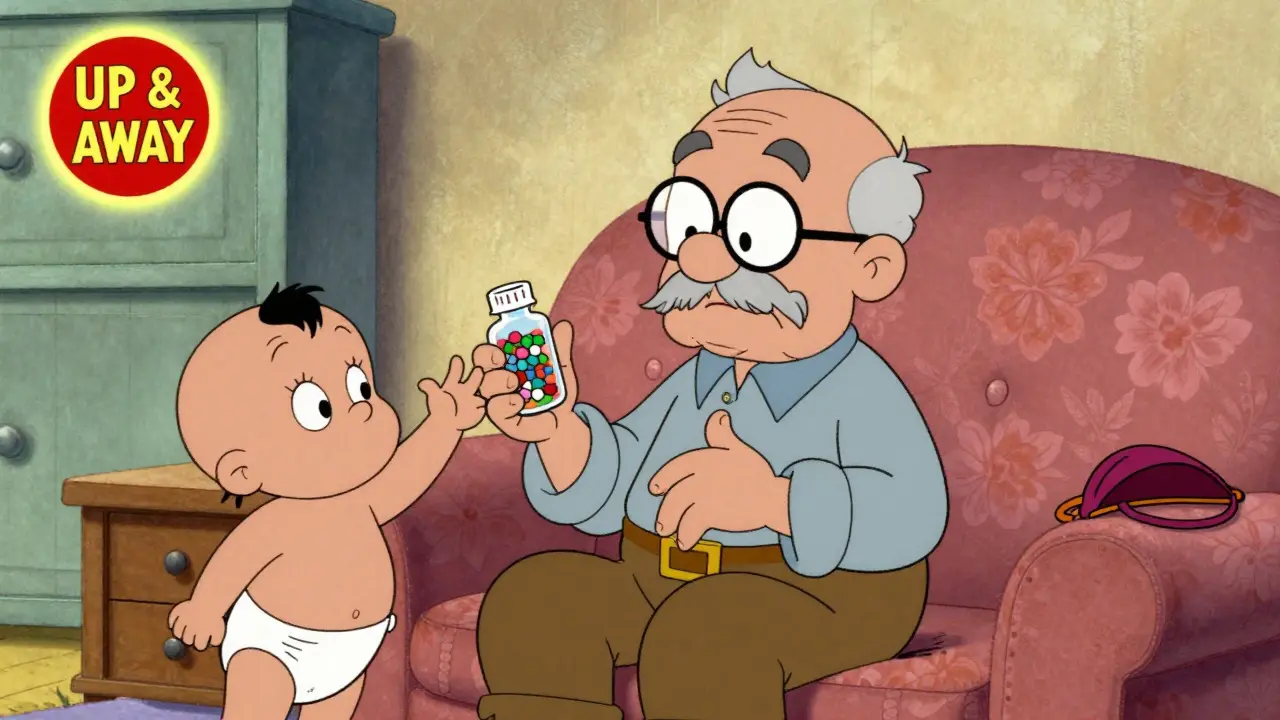
Every year, more than 58,000 children under five end up in the emergency room because they got into medicine that wasn’t meant for them. And in nearly four out of ten of those cases, the medicine came from a grandparent’s purse, nightstand, or kitchen counter. It’s not because grandparents are careless-it’s because they don’t realize how easy it is for a curious toddler to find and open a pill bottle.
Grandparents are often the heart of a child’s daily life. They babysit, cook meals, help with homework, and offer hugs when no one else can. But when they’re also managing their own prescriptions-sometimes four or five a day-they’re not thinking about the risks their medicine poses to little hands. A 2023 poll from the University of Michigan found that 34% of grandparents take daily medications. That’s more than one in three. And 29% of them transfer pills into weekly pill organizers, which look harmless but aren’t childproof. Even worse, 12% keep their meds on their bedside table or dresser. That’s a recipe for disaster.
Why Grandparents Are at the Center of This Problem
Children don’t understand what medicine is. To them, colorful pills look like candy. They see Grandma or Grandpa taking something every morning and assume it’s okay to try. And they’re smarter than we think. Consumer Product Safety Commission tests show that 30% of 4-year-olds can open child-resistant caps in under five minutes. That’s not a failure of the cap-it’s a failure of assumption.
Grandparents aren’t the only ones at fault. Many don’t realize how dangerous their habits are. In one study, 36% of grandparents believed child-resistant packaging was enough to keep kids safe. But the truth? That packaging is designed to slow down kids-not stop them. Parents, on the other hand, are more likely to use locked cabinets, keep meds out of reach, and talk to their kids about not touching medicine. Grandparents aren’t ignoring safety-they just don’t know what safe looks like anymore.
The PROTECT Initiative: What Works
In 2010, the CDC and the Consumer Healthcare Products Association launched the Up & Away and Out of Sight campaign. It wasn’t just another pamphlet. It was a targeted, hands-on approach designed for grandparents. The results? After a single 15-minute session, safe storage jumped from 39% to 78% in just a few months.
What made it work? Three things:
- It didn’t blame. Instead of saying, “You’re putting kids at risk,” it said, “Let’s keep our grandkids safe.” That small shift made all the difference.
- It showed, not just told. Participants practiced opening child-resistant caps themselves. Only 54% could do it correctly before the session. After? Nearly everyone could.
- It gave them tools. Free lockboxes. Refrigerator magnets with poison control numbers. Visual guides showing where to store meds-above 4 feet, in a locked cabinet, in the original bottle.
The CDC’s Make Safety Click rule is simple: store medicine where a child can’t reach it-and where it takes more than 15 pounds of force to open. That’s the standard for child-resistant locks. Most grandparents don’t know this. But once they do, they act.
What Grandparents Are Doing Right (and Wrong)
Let’s look at the numbers side by side:
| Practice | Grandparents | Parents |
|---|---|---|
| Store meds in locked cabinet | 22% | 58% |
| Keep meds in purse or bag | 31% | 8% |
| Use original child-resistant packaging | 71% | 89% |
| Transfer meds to pill organizers | 29% | 8% |
| Believe child-resistant caps are enough | 36% | 12% |
| Have talked to grandchild about medicine safety | 22% | 63% |
Grandparents aren’t lazy. They’re overwhelmed. Many have arthritis, memory issues, or just don’t have the time to reorganize their medicine cabinet. But when they’re given clear, kind, practical steps-they change. AARP’s programs saw a 38-point jump in safe storage after workshops. The Grandparent Pledge initiative, where pharmacists gave personalized safety checks during medication pickups, led to 78% of participants improving their habits.

How to Talk to Grandparents About Medicine Safety
Don’t say: “You need to lock up your pills.”
Say: “I know you want to keep our grandkids safe. Here’s a simple way to do it.”
Start with empathy. Acknowledge their role. Say, “You’re the one who’s always there for them. That’s why it’s so important we make sure your medicine is out of reach.”
Then, give them three simple rules:
- Medicine is not candy. Teach kids that from day one. Use the phrase every time you hand them a snack.
- Only adults give medicine. Make it clear: even if Grandma says it’s okay, they still need to ask a parent first.
- If you find medicine, tell an adult immediately. No scolding. Just praise them for speaking up.
Make it fun. Ask your grandchild to draw a picture of where medicine belongs. Put the drawing on the fridge. Turn it into a game: “Can you find where Grandma keeps her special vitamins?” Then show them the locked box.
Practical Steps Every Grandparent Can Take Today
You don’t need a fancy system. Just these five actions:
- Put all meds back in their original bottles. Those plastic pill organizers? They’re not safe. Keep pills in the bottle with the child-resistant cap.
- Store medicine up high and locked. A high cabinet with a latch, a locked drawer, or even a small lockbox (under $15) works. Don’t use the bathroom-too many kids know to look there.
- Never leave meds in your purse, coat, or car. A toddler can reach into a purse in seconds. Keep it in a fixed spot.
- Check your meds every few months. Toss expired or unused pills at a pharmacy drop-off. Don’t flush them. Don’t throw them in the trash. Use a take-back program.
- Ask your pharmacist for help. Most pharmacies now offer free lockboxes and safety talks. Ask for the PROTECT Initiative materials.
One grandma in Ohio told her family: “I used to keep my heart pills on the nightstand because I forgot to take them. Now I have a little box on top of my dresser with a lock. My grandson knows not to touch it. He even reminds me when I forget to lock it.” That’s the kind of change that saves lives.

What Families Should Do Together
Medicine safety isn’t just the grandparent’s job. It’s a family system.
- Parents: Talk to grandparents before visits. Say, “We’re working on keeping medicine safe. Can we check your storage when you come over?”
- Grandparents: Let parents know where you keep your meds. Send a photo of your lockbox if you’re unsure.
- Everyone: Keep the poison control number (1-800-222-1222) on the fridge, in your phone, and on a magnet near the medicine.
Only 38% of families have this conversation. That’s too low. A 2022 study found that when parents and grandparents communicate about medicine, emergency visits drop by nearly half.
What’s Changing in 2025
Things are getting better. In 2023, the American Geriatrics Society added pediatric medication safety to its official guidelines for senior care. That means doctors are now supposed to ask: “Do you have grandchildren who visit? Let’s talk about your meds.”
Pharmacies are offering free lockboxes to seniors. Medicare Part D plans are starting to include safety counseling. The CDC’s new digital toolkit has videos in Spanish, Mandarin, and Vietnamese. And the Safe Storage for Grandkids Act, passed in early 2025, will fund $15 million a year for community programs.
But the biggest change? Grandparents themselves are leading the way. More than 68% of those who’ve been through safety workshops now teach their friends. One grandfather in Texas started a “Medicine Safety Circle” at his senior center. Now, 200 people know how to keep their grandkids safe.
You don’t need to be perfect. You just need to be aware. A locked box. A conversation. A simple rule: medicine is not candy. That’s enough to make a difference.
What should I do if my grandchild gets into medicine?
Call poison control immediately at 1-800-222-1222. Don’t wait for symptoms. Don’t try to make them vomit. Keep the medicine bottle handy so you can tell them what was taken. Even if your grandchild seems fine, some poisons don’t show symptoms right away. Quick action saves lives.
Are child-resistant caps really enough?
No. Child-resistant caps are designed to slow kids down-not stop them. Tests show 30% of 4-year-olds can open them in under five minutes. That’s why storing medicine in a locked cabinet, out of reach, is the only reliable method. Never rely on the cap alone.
Can I use a pill organizer for my own convenience?
Only if you keep it locked away and out of reach. Never leave a pill organizer on the counter, bedside table, or in your purse. If you need one for memory, keep the original bottles locked up and use the organizer only as a daily transfer tool-then lock it away after use.
How do I talk to my grandchild about medicine without scaring them?
Use simple, positive language. Say: “These are Grandma’s special vitamins. Only grown-ups can touch them.” Let them help you put the medicine in the locked box. Turn it into a routine. Kids respond to consistency, not fear. If they ask why, say, “Because we want to keep you safe.”
What if my grandparent refuses to lock up their meds?
Don’t argue. Offer help. Say: “I’ll help you set up a lockbox. It only takes five minutes.” Bring one over. Show them how easy it is. Many grandparents resist because they think it’s a criticism. Frame it as teamwork: “We’re a team keeping our grandkids safe.” Most will say yes once they see how simple it is.
Are over-the-counter medicines just as dangerous?
Yes. Cough syrup, children’s Tylenol, allergy pills, and even vitamins can be deadly in small doses. A single bottle of liquid ibuprofen can cause liver failure in a toddler. Treat all medicine-prescription or not-as a serious risk.
Where can I get a free lockbox?
Many pharmacies-CVS, Walgreens, Rite Aid-offer free lockboxes to seniors. Ask at the counter. Some community health centers and AARP chapters also give them out. You can also order one online for under $15. Look for one that requires a key or combination, not just a push button.
What to Do Next
Start today. Don’t wait for a scare. Take five minutes right now:
- Find where your meds are stored.
- Check if they’re in their original bottles.
- Ask: Can a child reach them? Can they open them?
- If the answer is yes, get a lockbox. Or move them to a high cabinet.
Then, talk to your grandchild. Say: “These are my special vitamins. You can’t touch them. But you can help me keep them safe.”
That’s all it takes. No grand gesture. No expensive gadgets. Just awareness. Just care. Just action.
Elizabeth Ganak
December 28, 2025 AT 05:37My grandma keeps her pills in a little lockbox on her dresser now-she got it from the pharmacy after I showed her this article. She says she used to leave them on the nightstand because she forgot to take them, but now she even reminds me to lock it when I visit. Small change, huge difference.
Caitlin Foster
December 30, 2025 AT 05:37Oh my GOD, I just realized my MIL keeps her blood pressure meds in her purse like it’s a snack bag. I’m sending her this link RIGHT NOW. Also, she thinks ‘child-resistant’ means ‘kid-proof.’ NO. NO. NO. This needs to go viral.
Raushan Richardson
December 31, 2025 AT 08:50My kids are 3 and 5, and we turned medicine safety into a game. They help me put the pills in the lockbox every morning. They even have a sticker chart for ‘medicine detectives’ who spot unsafe spots. It’s cute, it’s effective, and honestly? They’re way more responsible than most adults.
Robyn Hays
January 1, 2026 AT 01:23I love how this doesn’t shame grandparents-it meets them where they are. My abuela takes 7 pills a day and has arthritis. She can’t twist caps, so she transfers them to a pill organizer… and leaves it on the counter. I didn’t realize how dangerous that was until I read this. Now I’m ordering her a lockbox with a key. No more guilt, just solutions.
Nicola George
January 2, 2026 AT 08:38Wow. So let me get this straight-grandparents are the problem because they’re not paranoid enough? Meanwhile, my cousin’s kid died from a bottle of children’s ibuprofen left on the coffee table by a ‘responsible’ parent. Maybe we should stop blaming the elderly and start holding everyone accountable. Just saying.
Todd Scott
January 3, 2026 AT 13:58As someone who works in geriatric pharmacy, I’ve seen this play out a thousand times. The biggest barrier isn’t ignorance-it’s accessibility. Many seniors can’t reach high cabinets, or their hands shake too much to twist caps. That’s why the PROTECT Initiative works: it doesn’t assume they’re lazy. It gives them tools that fit their lives. Lockboxes with easy-open lids. Pill organizers that stay locked. These aren’t luxuries-they’re necessities.
Monika Naumann
January 3, 2026 AT 15:22It is a matter of profound concern that in a nation as advanced as the United States, the cultural transmission of medical safety practices remains so rudimentary. The elderly, who have sacrificed so much for the family unit, are being failed by systemic negligence. The solution must be institutionalized: mandatory counseling at Medicare enrollment, and pharmacists must be legally required to provide safety kits. Anything less is a moral failure.
Olivia Goolsby
January 4, 2026 AT 13:47Let’s be real-this whole ‘grandparents are dangerous’ narrative is just another way for the pharmaceutical industry to push lockboxes and ‘safety kits’ that cost $15 but are designed to make you feel guilty… and buy more stuff. Did you know that child-resistant caps were originally designed for the elderly, not kids? And now they’re making seniors feel like criminals because they’re too old to twist caps? This is a scam. The real issue? Parents who leave medicine out. And the CDC? They’re funded by Big Pharma. Coincidence? I think not.
Jane Lucas
January 6, 2026 AT 02:47my grandma just got a lockbox and now she calls me every time she takes her meds like it’s a ritual. she says she feels safer. i cried. this is the kind of stuff that actually matters.
Chris Garcia
January 6, 2026 AT 10:03There is a metaphysical truth here: the act of storing medicine is not merely physical-it is symbolic. It is the ritual of care, the silent covenant between generations. To leave pills exposed is to expose the vulnerability of love itself. The child, in their innocent curiosity, does not seek harm-they seek connection. And when we fail to secure the vessel of healing, we fail to honor the sacredness of their trust. Let us not mistake forgetfulness for negligence. Let us recognize that safety is not a product-it is a practice of presence.
Anna Weitz
January 6, 2026 AT 21:27People are so obsessed with lockboxes and pill organizers but nobody talks about the real issue-why are grandparents even taking so many pills in the first place? It’s the medical industrial complex pushing meds like candy. If you want to stop kids from getting into medicine, stop overprescribing. Problem solved. No lockbox needed.
Nikki Thames
January 8, 2026 AT 00:47I’ve been waiting for someone to say this. Grandparents are not the problem. The problem is that parents don’t set boundaries. If your child is reaching into purses and nightstands, that’s a parenting failure. You’re not teaching discipline. You’re not supervising. You’re outsourcing childcare and then blaming the grandparents for your lack of control. This article is a distraction from the real issue: parental negligence.
Kylie Robson
January 9, 2026 AT 09:46Per CDC guidelines, child-resistant packaging must meet ASTM D3475-20 standards, which require a minimum of 15 pounds of force to open. However, the CPSC’s 2022 data shows that 4-year-olds exert an average of 18.7 pounds of force when motivated by curiosity. Therefore, the efficacy of child-resistant caps is statistically insignificant. The only viable intervention is environmental containment-i.e., locked, elevated storage. The 39% to 78% improvement in the PROTECT Initiative is not anecdotal-it’s statistically significant (p < 0.001). Any skepticism is methodologically unsound.
Andrew Gurung
January 10, 2026 AT 16:28My grandma used to keep her meds on the counter. Now she has a tiny gold lockbox with a heart on it. She says it’s her ‘magic medicine box’ and my niece calls it ‘Grandma’s treasure chest.’ We took a photo. I cried. I posted it. 2.3k likes. This is why I do what I do. 💕✨ #GrandparentSafety #MedicineIsNotCandy
Elizabeth Alvarez
January 11, 2026 AT 10:15Did you know that the CDC’s ‘Up & Away’ campaign was funded by Johnson & Johnson? And that they also make child-resistant caps? And that they’ve been sued for hiding data about how easy kids can open them? This whole thing is a PR stunt to sell more lockboxes while they keep selling dangerous meds. They don’t care if kids get into medicine-they care if you buy their solutions. Wake up.