
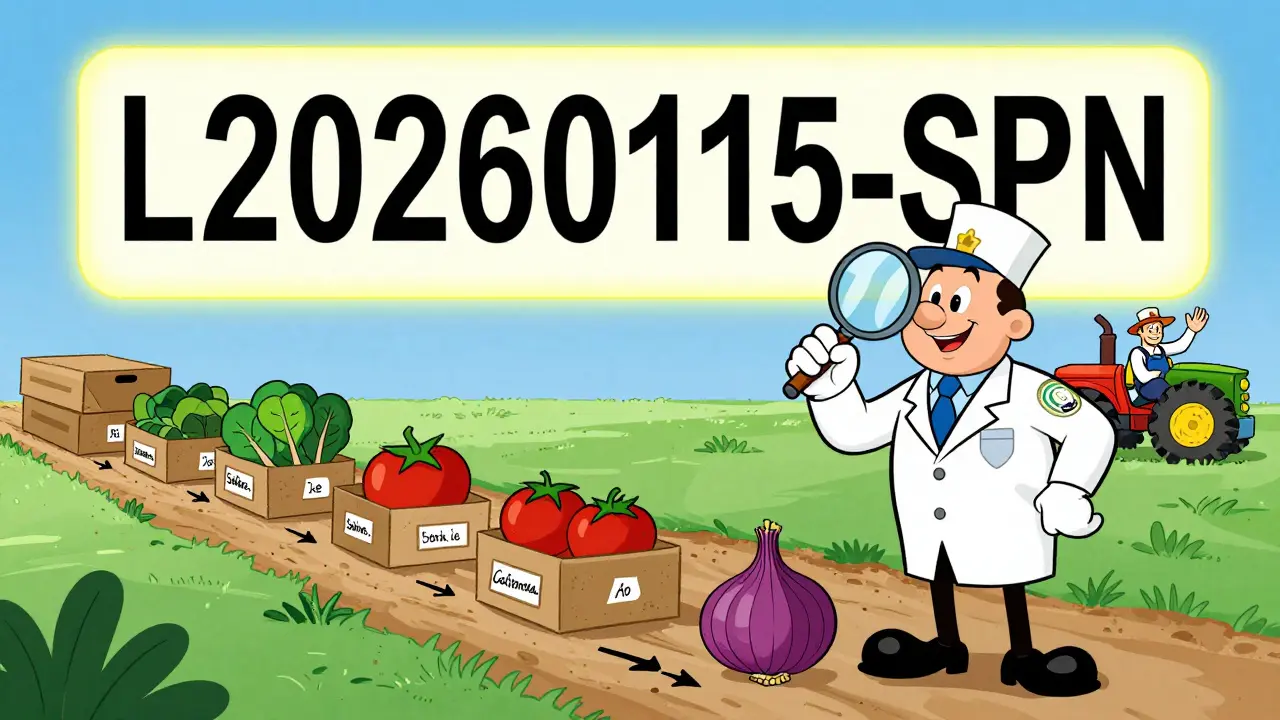
When a batch of spinach causes a nationwide outbreak of E. coli, how does the FDA find the exact source in time to stop more people from getting sick? The answer isn’t guesswork or old-school phone calls-it’s the Lot Number Tracking system under the FDA’s Food Traceability Rule. This isn’t just paperwork. It’s a real-time lifeline in food safety.
Why Lot Numbers Matter More Than Ever
Before 2022, tracing contaminated food often meant chasing paper trails across dozens of companies. Investigators had to call farms, packers, distributors, and retailers-sometimes for weeks-just to find where a bad batch came from. By then, hundreds could be sick, and the product was already gone from shelves. The FDA changed that with the Food Traceability Rule, part of the Food Safety Modernization Act (FSMA). The rule targets high-risk foods that cause the most outbreaks: leafy greens, tomatoes, onions, fresh-cut fruits and veggies, nut butters, soft cheeses, eggs, and certain seafood. These make up about 15% of the U.S. food supply but cause nearly half of all foodborne illnesses. At the heart of this system is the Traceability Lot Code (TLC). It’s not just any lot number. It’s a unique, trackable identifier assigned at three specific points: when raw agricultural commodities are first packed (like when lettuce is boxed at the farm), when seafood is first received on land, and when food is transformed (like when tomatoes are turned into salsa). Once assigned, that TLC travels with the product through every step of the supply chain.How the TLC System Works
The TLC is the glue that connects everything. Each code links to seven Key Data Elements (KDEs): where it was assigned, what the product is, how much there is, the unit of measure, and transaction details like who sent it and when. These aren’t optional. If the FDA asks for them during an outbreak, companies must deliver them electronically within 24 hours. Companies can use any format for their TLC-alphanumeric, Julian date + product code, or even a random string-as long as it’s unique and stays with the product. The FDA doesn’t mandate a specific system. That flexibility lets big players like Tyson Foods use their existing codes, and small farms use simple handwritten labels. But here’s the catch: the TLC must be passed along unchanged unless the food is transformed. If a distributor repacks 100 boxes of spinach into 20 larger crates, they can’t just slap on a new code. They must keep the original TLC and link it to the new packaging. That’s how the FDA traces a single contaminated head of lettuce back to the field where it was grown-even if it passed through five different handlers.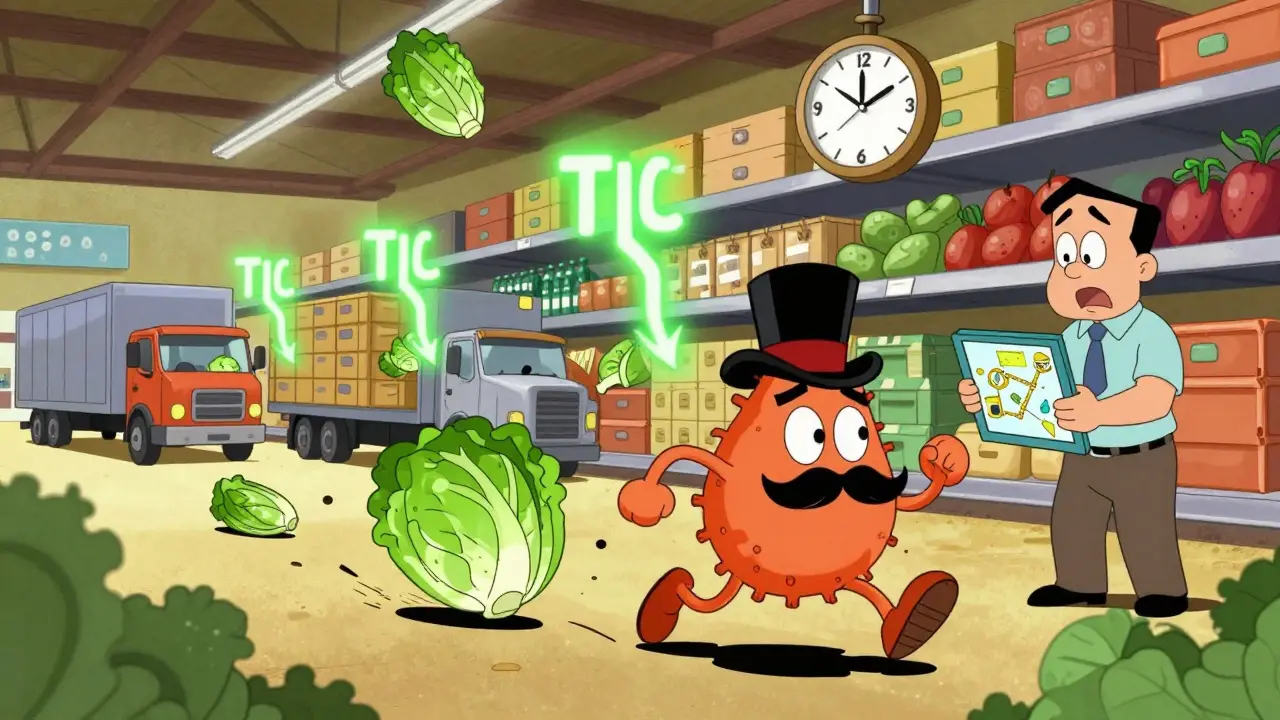
What Happens During an Outbreak
Imagine a cluster of illnesses in Ohio, Texas, and California. The CDC spots the pattern and alerts the FDA. Instead of calling every supplier, FDA investigators pull up digital records linked to the TLC. They see that all affected products came from the same lot code: L20260115-SPN. They trace it backward: who shipped it? Who packed it? Who grew it? Within hours, they isolate the source: a single farm in Salinas, California. That farm’s entire harvest from that day is pulled from stores. Other lots are flagged for testing. The outbreak is contained before it spreads further. This is what the FDA says is possible: cutting outbreak response time from weeks to under 24 hours. Pilot programs showed a 20-30% drop in illness cases when traceability was fast and accurate. That’s not theoretical. It’s lives saved.Who Has to Comply-and When
The rule applies to anyone who manufactures, processes, packs, or holds food on the Food Traceability List (FTL). That’s about 15,000 facilities across the U.S. Compliance was originally set for January 20, 2026, but in September 2023, the FDA proposed pushing that date to July 20, 2028. Why? Because many small businesses weren’t ready. A 2023 survey found only 42% of small and medium food businesses even knew about the TLC requirements. Many are still using paper logs or outdated software. The FDA has responded with training modules, a Traceability Assistance Program, and $25 million in funding from the 2023 Farm Bill to help small farms and processors get up to speed. Large companies like Walmart and Kroger were already ahead of the curve. Walmart started requiring blockchain-based traceability for leafy greens back in 2019. They’re not just meeting the rule-they’re exceeding it. But for smaller players, the challenge is real. Integrating TLCs into legacy ERP systems, training staff, and syncing with suppliers all take time and money. The average cost per company is around $42,500.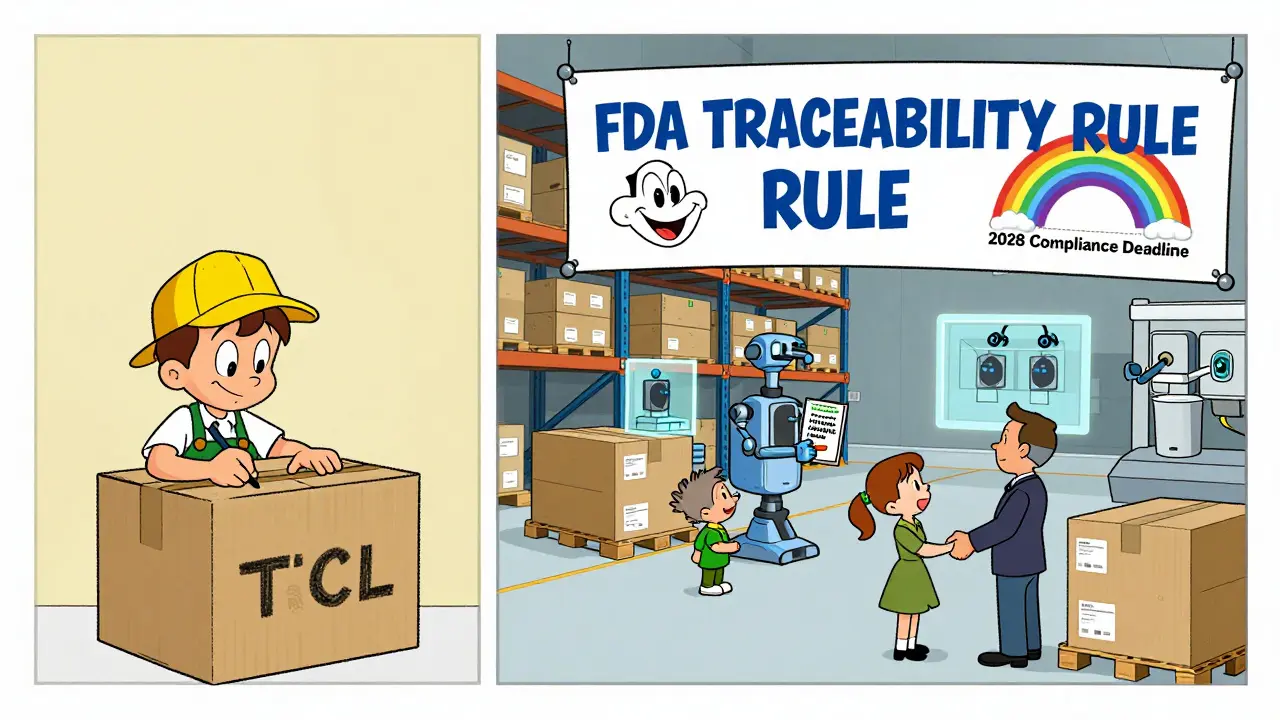
Challenges and Criticisms
Not everyone is thrilled. Critics say the Food Traceability List is too narrow. Melons, for example, have caused major outbreaks but aren’t included. Consumers Union called it a dangerous gap. Others worry about “tandem coding”-having to maintain both internal lot codes and TLCs. The FDA addressed this by saying: if your current lot code meets the rules, it can be your TLC. No need for two systems. Another issue? Data silos. Even if every company has a TLC, if they don’t share data in the same format, it’s useless. Mike Taylor, former FDA deputy commissioner, called the system “necessary but insufficient” without standardized electronic formats. The FDA is working on that now, with draft standards expected in mid-2024. And then there’s the global gap. The EU launched its Digital Product Passport in January 2023-different rules, different tech. The FDA is holding talks with international regulators to align standards. Otherwise, U.S. exporters could face barriers abroad.What’s Next for Lot Tracking
The future of food traceability isn’t just about codes-it’s about technology. The FDA is funding pilots using blockchain, IoT sensors, and AI to automatically log temperature, location, and handling data alongside TLCs. Imagine a truck carrying spinach that logs its temperature in real time. If a batch turns contaminated, you don’t just know where it came from-you know exactly when it was exposed to unsafe conditions. The U.S. food traceability market is expected to grow from $1.87 billion in 2022 to $4.62 billion by 2028. That’s not just tech companies making money-it’s safer food for everyone. The bottom line? Lot number tracking isn’t about bureaucracy. It’s about stopping sickness before it spreads. The TLC system gives the FDA the tools to act fast, protect public health, and hold the right people accountable. It’s not perfect yet. But it’s the most powerful food safety tool the U.S. has ever had.What is a Traceability Lot Code (TLC)?
A Traceability Lot Code (TLC) is a unique alphanumeric identifier assigned to a specific batch of food on the FDA’s Food Traceability List. It must be assigned at three key points: when raw produce is first packed, when seafood is first received on land, and when food is transformed (like chopped, cooked, or repackaged). The TLC links to seven key data elements and must stay with the product through the entire supply chain so the FDA can trace it back to its origin during an outbreak.
Which foods require lot number tracking under the FDA rule?
The FDA’s Food Traceability List (FTL) includes high-risk foods linked to frequent outbreaks: leafy greens (like lettuce and spinach), tomatoes, onions, fresh-cut fruits and vegetables, soft cheeses, eggs, nut butters, and certain seafood (like shrimp and catfish). These foods make up about 15% of the U.S. food supply but are responsible for a large share of foodborne illnesses. Melons and ready-to-eat foods are under review for future inclusion.
When does the FDA’s lot tracking rule take effect?
The rule became effective on December 13, 2022, but compliance was originally due on January 20, 2026. In September 2023, the FDA proposed extending the deadline to July 20, 2028, to give businesses more time to implement systems. This extension is pending final approval but is widely expected to be granted.
Can a company use its existing lot code as the TLC?
Yes. The FDA explicitly states that any existing lot code a company already uses can serve as the Traceability Lot Code, as long as it meets the rule’s requirements: it must be unique, passed along the supply chain, and linked to the required seven Key Data Elements. There’s no need to create a second code unless the existing one doesn’t meet the standards.
What happens if a company doesn’t comply with the lot tracking rule?
Non-compliance can lead to enforcement actions, including warning letters, import alerts, or even product seizures. The FDA can also refuse entry of imported foods that lack proper TLC documentation. While the agency has emphasized education over punishment in the early stages, penalties will increase as compliance deadlines pass.
How does lot tracking help small farms?
The FDA offers a Traceability Assistance Program to help small farms and businesses meet the requirements. This includes free training modules, templates for Traceability Plans, and technical support. Small businesses can use simple methods like handwritten labels or low-cost software. The 2023 Farm Bill also allocated $25 million to fund grants and outreach specifically for small farms, making compliance more achievable.
Is blockchain required for lot tracking?
No, blockchain is not required. The FDA rule allows any format for TLCs and doesn’t mandate specific technology. However, some retailers like Walmart and Whole Foods use blockchain systems voluntarily because they offer faster, more transparent tracking. The FDA is funding pilot projects with blockchain and IoT to explore future improvements, but compliance can be met with spreadsheets, ERP systems, or even paper records-as long as the data can be provided electronically within 24 hours when requested.
How does this system compare to pharmaceutical traceability?
Pharmaceuticals use the Drug Supply Chain Security Act (DSCSA), which requires unique serial numbers on every individual package. Food traceability uses lot-level tracking instead-meaning one code covers a batch of hundreds or thousands of units. This is more practical for food, where products are often bulk-packed and less valuable per unit. The FDA chose lot-level tracking to balance safety with feasibility across a fragmented supply chain.
Diana Dougan
January 31, 2026 AT 01:23soooo... we're spending millions so the FDA can *maybe* find the bad spinach before 300 people get diarrhea? 🤡 i've seen better traceability in my dog's microchip. also, who wrote this? it's like a corporate brochure with extra steps.
Bobbi Van Riet
February 1, 2026 AT 08:34Honestly, this is one of those rare policy wins that actually saves lives. I work in a small organic farm, and yeah, the paperwork is a pain-but the Traceability Assistance Program helped us set up a simple QR code system for $200. Now, if something goes wrong, we can tell exactly which box went to which store. That’s peace of mind. And honestly? I’d rather have a few extra labels than explain to a kid’s parent why they got sick from our kale. It’s not perfect, but it’s a damn good start.
Natasha Plebani
February 3, 2026 AT 06:21The TLC system represents a paradigmatic shift from reactive containment to anticipatory governance within the food supply chain’s ontological architecture. By embedding traceability as a structural invariant-rather than an ad hoc compliance artifact-we’re witnessing the emergence of a post-Fordist bio-regulatory regime where the commodity is no longer merely a product, but a data node in a distributed epistemic network. The seven KDEs function as semiotic anchors, rendering the invisible labor of agrifood systems legible to technocratic surveillance. Yet, the persistent fragmentation of data ontologies across supply chain actors reveals the enduring tension between standardization and heterogeneity in neoliberal biopolitics.
Eliana Botelho
February 4, 2026 AT 10:38Okay but why only these 15% of foods? What about melons? They’ve killed people too. And what about deli meats? Or that one time 50 people got sick from pre-made sandwiches? This system feels like it was designed by someone who only eats kale smoothies and thinks everything else is ‘low risk.’ Also, why is Walmart the hero here? They’re the reason we have 10 varieties of kale in every aisle. This isn’t safety-it’s corporate virtue signaling wrapped in a government mandate. And don’t even get me started on how ‘simple’ handwritten labels are going to work when the farmer’s handwriting looks like a spider had a seizure.
Darren Gormley
February 5, 2026 AT 14:37LOL imagine having to track every single lettuce like it’s a luxury watch 🤦♂️💸
Also, why is the FDA the only one who gets to see this data? Shouldn’t consumers have access? Or is this just another ‘trust us, we know best’ move? Also, blockchain? Nah. Just give me a QR code that doesn’t break when I scan it in the dark. 📱😭
Mike Rose
February 5, 2026 AT 15:20bro why do we even need all this? i just wash my veggies and hope for the best. also, ‘traceability lot code’ sounds like something a robot made up. just tell me if it’s safe. not give me a 12-digit code to type into a phone app. i’m not a nerd.
Sheila Garfield
February 5, 2026 AT 15:33I appreciate the effort here. Small farms are doing their best, and the $25 million in aid is a real lifeline. I’ve seen farmers struggle with tech, but the fact that they’re offering free templates and training? That’s not just policy-it’s compassion. Maybe it’s not perfect, but it’s moving in the right direction. Let’s not tear it down before it’s had a chance to work. We all want safe food. Let’s help each other get there.
Shawn Peck
February 5, 2026 AT 21:33THIS IS A DISASTER. They’re making farmers into IT technicians. You think a 70-year-old guy in Idaho who’s been selling onions since 1982 is gonna learn blockchain? No. He’s gonna get fined. And then his family loses the farm. This isn’t safety-it’s bureaucratic violence. The FDA is out of touch. We need to burn this whole system down and start over. I’m not even kidding.
Niamh Trihy
February 6, 2026 AT 22:36Actually, this is a huge step forward, especially for international trade. The EU’s Digital Product Passport is already live, and if we don’t align, U.S. exporters are going to get stuck at borders. The FDA’s flexibility with existing codes is smart-it avoids forcing everyone to rebuild from scratch. And yes, the 24-hour data requirement is intense, but if we can do it for pharmaceuticals, why not food? We’re not talking about tracking a single pill-we’re talking about batches. It’s doable. The tech is here. It’s just about rollout.
Sarah Blevins
February 8, 2026 AT 12:08Compliance data from 2023 indicates that 58% of non-compliant entities are concentrated in the Southeastern U.S., with primary barriers being infrastructure deficits and workforce training gaps. The projected $42,500 average cost per entity exceeds median annual revenue for 37% of small food processors. Without standardized API protocols, interoperability remains a systemic risk. The FDA’s current framework lacks enforceable data schema requirements, rendering the system vulnerable to semantic drift across supply chain tiers.
Jason Xin
February 9, 2026 AT 03:58Yeah, I get the frustration. I work with small farms, and the paperwork is brutal. But I also remember when a kid got sick from contaminated spinach in 2006-and it took *months* to trace. This system isn’t perfect, but it’s the first time we’ve had a real shot at stopping outbreaks before they go national. The sarcasm is funny, but this isn’t a joke. It’s about keeping people alive. And honestly? If Walmart can do it with blockchain, we can all do it with Excel.