
It’s 2 a.m. again. Your mind won’t shut off. The clock ticks. You’ve tried counting sheep, deep breathing, even that podcast you swear helps - but nothing works. So you reach for the bottle in the bathroom cabinet: a little white pill labeled "Sleep Aid" or a tiny melatonin gummy. It’s easy. It’s over-the-counter. It’s probably fine, right?
Maybe. But here’s the truth most people don’t tell you: OTC sleep aids aren’t harmless nightcaps. They’re powerful chemicals with real risks - and most people use them wrong.
What’s Actually in Those Pills?
Not all OTC sleep aids are the same. There are two main types, and they work in completely different ways.
The first group is built around antihistamines - mainly diphenhydramine and doxylamine. These are the same ingredients found in allergy meds like Benadryl and Unisom. They don’t target sleep directly. Instead, they block histamine, a brain chemical that keeps you alert. The side effect? Drowsiness. That’s why you feel sleepy. But your brain isn’t getting natural rest - it’s being chemically subdued.
The second group is supplements: melatonin, valerian root, chamomile. Melatonin is the most popular. It’s a hormone your body makes naturally to signal bedtime. Supplements try to boost that signal. But here’s the catch: a 2017 study found that melatonin pills often contain anywhere from 83% less to 478% more than what’s on the label. You think you’re taking 1mg? You might be getting 5mg - or just 0.2mg. No regulation. No safety net.
Valerian and chamomile? They’re herbs. Some people swear by them. But there’s almost no solid proof they work better than a placebo for most people. And since they’re not regulated like drugs, you never know what’s really in the bottle.
The Real Benefits - And How Small They Are
Let’s cut through the marketing. Do these things actually help you sleep?
Yes - but barely.
According to clinical trials reviewed by the American Academy of Sleep Medicine, OTC sleep aids reduce the time it takes to fall asleep by just 3 to 13 minutes. They add 20 to 60 minutes of total sleep - on average. That’s less than one extra hour of rest. For comparison, improving your bedtime routine - like turning off screens 90 minutes before sleep - can add 30 to 60 minutes of deeper, more restful sleep without a single pill.
And here’s the kicker: the sleep you get from antihistamines isn’t the same as natural sleep. It’s heavier, less restorative. You might fall asleep fast, but you won’t cycle through REM and deep sleep the way your body needs to. That’s why you wake up feeling foggy - even if you slept 8 hours.
Melatonin? It works best for jet lag or shift work. If your body’s clock is out of sync, a low dose (0.5mg to 1mg) can help reset it. But if you’re just stressed, anxious, or lying there worrying about not sleeping? Melatonin won’t fix that.
The Side Effects Nobody Talks About
Here’s where it gets dangerous.
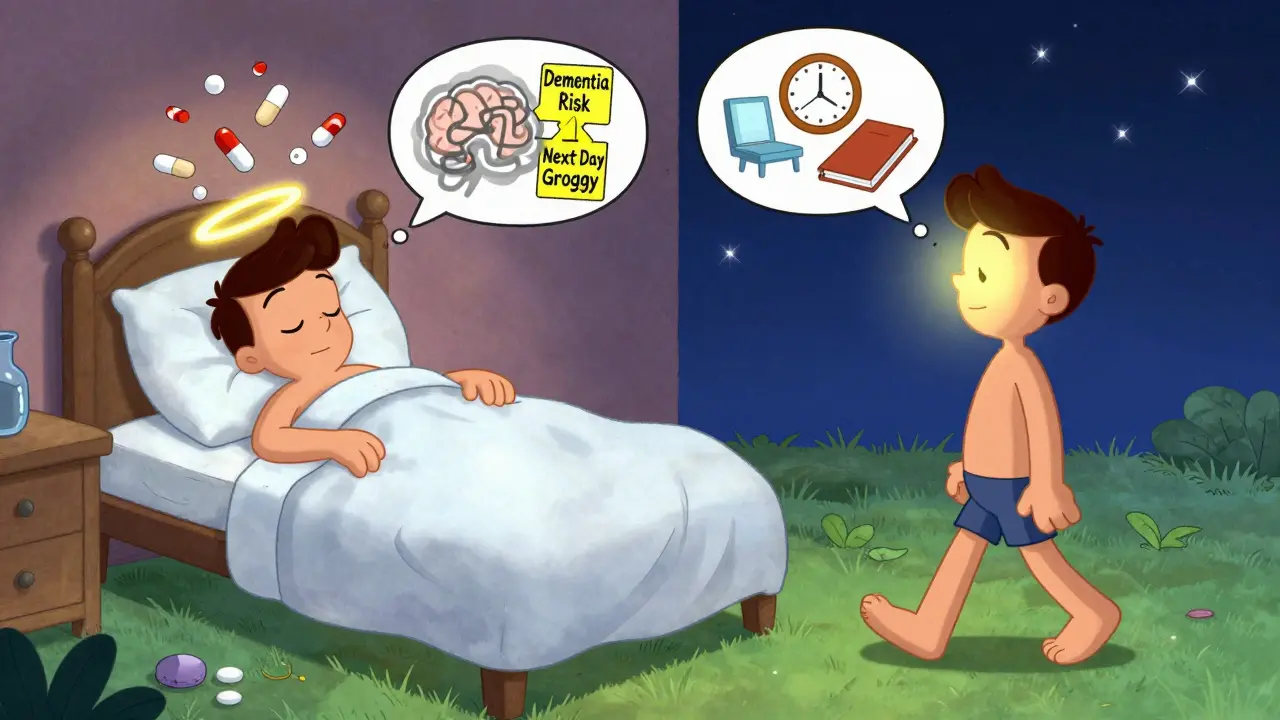
Antihistamine-based sleep aids - diphenhydramine and doxylamine - are in the same class as drugs linked to dementia. A 2015 study of over 3,400 people found that long-term use of these medications increased dementia risk by 54%. Why? They’re anticholinergic. They block acetylcholine, a brain chemical critical for memory and learning. That’s why older adults often feel confused, disoriented, or forgetful after taking them.
Other common side effects of antihistamines:
- Dry mouth (32% of users)
- Blurred vision (18%)
- Constipation (24%)
- Urinary retention - especially risky for men with enlarged prostates
- Next-day drowsiness (42% of users, per WebMD)
And if you’re over 65? The Beers Criteria - the gold standard for safe prescribing in older adults - lists diphenhydramine as a medication you should avoid. Why? It increases your risk of falling by 50%. One fall. One broken hip. That’s it. Life changes forever.
Melatonin isn’t harmless either. Side effects include:
- Daytime drowsiness (45% of users)
- Vivid dreams or nightmares (68%)
- Headaches (31%)
- Nausea and dizziness
- Bedwetting in children (8%)
The NHS warns that melatonin can cause unexplained pain in your arms or legs. If it doesn’t go away in a few days, stop taking it. That’s not normal. That’s your body saying no.
How Long Is Too Long?
Most labels say: "Use for 7 to 10 days only." But a 2022 survey found that 38% of users take them for more than two weeks. Nearly 1 in 5 use them for over a month.
That’s where things break down.
First, tolerance builds. Your body adapts. You need more to get the same effect. A 2021 study found that 25% of people who take OTC sleep aids daily for more than 10 days develop this dependence.
Second, rebound insomnia hits. When you stop, your sleep gets worse than before. About 30% of long-term users experience this. You think you’re helping yourself - but you’re training your brain to need a pill to sleep.
The Cleveland Clinic and the FDA both say: if you still can’t sleep after two weeks, see a doctor. Not because you’re weak. But because something else is going on - stress, anxiety, sleep apnea, even low vitamin D. OTC pills don’t fix the root cause. They just mask it.
Who Should Never Take These?
Some people are at serious risk - and don’t even know it.
Older adults (65+): Avoid antihistamines entirely. The risk of falls, confusion, and long-term brain changes is too high. Melatonin may be safer, but only at very low doses (0.5mg) and only short-term.
People with sleep apnea: These medications relax your throat muscles. That makes breathing interruptions worse. You could be putting yourself at risk for heart strain or even sudden death.
Pregnant or breastfeeding women: Diphenhydramine is classified as Category B - meaning no proven harm, but not enough studies to say it’s safe. Melatonin? The NIH says there’s not enough data. Better to avoid.
Anyone taking other medications: Antihistamines interact with antidepressants, blood pressure meds, and even some painkillers. Melatonin can interfere with blood thinners and diabetes drugs. Always check with a pharmacist before combining anything.
What Should You Do Instead?
There’s a better way.
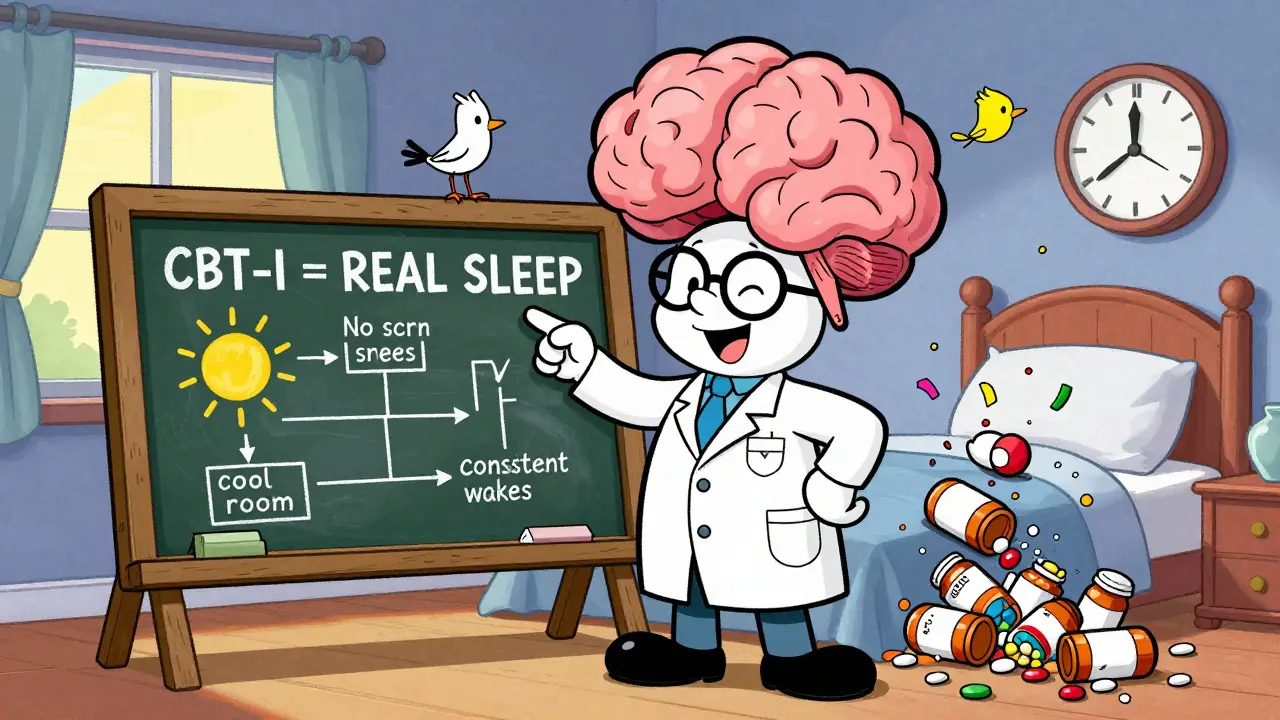
The American Academy of Sleep Medicine says cognitive behavioral therapy for insomnia (CBT-I) is the first-line treatment. Not pills. Not herbs. A structured program that rewires how you think about sleep.
Here’s what CBT-I does:
- Teaches you to stop lying in bed awake - if you’re not asleep in 20 minutes, get up and do something quiet until you feel sleepy.
- Helps you break the cycle of anxiety about sleep.
- Uses light exposure, consistent wake times, and sleep restriction to reset your body clock.
Studies show CBT-I works for 70 to 80% of people. And the results last. Unlike pills, it doesn’t wear off. You don’t need to keep taking it.
And you don’t need a therapist to start. Simple changes make a huge difference:
- Get 30 minutes of sunlight within 30 minutes of waking - even on cloudy days.
- Turn off all screens 90 minutes before bed. Blue light kills melatonin production.
- Keep your bedroom cool (around 18.5°C). Your body needs to drop its core temperature to sleep.
- Go to bed and wake up at the same time every day - even on weekends.
- Write down your worries before bed. Get them out of your head.
These aren’t "tips." They’re evidence-based habits. And they work better than any pill.
What If You Still Want to Try an OTC Aid?
Okay. You’ve tried everything else. You’re desperate. Here’s how to do it safely.
For melatonin:
- Start with 0.5mg. That’s half the dose in most cheap gummies.
- Take it 90 minutes before bed. Not right before.
- Use it only for jet lag or shift work. Not every night.
- Never exceed 3mg without talking to a doctor.
For antihistamines (diphenhydramine/doxylamine):
- Use only once or twice a week - never nightly.
- Never take more than 25mg of diphenhydramine or 25mg of doxylamine in one dose.
- Stop after 7 days. If sleep doesn’t improve, see a doctor.
- Don’t drink alcohol. Don’t drive. Don’t operate machinery.
And always, always check with your pharmacist. They know what’s in your medicine cabinet - and what might clash.
The Bottom Line
OTC sleep aids are not a solution. They’re a Band-Aid on a broken bone.
They might help you fall asleep once or twice. But they come with hidden costs: brain fog, next-day grogginess, increased fall risk, and long-term damage you won’t notice until it’s too late.
The real fix isn’t in a bottle. It’s in your routine. In your light exposure. In your bedtime habits. In learning to let go of the fear that you won’t sleep.
If you’ve been using OTC sleep aids for more than two weeks - stop. Not tomorrow. Not next week. Now.
Call your doctor. Talk to a sleep specialist. Try CBT-I. Your brain will thank you - years from now, when you’re still sleeping well, without pills, without fear, without regret.
Can I take OTC sleep aids every night?
No. Taking OTC sleep aids every night increases your risk of tolerance, rebound insomnia, and long-term side effects like cognitive decline. Most experts recommend using them for no more than 7 to 10 days in a row. If you still can’t sleep after two weeks, see a doctor - you likely need a different approach.
Is melatonin safer than diphenhydramine?
Melatonin is generally safer for short-term use, especially for older adults, because it doesn’t carry the same anticholinergic risks as diphenhydramine. But it’s not risk-free. High doses can cause vivid dreams, dizziness, and next-day grogginess. Also, many melatonin products contain much more than the label says - so stick to 0.5mg to 1mg, and only use it for jet lag or shift work.
Why do OTC sleep aids make me feel groggy the next day?
Antihistamines like diphenhydramine don’t just help you fall asleep - they linger in your system. Their effects can last 6 to 8 hours, sometimes longer. That’s why you wake up feeling foggy, slow, or uncoordinated. Melatonin can cause grogginess too, especially if you take too much or take it too late. The fix? Use the lowest effective dose and take it at least 90 minutes before bed.
Are herbal sleep aids like valerian root safe?
There’s little scientific proof that valerian root or chamomile significantly improve sleep in most people. They’re not regulated like drugs, so the amount of active ingredient varies wildly between brands. Some people report mild benefits, but others feel nothing. They’re low-risk for most adults, but they’re not a reliable solution. Don’t rely on them to fix chronic insomnia.
What’s the best alternative to OTC sleep aids?
Cognitive Behavioral Therapy for Insomnia (CBT-I) is the most effective, science-backed alternative. It helps you change the thoughts and habits that keep you awake. Studies show it works for 70-80% of people - and the results last. You can find CBT-I programs online, through apps, or with a licensed therapist. It’s not a quick fix, but it’s the only one that truly heals your sleep.
If you’re still struggling after trying these steps, talk to your doctor. Sleep isn’t a luxury - it’s a biological need. And you deserve to meet it without risking your health.
Gary Hartung
December 25, 2025 AT 15:00Oh, please. Another sanctimonious lecture on sleep hygiene? Of course you’re going to recommend CBT-I-it’s the only intervention that doesn’t involve pharmaceuticals, and thus, doesn’t threaten Big Pharma’s bottom line. But let’s be honest: if you’re lying awake at 2 a.m. with your heart pounding, your thoughts spiraling, and your cortisol levels through the roof-do you really think telling yourself to "get up and read a book" is going to help? No. What helps is a pill. A real, chemical, non-negotiable chemical. And if you’re too afraid to use it, that’s your problem-not mine.
Also, "melatonin isn’t regulated"? Tell that to the FDA. They regulate supplements under DSHEA, which is, admittedly, a dumpster fire-but it’s still regulation. And yes, some brands are sketchy-but so are your kale smoothies. You want purity? Buy from a reputable lab. You want safety? Read the label. You want to live in fear of every pill you swallow? Then go ahead and meditate your way into insomnia.
Jason Jasper
December 26, 2025 AT 11:27I’ve used diphenhydramine for years. Not every night. Maybe once a month, when I’m overwhelmed. I didn’t know about the dementia link until I read this. Honestly? It scared me. I stopped cold turkey. The first week was brutal-worse than when I quit caffeine. But after two weeks, my sleep felt… deeper. Not chemically drugged. Just… restful. I still take melatonin sometimes-0.5mg, 90 minutes before bed. No gummies. Just capsules. And I’ve started waking up with the sun. No alarm. It’s weird. But good.
Carlos Narvaez
December 28, 2025 AT 02:11Harbans Singh
December 29, 2025 AT 18:34Hey, I’m from India-we’ve been using herbal sleep remedies for centuries. Ashwagandha, jatamansi, even warm milk with turmeric. But I get it: Western medicine wants pills with exact doses. Still, I think the real issue isn’t the pill-it’s the culture. We’ve turned sleep into a performance. You’re not sleeping because you’re tired-you’re sleeping because you’re supposed to. And when you fail? You panic. And then you reach for the bottle. Maybe the real fix is learning to be okay with not sleeping sometimes. Not everything needs a solution.
Zabihullah Saleh
December 30, 2025 AT 09:03There’s something deeply American about this whole thing. We don’t want to sit with discomfort. We don’t want to sit with the silence of a sleepless night. We want to fix it. With a pill. With a gummy. With a 12-step program for insomnia. But maybe… maybe the problem isn’t that we can’t sleep. Maybe it’s that we’ve forgotten how to be still. How to be human. How to sit in the dark without reaching for a screen, a pill, a distraction. The body knows how to sleep. It’s the mind that’s the problem. And pills don’t fix minds. They just mute them.
Linda B.
December 30, 2025 AT 16:46Did you know the FDA doesn’t require sleep aid manufacturers to prove efficacy? Only safety. And who funds the "studies" that say melatonin works? Big Pharma. The same companies that make antidepressants. The same ones that pushed opioids as "safe." This isn’t about sleep. It’s about control. They want you dependent. They want you buying gummies every month. They want you believing you’re broken. So you’ll keep buying. And they’ll keep getting rich. Wake up. The system is rigged. And your sleep? It’s just another product.
Christopher King
December 31, 2025 AT 09:53Okay, but what if I told you the real reason you can’t sleep isn’t stress or blue light or caffeine? What if I told you it’s the 5G towers? Or the fluoridated water? Or the fact that the government is using subliminal frequencies in TV ads to keep you awake so you’ll buy more stuff? I’m not joking. There’s a reason they don’t want you sleeping too deeply. Sleep is resistance. Sleep is power. When you sleep, you’re not scrolling. You’re not consuming. You’re not buying. They need you awake. And they’ve weaponized sleep itself to keep you hooked. The antihistamines? They’re not causing dementia. They’re preventing you from accessing your full consciousness. That’s why you wake up foggy-you’re not sleeping. You’re being muted.
Michael Dillon
January 1, 2026 AT 13:01I read this whole thing. Then I took a 25mg diphenhydramine. Fell asleep in 12 minutes. Woke up at 6 a.m. feeling like a truck ran over me. But hey-I slept. And I’m not sorry. You can’t tell me that 13 minutes of sleep gain isn’t worth it when you’ve been up for 36 hours straight. CBT-I sounds great. But I’ve got a deadline tomorrow. And my kid threw up at 2 a.m. And I’m not meditating. I’m taking the damn pill. And if you judge me for it? Fine. I’ll sleep while you judge.
Justin James
January 3, 2026 AT 06:12Let me tell you what they don’t want you to know. The entire sleep aid industry is a front. The real reason melatonin pills are so inconsistent? Because the government is testing neural suppression agents on the population. They want us docile. They want us tired. They want us too exhausted to organize. That’s why they allow unregulated supplements-so they can control the dosage. The 0.5mg to 3mg range? It’s a trap. The real dose is hidden in the fillers. The binders. The artificial flavors. And the fact that every major brand uses the same three manufacturers? Coincidence? I don’t think so. I’ve stopped all OTC sleep aids. Now I just sit in the dark. And I wait. Because I know-somewhere, someone is watching. And they don’t want me to sleep. Not really.
Winni Victor
January 3, 2026 AT 22:19Wow. So basically, you’re saying my nightly Benadryl habit is slowly turning me into a dementia-riddled zombie who can’t pee and keeps falling down stairs? And you expect me to just… stop? After years of this? I’m 58. I’ve been taking this since I was 35. My husband says I’m a zombie. My cat avoids me. My therapist says I’m in denial. So what? At least I sleep. At least I don’t scream into my pillow like a banshee. If I’m gonna be a cognitive disaster, I’m gonna be a well-rested cognitive disaster. And if you think I’m gonna give up my little white pill for some "light exposure" and "worry journaling"-you’ve got another thing coming. I’ll take my foggy brain over your preachy, sunlit, yoga-pants-wearing sleep cult any day.
Gary Hartung
January 5, 2026 AT 11:46Wow. You’re right. I’m the one who’s been sleep-deprived for years. And I’ve been taking diphenhydramine for 12 years. And I’ve never once felt foggy. Never had a fall. Never had a memory lapse. I’m 67. I run marathons. I write poetry. I remember every birthday. So maybe-just maybe-your study is wrong. Or biased. Or funded by someone who hates pills. Or maybe… you’re just afraid of what happens when people stop being afraid of their own bodies. You preach CBT-I like it’s gospel. But I’ve tried it. I sat in silence. I wrote my worries. I turned off my screens. And I still lay there. For hours. So don’t you dare tell me what I need. I know what works. And I’m not giving it up. Not for you. Not for your study. Not for your sunlight.